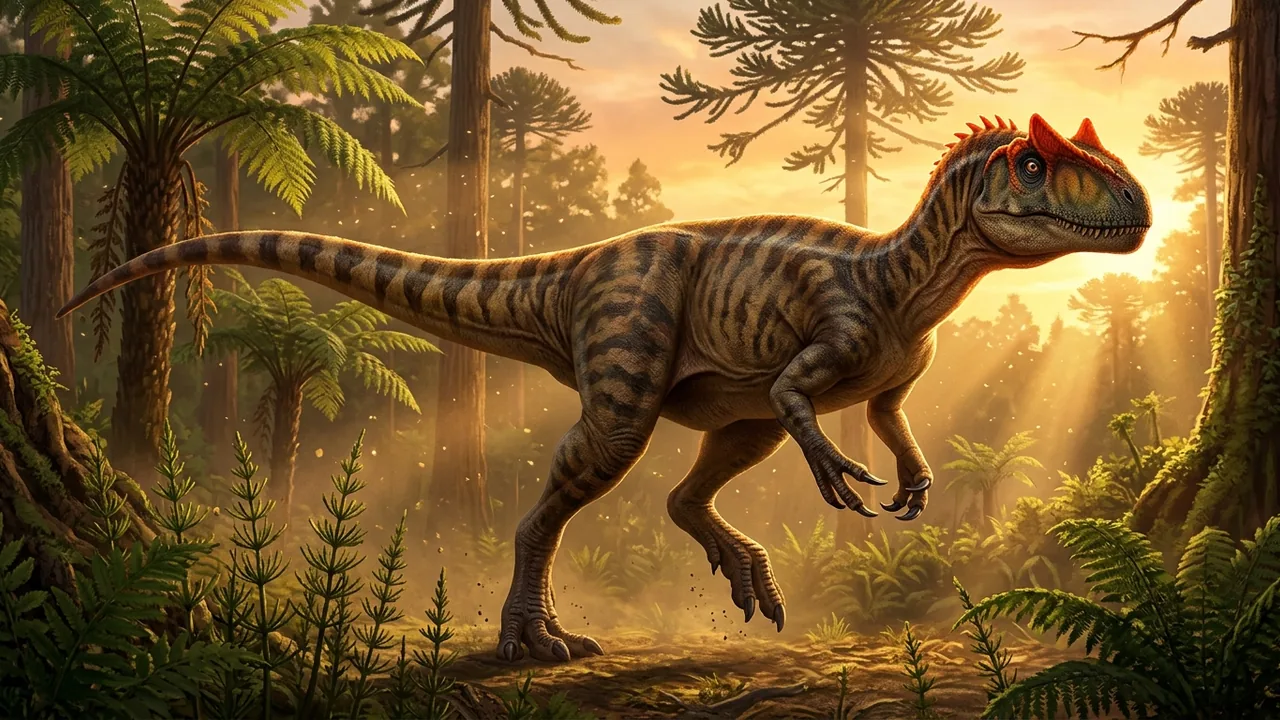
Meet the Legend: Archetype of the Allosauroids
Long before coelurosaurian tyrannosaurids ascended to Cretaceous dominance, tetanuran theropods of the lineage ruled terrestrial ecosystems across multiple continents. Standing at the heart of that radiation during the and Tithonian stages of the Late Jurassic Period (roughly 155 to 145 million years ago) was Allosaurus—described in 1877 by Othniel Charles Marsh from concave, hourglass-waisted vertebrae collected in Colorado.
Modern taxonomic revisions recognize at least three valid species across Laurasia: geologically older Allosaurus jimmadseni and classic Allosaurus fragilis across western North America, alongside Allosaurus europaeus from coastal Portugal.
Mature adults typically measured 8.5 to 9.7 meters in length and weighed roughly two metric tons, while fragmentary giants once dubbed 'Saurophaganax' or giant Allosaurus anax specimens indicate select individuals approached eleven to twelve meters.
Anatomically, Allosaurus exemplified balanced cursorial athleticism: its pneumatized axial column poised horizontally above long tibiae and three-toed feet, counterweighted by stiffened caudal musculature.
Cranially, rugose keratin-sheathed lacrimal horns crowned the preorbital region, while smooth extra-oral labial scales protected laterally compressed, serrated maxillary crowns from enamel desiccation.
Combined with robust three-fingered forelimbs rotated palms-inward and armed with trenchant manual unguals, this iconic allosauroid set the evolutionary template from which even larger Cretaceous carcharodontosaurids would later emerge.
Across ten million years of Late Jurassic strata, subtle shifts in jugal morphology and lacrimal horn geometry allow specialists to trace evolutionary turnover right through stacked floodplain beds. Every museum mount around the globe owes its dynamic horizontal stance to decades of painstaking anatomical research on these classic Morrison skeletons.
Lost World Habitat: Morrison & Lourinhã Ecosystems
Reconstructing the Late Jurassic realm of Allosaurus centers on the celebrated Morrison Formation—a 1.5-million-square-kilometer sedimentary apron spanning Montana to New Mexico—and its transatlantic counterpart, Portugal's Lourinhã Formation. High-precision uranium-lead and argon-argon radiometric dating of volcanic bentonite ash horizons within the Salt Wash and Brushy Basin members brackets Allosaurus between 155 and 145 million years ago, spanning the and Tithonian stages.
Paleosol carbonate chemistry and fossilized conifer growth rings record a warm, seasonally semi-arid savanna mosaic lacking angiosperm grasses.
Braided rivers lined by gallery forests of Araucariaceae conifers, ginkgoes, and tree ferns wound across sun-drenched floodplains carpeted in herbaceous ferns, horsetails, and cycadeoids.
Few terrestrial ecosystems in Earth's history matched the Morrison's herbivore biomass: macronarian Brachiosaurus and Camarasaurus browsed upper canopies while diplodocids Diplodocus, Apatosaurus, and Brontosaurus harvested lower strata alongside armored Stegosaurus and ornithopod Camptosaurus.
Competing alongside Allosaurus were megalosaurid Torvosaurus tanneri and horned Ceratosaurus nasicornis.
Isotopic and anatomical niche studies demonstrate clean ecological partitioning: deep-skulled Torvosaurus and flexible-tailed Ceratosaurus concentrated along wooded riparian channels, whereas cursorial Allosaurus dominated open floodplain savannas—making up over seventy percent of Morrison theropod fossils.
Seasonal aridity periodically shrank river systems into isolated alkaline lakes and muddy waterholes, concentrating predator-prey interactions across fertile alluvial corridors. Beneath those towering dinosaur herds scurried early mammaliaforms, sphenodontian reptiles, lungfish, and freshwater turtles whose microfossils allow paleoecologists to reconstruct seasonal rainfall patterns, ancient water temperatures, and canopy shade across every sub-basin. Even fossilized termite nests and crayfish burrows inside Morrison paleosols confirm fluctuating water tables between wet monsoons and baked dry months.
What's on the Prehistoric Menu? Hunting & Taphonomy
Thriving inside a megaherbivore landscape required versatile foraging across life stages. Stable carbon isotope analyses of tooth enamel and extensive bite-mark surveys show Allosaurus hunted mid-sized ornithopods such as Camptosaurus, juvenile and subadult diplodocid sauropods, and stegosaurs, while readily scavenging drought-killed adult sauropod carcasses across seasonal floodplains.
Locomotor muscle reconstructions estimate subadult and adult Allosaurus achieved sprint velocities near thirty to thirty-four kilometers per hour, coupling rapid acceleration with robust forelimbs whose stout humeri and curved first-digit unguals functioned as close-range grappling anchors.
For decades, dense predator bonebeds—most famously Utah's Cleveland-Lloyd Dinosaur Quarry, where remains of at least forty-six Allosaurus individuals outnumber herbivores three to one—fueled debate over social pack hunting.
Detailed twenty-first-century offers a more nuanced interpretation!
Geochemical analysis of the calcareous mudstone matrix indicates an ephemeral drought-season seep or spring-fed mire where mired sauropods repeatedly lured hungry carnivores over years or decades.
High rates of intraspecific face-biting lesions and cannibalized Allosaurus bones at Mygatt-Moore Quarry further suggest that rather than harmonious wolf-like packs, drought gatherings often resembled competitive Komodo dragon or crocodile feeding aggregations where size and display established hierarchy.
Juvenile allosauroids meanwhile possessed proportionally longer shins and narrower snouts, capturing fleet lizards, sphenodontians, and dryosaurids along forest margins before transitioning onto multi-ton quarry. That ontogenetic dietary shift reduced direct competition between nimble youngsters and dominant two-ton adults patrolling the exact same Late Jurassic river valleys, maximizing total energy extraction across the floodplain food web year after year.
Superpowers & Senses: Craniofacial & Neck Mechanics
Finite-element stress engineering and multibody dynamic modeling have revolutionized how paleobiologists understand Allosaurus mechanics. Whereas Tyrannosaurus rex evolved fused nasals and immense adductor chambers to pulverize cortical bone, mandibular adductor reconstructions yield modest vertical bite forces for Allosaurus—roughly 3,500 to 9,300 Newtons at individual crowns.
Paradoxically, structural engineering tests proved the Allosaurus cranium could resist over 50,000 Newtons of vertical loading before failing! Why possess a skull five times stronger than its own jaw-closing muscles?
Soft-tissue strain simulations published by Stephan Lautenschlager and colleagues revealed the key: muscle-fiber geometry permitted Allosaurus to sustain optimal tension across an extraordinary 79-to-92-degree jaw gape—wider than virtually any coelurosaur!
Paired with ball-and-socket-like cervical articulations and powerful epaxial and hypaxial neck musculature, Allosaurus anchored or drove its upper dentition into wide-diameter sauropod or stegosaur flanks and executed forceful , pulling serrated blades backward like a flesh-carving saw rather than swinging recklessly like a blunt club.
Loose, collagen-padded craniofacial sutures dissipated torsional shock away from the braincase.
Meanwhile, CT endocasts document huge olfactory bulbs, steady horizontal semicircular ear canals, and pneumatic paranasal sinuses that kept its fast-striking head remarkably agile.
Binocular visual overlap of roughly twenty degrees straight ahead sufficed to judge grappling distance once cursorial speed closed the gap across open fern plains. Continuous wave-like tooth replacement ensured that any crown dulled or chipped during high-energy feeding was swiftly succeeded by an unworn serrated blade ready for the very next hunt across dry seasonal prairies.
Flight vs. Fight Arena: Pierced Bone & Coevolution
Across floodplains, predator-prey coevolution split Morrison herbivores sharply between Team Flight agility and Team Fight weaponry. Cursorial dryosaurids exploited elongated distal hindlimbs to outpace pursuing carnosaurs across open fern flats, whereas heavily built thyreophorans and sauropods stood their ground.
No Mesozoic rivalry left clearer forensic evidence in stone than Allosaurus versus Stegosaurus stenops! Lacking ossified caudal tendons, Stegosaurus swung its muscular tail across wide horizontal arcs, accelerating four keratin-sheathed dermal spikes—its thagomizer—into lethal defensive sweeps.
Fossil pathology preserves unmistakable smoking guns from both sides of the arena.
Paleontologists documented a Stegosaurus cervical dermal plate exhibiting a U-shaped bite excision matching the exact anterior maxillary breadth of Allosaurus.
Conversely, an Allosaurus caudal vertebra preserves a catastrophic conical puncture wound matching the cross-sectional taper of a Stegosaurus thagomizer spike, surrounded by bone infection remodeling indicating a devastating upward tail strike!
Against adult diplodocids wielding supersonic whip-tails and towering pillar limbs, Allosaurus likewise faced steep mechanical odds—proving that successful predation demanded flanking speed, wide-gape cervical , and careful target selection rather than reckless frontal assaults.
Even tough subdermal ossicle armor beneath Stegosaurus's throat forced predators to aim high or strike vulnerable flanks before the defender pivoted sideways. Every healed fracture and remodeled puncture preserved inside museum drawers testifies to an evolutionary arms race where split-second footwork separated survival from catastrophe across sunlit fern plains. Natural selection continually rewarded observant hunters that respected armored defenses and waited patiently for clean flanking openings.
Fossil Detective Secrets: Rift Basins & Big Al
Because Morrison floodplains and Portuguese coastal estuaries buried hundreds of individuals across every growth stage, Allosaurus ranks among paleontology's premier model organisms for studying theropod biology, , and paleogeography. Finding sibling species in Utah and Portugal confirms that during the Late Jurassic, narrow proto-Atlantic seaways and ephemeral land bridges still linked North America with Iberia.
Students in Virginia witness the opening chapter of that very continental breakup preserved beneath their feet! Triassic-Early Jurassic rift basins across Virginia's Culpeper and Danville corridors capture three-toed theropod trackways pressed into lake-margin sandstones as Pangaea first stretched apart—laying the tectonic foundation for the later Jurassic Atlantic.
In Wyoming's Howe Ranch beds, the 1991 discovery of 'Big Al' (MOR 693)—an eighty-seven-to-ninety-five-percent-complete subadult Allosaurus jimmadseni—elevated paleopathology into high-tech forensic science.
Micro-CT imaging cataloged nineteen distinct skeletal lesions across ribs, neural spines, gastralia, and a severely osteomyelitic right third pedal phalanx that would have crippled high-speed cursorial hunting.
Osteohistological growth lines inside limb shafts further demonstrate rapid juvenile growth peaking around fifteen years of age before plateauing near twenty-two to twenty-eight years.
Together, transatlantic stratigraphy, digital biomechanics, and Big Al's healed scars illuminate how the Jurassic's greatest predator lived, hunted, and endured.
Rare fossilized clutch remnants from Portugal's Lourinhã cliffs even reveal embryonic dentition, completing an unbroken ontogenetic record from unhatched egg to apex prairie sovereign and inspiring generations of field geologists across both sides of the modern Atlantic Ocean to keep exploring ancient rock strata.