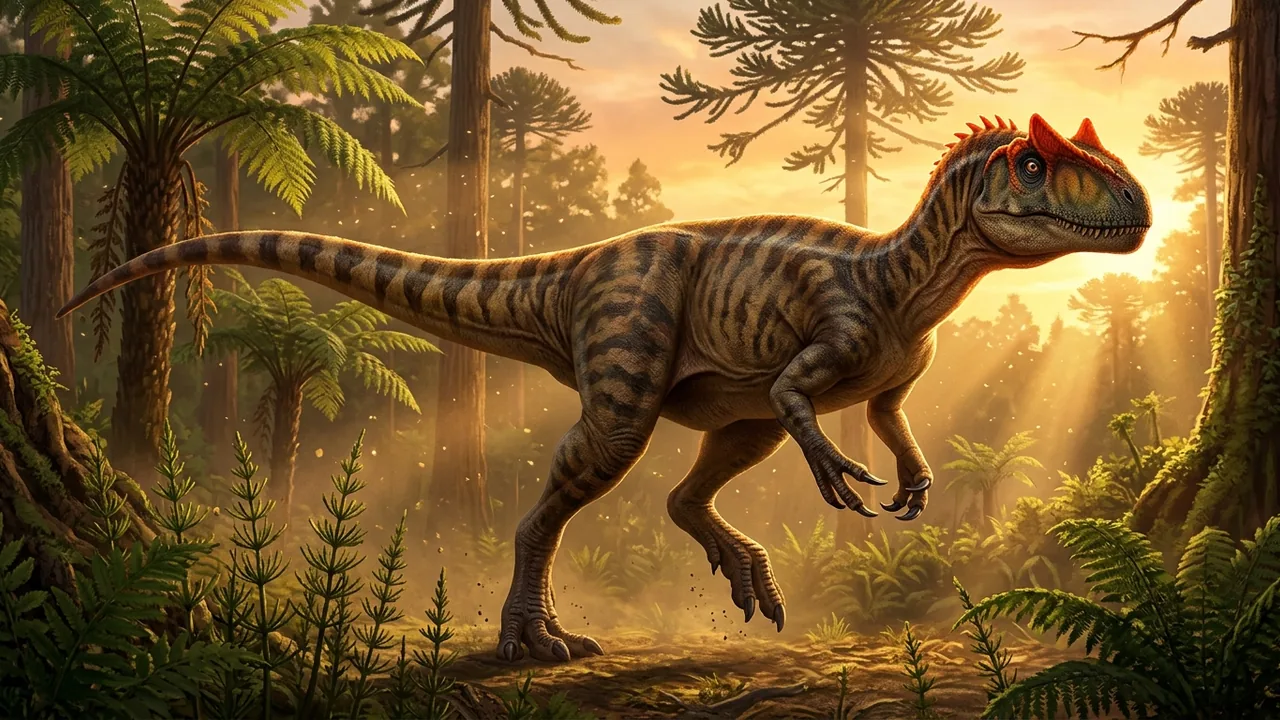
Meet the Legend: Blueprint of a Jurassic Carnosaur
During the Late Jurassic Period roughly 155 to 145 million years ago, Allosaurus fragilis dominated western North America and western Europe as the quintessential large carnosaur. Averaging twenty-eight to thirty-two feet long and weighing two to two-and-a-half tons—with exceptional giants approaching thirty-eight feet—it combined formidable strength with genuine cursorial speed.
Unlike deep-bodied tyrannosaurs that evolved eighty million years later, Allosaurus carried a sleek, laterally narrow torso suspended horizontally over long muscular legs and a stiffened counterbalance tail.
Its skull measured nearly three feet long, framed by twin keratin-covered lacrimal horns just ahead of the eyes and lined with roughly seventy teeth shielded at rest by smooth extra-oral lip scales.
Below sturdy shoulder girdles hung muscular forelimbs armed with three curved claws—the innermost thumb talon measuring up to six inches around its curve—with palms facing inward toward the chest.
Internal air-sac spaces lightened its vertebrae without weakening spinal stiffness during high-speed turns.
Every detail of its favored swift pursuit, wide-jawed slashing strikes, and powerful forelimb grappling across semi-arid floodplains.
Even flexible belly ribs called gastralia braced its chest and helped pump oxygen efficiently through bird-like air sacs during energetic sprints.
Lost World Habitat: Trophic Webs of the Morrison Plains
One hundred and fifty million years ago, a vast lowland basin stretched across half a million square miles from Montana and Wyoming south through Utah, Colorado, and New Mexico. Seasonal wet-and-dry climates sculpted braided rivers, alkaline lakes, conifer gallery forests, and sunlit fern-and-cycad savannas completely devoid of modern turf grasses.
Across this sprawling food web, towering sauropods partitioned plant canopy heights with remarkable efficiency: high-browsing Brachiosaurus harvested araucaria crowns forty feet overhead, while Diplodocus and Apatosaurus stripped ground-level ferns and horsetails.
Alongside those multi-ton giants grazed plated Stegosaurus, mid-sized ornithopod Camptosaurus, and fleet Dryosaurus.
At the apex tier, Allosaurus shared river corridors with blade-horned Ceratosaurus and heavily built Torvosaurus.
Tooth-wear studies and quarry distributions suggest neat habitat sorting: Ceratosaurus and Torvosaurus favored dense wooded waterways and aquatic prey, while long-legged Allosaurus patrolled open fern savannas as well as streamside ambushes.
During harsh dry-season droughts, shrinking waterholes concentrated prey and carcasses alike, creating rich caloric bonanzas for dominant predators.
Decomposer beetles, freshwater lungfish, and armored goniopholidid crocodylomorphs recycled nutrients back into fertile floodplain soils each rainy season, sustaining the entire Late Jurassic landscape.
What's on the Prehistoric Menu?
How did a two-ton predator harvest energy inside an ecosystem crowded with thirty-to-fifty-ton sauropods? logic and fossil bite traces show Allosaurus combined agile pursuit of medium ornithopods with selective targeting of juvenile sauropods—plus opportunistic scavenging whenever adult titans perished during droughts.
Musculoskeletal computer simulations calculate that caudofemoralis tail-retractor muscles propelled Allosaurus to top sprinting speeds of roughly nineteen to twenty-one miles per hour, easily overtaking Camptosaurus or stray young Diplodocus.
Once alongside a target, Allosaurus deployed its muscular forelimbs like twin grappling hooks! Stress tests on its heavy radius, ulna, and curved thumb claws show the arms withstood immense pulling forces while pinning struggling quarry.
Some bonebeds, such as Utah's Cleveland-Lloyd quarry where dozens of Allosaurus skeletons accumulated in sticky mud around mired herbivores, even sparked scientific debate over cooperative mobbing versus aggressive dry-season scavenging crowds.
Whether hunting solo or converging around drought-stressed herds, Allosaurus extracted steady nutrition from Earth's richest sauropod landscape.
Shed crowns beside gnawed Apatosaurus ribs confirm zero floodplain protein went unclaimed, while replacement teeth continually grew upward to keep its cutting row razor-sharp across decades of active hunting.
Superpowers, Senses & Anatomy: Wide-Gape Jaw Physics
When engineering teams ran digital stress tests on an Allosaurus skull in 2001 and 2013, they uncovered a surprising mechanical contrast! Its vertical jaw-closing muscles generated roughly 800 to 2,100 pounds of clamping force (about 3,500 to 9,300 Newtons)—stronger than a modern lion, yet far lighter than Tyrannosaurus rex's bone-pulverizing vise.
Yet strangely, the Allosaurus cranium itself was over-engineered to withstand nearly 12,000 pounds (55,000 Newtons) of vertical stress! Why build such a strong skull around moderate jaw-closing muscles?
solved the mystery through wide-gape neck physics! Elastic muscle modeling proved Allosaurus could hinge its jaws open 79 to 92 degrees wide without tearing muscle fibers.
Anchoring its lower jaw or striking open-mouthed, powerful neck muscles executed rapid —driving the upper tooth row downward and backward like a curved flesh-slicing saw!
Loose, shock-absorbing sutures between skull plates cushioned impact vibrations, while enlarged olfactory bulbs and steady inner-ear balance canals guided pinpoint strikes.
Instead of crunching solid thighbones, Allosaurus perfected high-clearance, neck-driven slashing efficiency.
That wide jaw gape was essential for gripping broad, rounded flanks of juvenile sauropods where narrow-opening jaws would simply bounce off.
Flight vs. Fight Arena: Claws vs. The Thagomizer
Every hunt across Morrison fern plains tested Allosaurus agility against specialized herbivore defenses. Fleet Dryosaurus trusted Team Flight, sprinting on feather-light legs to outmaneuver larger carnosaurs across open flats.
Plated Stegosaurus stenops anchored Team Fight with one of prehistory's deadliest defensive weapons! Weighing up to five tons, Stegosaurus lacked running speed, but flexible tail vertebrae omitted stiffened bony tendons so its muscular tail whipped side to side with terrifying speed.
At the tail tip sat four three-foot spikes encased in horn sheaths—the famous thagomizer!
Hard evidence proves these rivals clashed fiercely. One Late Jurassic Allosaurus tailbone preserves a conical puncture hole matching a Stegosaurus spike driven upward with lethal momentum, while a fossilized Stegosaurus neck plate bears a U-shaped bite notch matching an Allosaurus snout width!
To succeed against Team Fight defenders, Allosaurus relied on lateral footwork, flanking speed, and staying strictly forward of the swinging tail arc.
Meanwhile, adult sauropods cracked supersonic whip-tails that deterred even bold predators from approaching healthy herds.
Smart carnivores quickly learned to test herd defenses cautiously rather than gambling life and limb against braced spikes.
Fossil Detective Secrets: Decoding Big Al's 19 Scars
Few dinosaurs reveal their daily struggles as vividly as 'Big Al' (MOR 693), a ninety-five-percent-complete subadult Allosaurus jimmadseni excavated near Shell, Wyoming, in 1991. Stretching twenty-six feet long, this teenage individual became a superstar of modern !
When researchers scanned Big Al's skeleton with high-resolution X-ray tomography, they identified nineteen separate bone abnormalities across ribs, vertebrae, hip bones, and feet.
Broken ribs showed smooth callus bumps proving the young hunter survived heavy chest impacts—perhaps from a stumbling fall during a twenty-mile-per-hour chase or a kick from defensive prey.
Most telling of all was a swollen, pitted bone infection wrapping the middle toe of Big Al's right foot.
Walking with a painful limp would have slowed a pursuit predator severely during Wyoming's harsh dry season, showing how heavily active hunters depended on healthy feet.
Paired with growth-ring slides showing Allosaurus reached full size between fifteen and twenty years of age, paleopathology turns silent stone bones into unforgettable real-life biographies!
Even preserved nests and embryonic teeth from Portugal reveal how tiny hatchlings began their journey toward becoming two-ton Jurassic champions, linking growth from egg to adulthood.