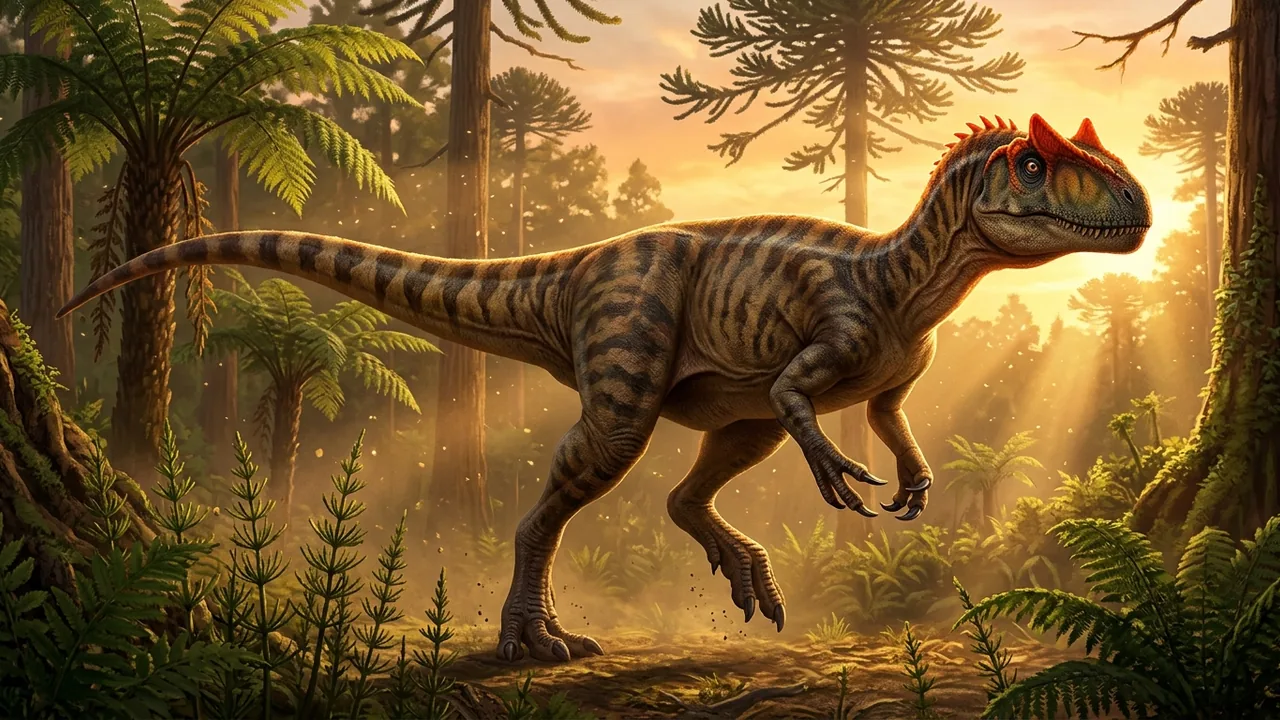
Meet the Legend: Built for Speed and Grapple
Eighty-five million years before Tyrannosaurus rex walked the Earth, sleek Allosaurus fragilis reigned as the premier hunter of the Late Jurassic Period! Measuring about thirty feet long and weighing two tons, this athletic carnosaur balanced horizontally over nimble three-toed legs with a stiff muscular tail.
When paleontologist Othniel Charles Marsh named Allosaurus in 1877, its scientific title meant 'Different Lizard' because its backbone contained hourglass-shaped, hollow chambers unlike solid lizard bones. Those bird-like air pockets kept this big predator surprisingly light and quick!
Up front, twin brow crests rose right in front of its eyes, smooth scaly lips covered seventy curved teeth, and brawny arms ended in three inward-facing six-inch claws.
Every single part of its body was a specialized built for agile movement, sharp balance, and active hunting across sun-drenched fern plains.
Lost World Habitat: A Savanna Without Grass
One hundred and fifty million years ago, western North America's Morrison Basin stretched from Montana down to New Mexico as a vast semi-arid floodplain. Because flowering grasses had not evolved yet, sunny prairies carpeted in low ferns, horsetails, and palm-like cycads rolled between gallery forests of tall araucaria pines and ginkgoes.
Seasonal monsoons soaked this Late Jurassic before long dry spells shrank winding rivers into crowded watering holes. Producers like ferns and tall conifers supported Earth's grandest herbivore community: towering Brachiosaurus, whip-tailed Diplodocus, heavy Apatosaurus, nimble Camptosaurus, and armored Stegosaurus.
At the top of the food chain, Allosaurus thrived alongside rarer neighbors like horned Ceratosaurus and massive Torvosaurus, keeping plant-eating herds healthy and moving across the plains.
Freshwater turtles, lungfish, and tiny early mammals sheltered near shaded river bends, completing a vibrant prehistoric habitat.
What's on the Prehistoric Menu?
Sharing a habitat with fifty-ton sauropods created huge opportunities for a smart predator with the right physical and behavioral toolkit. While healthy adult Brachiosaurus and Apatosaurus were living fortresses far too massive for one two-ton hunter, sprawling herds included countless fast-growing juveniles.
Allosaurus also targeted medium-sized plant-eaters like Camptosaurus and Dryosaurus along wooded river bends. Hiding quietly in streamside ginkgo shadows, it burst forward at speeds over twenty miles per hour to close the gap before prey reached safety.
Once within arm's reach, its muscular shoulders and inward-facing three-clawed hands acted like grappling hooks—an essential physical adaptation that held prey steady while curved, saw-edged teeth sliced cleanly and scent-tracking guided it to dry-season carrion.
During harsh droughts when waterholes dried up, abundant carcasses fed hungry young and adult predators alike across the .
Superpowers, Senses & Anatomy
Unlike later bone-crushing tyrannosaurs with rigid skulls, Allosaurus engineered its skull for an astonishing wide-gape strike! Specialized jaw hinges allowed its lower mandible to drop nearly eighty to ninety degrees wide without straining jaw muscles.
Braced by neck vertebrae and strong cables of neck muscle, Allosaurus drove its upper tooth row downward and pulled backward like a curved saw, raking cleanly without risking broken teeth against heavy sauropod bones. Meanwhile, twin horns wrapped in tough keratin shaded bright savanna glare and signaled dominance to rivals.
Inside its braincase, large scent bulbs detected distant herds on dry winds, while inner-ear balance canals kept its head steady as it sprinted across uneven fern prairies.
Flexible joints between skull bones acted like natural shock absorbers, protecting its brain and eyes during every high-energy strike.
Flight vs. Fight Arena!
Across the open Jurassic , herbivores answered Allosaurus with two dramatically different survival blueprints. Lightweight Dryosaurus relied on pure Team Flight speed, bounding away on gazelle-like hind legs the moment alarm calls echoed through the ferns.
Five-ton Stegosaurus chose 100 percent Team Fight! Protected by throat armor beads and seventeen tall back plates, Stegosaurus pivoted sideways to whip four yard-long tail spikes at dangerous speed.
Spectacular fossil discoveries prove these clashes truly happened! Paleontologists found a Stegosaurus neck plate bearing a U-shaped bite notch matching an Allosaurus snout—and an Allosaurus tail vertebra punctured cleanly by a conical Stegosaurus tail spike! Only nimble footwork and careful timing kept an apex hunter safe.
Even giant Diplodocus cracked whip-like tails louder than thunderclaps to warn approaching hunters to keep a respectful distance! Every survival shaped who thrived across those ancient sunlit plains.
Fossil Detective Secrets: Continents & Quarries
When ancient rivers flooded across western North America, mud and volcanic ash buried dinosaur bones inside colorful striped layers of rock called the Morrison Formation. Amazingly, paleontologists also dig up Allosaurus skeletons across the ocean in Portugal!
How did a land dinosaur cross the Atlantic? Plate tectonics holds the answer—and connects directly to Virginia's own geology! Earlier in the Mesozoic Era, when supercontinent Pangaea first began rifting apart to form the young Atlantic Ocean, dinosaur footprints were pressed into Virginia's Culpeper Basin sandstones while narrow land bridges still linked North America to Europe.
From Portugal's coastal cliffs to Utah's Cleveland-Lloyd quarry and Wyoming's famous 'Big Al' skeleton, sedimentary rocks preserve an unbroken global detective trail.
Counting microscopic rings inside fossilized shinbones even shows detectives how fast teenage carnosaurs grew into prairie kings!