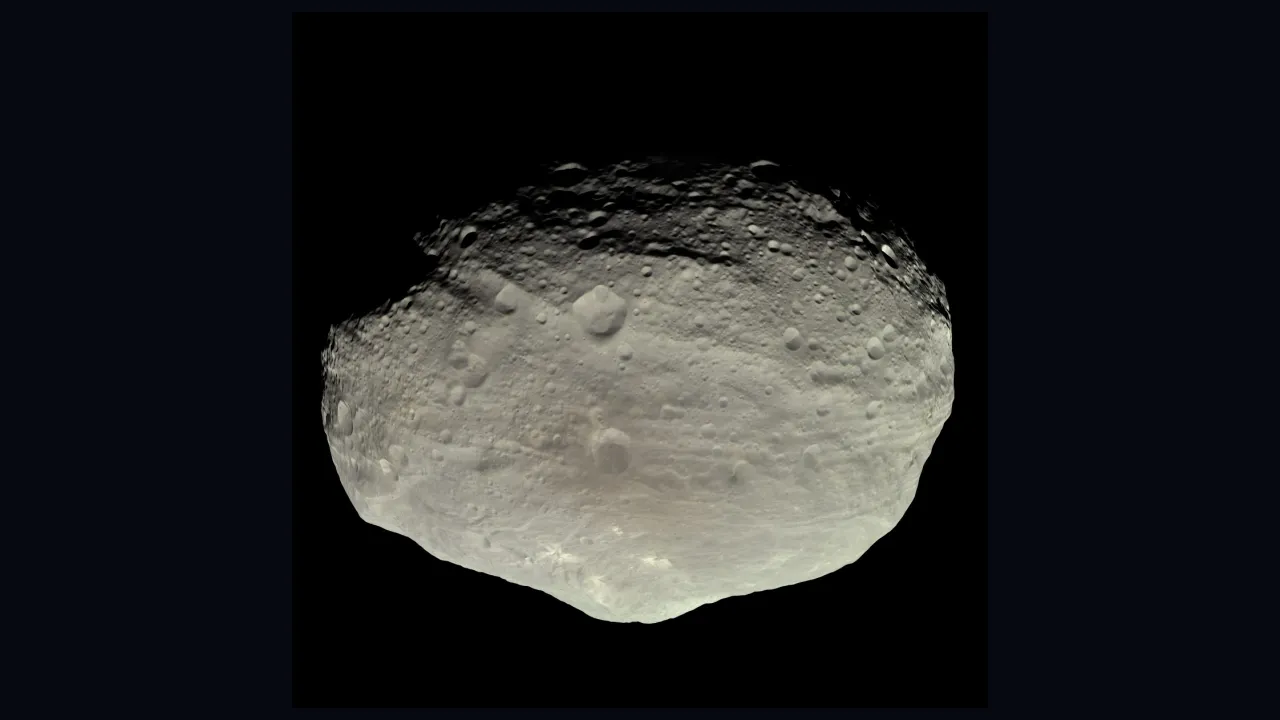
1. How tall is the giant mountain near Vesta's south pole compared to Earth's Mount Everest?
2. What makes Vesta's inside structure special compared to ordinary asteroids?
🤯 Mind-Blowing Fact • Grade 2
Three craters lined up side by side on Vesta look just like a three-scoop snowman, so scientists officially nicknamed them the 'Snowman Craters'!
✨ Word Sparks (Grade 2 Glossary)
Tap 🔊 to hear
protoplanet
A baby planet that stopped growing early
mantle
Thick rocky middle layer around a core
meteorite
A space rock that lands on Earth
🪝
How did pieces of Vesta land in museums on Earth without any rocket bringing them back?
1
A Surviving Baby Planet
Discovered in 1807 by German astronomer Heinrich Olbers, 4 Vesta spans 326 miles across—roughly the width of Arizona! Scientists call Vesta a because it grew layers of metal core, rocky , and lava crust before Jupiter's gravity halted its growth.
2
A Crash That Nearly Split Vesta
When NASA's Dawn spacecraft orbited Vesta in 2011, cameras revealed a gigantic dent at its south pole named Rheasilvia! A billion years ago, another asteroid slammed into Vesta, carving a 310-mile crater and pushing up a 14-mile-high mountain in the center.
3
Free Meteorite Deliveries
Millions of rocky chips blasted out of that crash drifted across space—and over a thousand have fallen to Earth as !
1. Which NASA spacecraft orbited Vesta for over a year in 2011 and 2012?
2. How did pieces of Vesta reach museums here on Earth?
🤯 Mind-Blowing Fact • Grade 3
The Rheasilvia impact scooped out about 1 percent of Vesta's entire volume—enough rock to bury the whole state of Texas under miles of rubble!
✨ Word Sparks (Grade 3 Glossary)
Tap 🔊 to hear
basalt
Hard volcanic rock formed from cooled lava
trough
Long, deep canyon trench across rocky ground
shockwave
Powerful blast wave racing through rock
🪝
Why does Vesta wear giant grooves belted around its middle like rings on a barrel?
1
Fourth Found, Second Heaviest
Spotted by Heinrich Wilhelm Olbers in March 1807, 4 Vesta was the fourth asteroid ever discovered. Packing 9 percent of all mass in the Main Asteroid Belt, it ranks second only to dwarf planet Ceres—yet reflects three times more sunlight thanks to bright volcanic minerals on its crust!
2
Twin South-Pole Super-Craters
When NASA's Dawn spacecraft entered orbit in July 2011, it uncovered not one, but two overlapping mega-basins at Vesta's south pole! Younger 310-mile-wide Rheasilvia partially erased older 250-mile-wide Veneneia, leaving behind a central peak rivaling Mars's Olympus Mons.
3
Canyons Ripped by Shockwaves
from those two colossal impacts raced around Vesta's globe and cracked open giant equatorial canyons! The biggest , Divalia Fossae, yawns wider and deeper than Arizona's Grand Canyon.
4
Matching Volcano Rocks in Labs
Light spectra from Vesta match a famous trio of volcanic meteorites called HED meteorites, giving geologists real samples of Vesta's crust and upper mantle!
1. What carved the giant Grand-Canyon-sized troughs belted around Vesta's equator?
2. Why does Vesta shine brighter from Earth than even larger Ceres?
🤯 Mind-Blowing Fact • Grade 4
One out of every sixteen meteorites ever found on Earth—the famous HED meteorite clan—chipped straight off Vesta's volcanic crust and mantle!
✨ Word Sparks (Grade 4 Glossary)
Tap 🔊 to hear
differentiation
Melting separation into heavy core and light crust
equilibrium
Balanced state where gravity pulls worlds round
eucrite
Volcanic basalt meteorite chipped from Vesta's crust
🪝
Why wasn't Vesta officially named a dwarf planet alongside Ceres when it has a real planetary core?
1
Differentiated Like Terrestrial Worlds
Within the very first two million years of Solar System history, decaying radioactive aluminum-26 melted 4 Vesta's interior completely! Heavy iron and nickel sank inward to forge a 135-mile-wide metallic core, silicate minerals rose into a rocky mantle, and erupting lava cooled into a basaltic crust. Unlike rubble-pile asteroids, Vesta underwent full planetary —just like Mercury, Venus, Earth, and Mars.
2
Knocked Out of Roundness
To qualify officially as a dwarf planet, an object's own gravity must pull it into a smooth, round shape called hydrostatic . Vesta started out nearly spherical, until the twin Veneneia and Rheasilvia impacts blasted away its southern hemisphere! Because Vesta's modest gravity wasn't quite strong enough to smooth that 310-mile basin and 14-mile peak back into a sphere, Vesta remains classified as an intact protoplanet.
3
Tracing the Vestoid Trail to Earth
Debris flung from Rheasilvia formed a swarm of bright 'V-type' Vestoid asteroids stretching straight to the 3:1 Kirkwood gap. Jupiter's resonance there hurls chips onto Earth-crossing paths as howardite, , and diogenite (HED) meteorites—accounting for 6 percent of all meteorites falling to Earth!
4
Dark Carbon Smudges
Dawn's cameras also solved dark streaks around Vesta's craters: gentle collisions with dark carbonaceous asteroids dusted Vesta with water-bearing clay minerals!
1. Why is Vesta classified as a rocky protoplanet rather than a dwarf planet like Ceres?
2. Where did the dark streaks and water-bearing minerals spotted on dry volcanic Vesta come from?
🤯 Mind-Blowing Fact • Grade 5
Because Vesta melted into a global magma ocean just two million years after the Solar System began, volcanic eucrite meteorites from Vesta are hundreds of millions of years older than the oldest surviving rocks on Earth!
✨ Word Sparks (Grade 5 Glossary)
Tap 🔊 to hear
achondrite
Igneous stony meteorite crystallized from melted magma
pyroxene
Volcanic silicate mineral absorbing specific infrared wavelengths
graben
Sunken block of crust between parallel faults
🪝
How did combining NASA's Dawn orbiter with terrestrial meteorite labs give Vesta the best-mapped geology of any world beyond Mars?
1
Bridging Telescopic Spectra and HED Petrology
Discovered in 1807 by Heinrich Wilhelm Olbers and named by mathematician Carl Friedrich Gauss after Rome's hearth goddess, 4 Vesta posed a thrilling clue in 1970 when MIT spectroscopists matched its absorption bands at 0.9 and 1.9 microns to terrestrial howardite, eucrite, and diogenite (HED) meteorites. When NASA's ion-propelled Dawn spacecraft spiraled into Vestan orbit from July 2011 to September 2012, gamma-ray, neutron, and visible-infrared spectrometers confirmed the link beyond doubt—making Vesta one of only four Solar System bodies (with the Moon, Mars, and Bennu/Ryugu/Itokawa) with verified geologic samples in Earth laboratories.
2
Rapid Magma Ocean Solidification
Radiometric hafnium-tungsten dating of eucrites proves Vesta accreted and melted into a global magma ocean within two to three million years after calcium-aluminum-rich inclusions condensed! Gravitational Doppler tracking of Dawn pinned Vesta's iron-nickel core at roughly 220 kilometers across (18 percent of Vesta's mass), overlain by an olivine-rich mantle, lower-crust orthopyroxene diogenites, and upper-crust basaltic eucrites.
3
Rheasilvia, Veneneia, and Structural Ring Troughs
Topographic mapping across Vesta's 525-kilometer spheroid revealed two superposed south-polar basins: two-billion-year-old Veneneia (400 km) and one-billion-year-old Rheasilvia (500 km—spanning 95 percent of Vesta's mean diameter!). Rheasilvia's rebound uplifted a 22-kilometer central peak while planetary-scale seismic focusing fractured two sets of concentric —Divalia Fossae and Saturnalia Fossae—each perpendicular to its parent basin's impact axis.
4
Pitted Craters and Exogenous Hydrated Carbon
Although Vesta lost native volatiles during its molten youth, Dawn's neutron detector mapped hydrogen-rich dark patches around Marcia and Cornelia craters—delivered by low-velocity carbonaceous chondrite impacts whose buried volatiles later degassed through Swiss-cheese-like 'pitted terrain.'
5
Survivor of the Terrestrial Planet Zone
Spinning briskly once every 5.34 hours, 4 Vesta endures as the last intact differentiated rocky protoplanet—showing exactly what baby Earth and Venus looked like before merging into full-scale worlds.