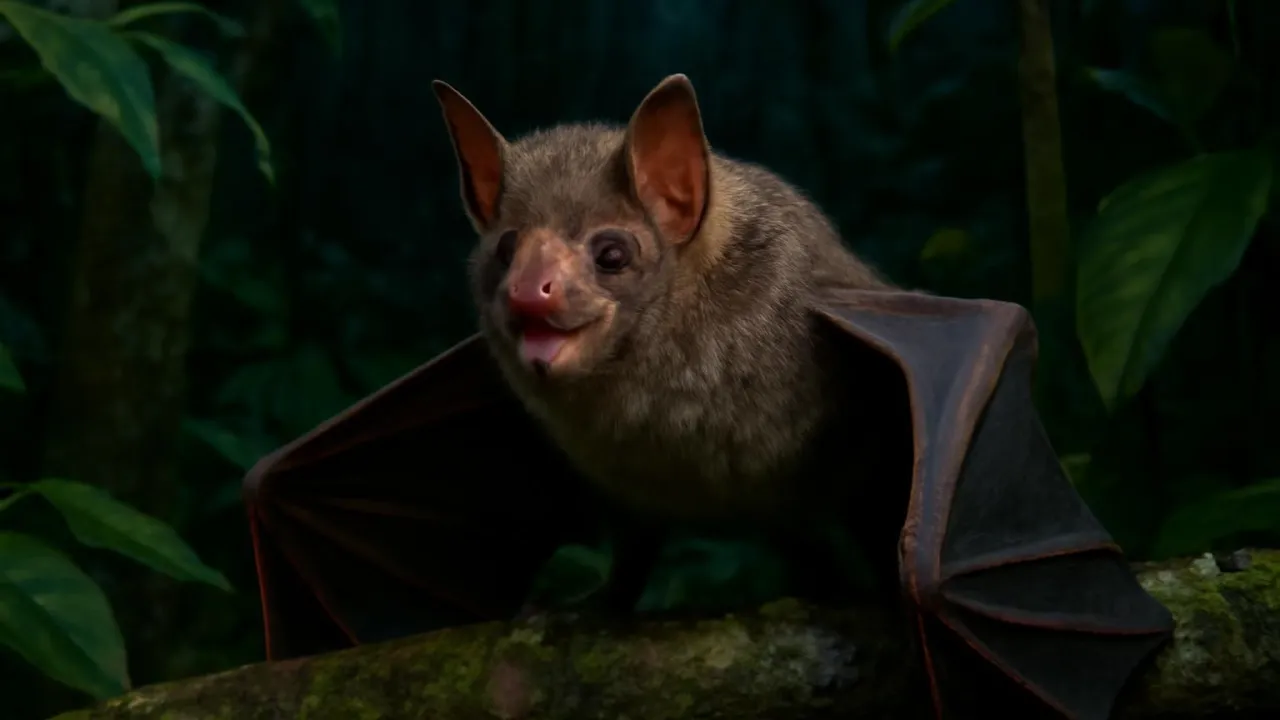
Vampire bats’ saliva contains medicine-like chemicals that stop blood from clotting.
✨ Word Sparks (Grade 2 Glossary)
Tap 🔊 to hear
saliva
Liquid in the mouth that helps with eating
clotting
When blood thickens to stop flowing
prey
An animal hunted by another animal
🪝
Have you ever wondered how a bat can drink blood without waking its prey?
1
Flying at Night
Vampire bats fly only at night and use their wings to move silently through the air. They live in warm places like Central and South America where many animals sleep during the night. These bats have soft brown fur that helps them blend into the dark caves where they rest during the day.
2
How They Drink Blood
Vampire bats have very sharp, tiny teeth that make a small cut on animals’ skin. They drink warm blood slowly without hurting the animal much. Their has special chemicals that stop the blood from so it flows easily while they feed.
3
Special Senses
These bats can sense heat to find where blood flows close to the skin. This helps them find the best spot to bite. They are very quiet and careful so that the animals do not wake up while the bat drinks its meal.
Vampire bats share blood meals with colony members who did not find food that night.
✨ Word Sparks (Grade 3 Glossary)
Tap 🔊 to hear
nocturnal
Active during the night, sleeping during the day
anticoagulant
A chemical that stops blood from clotting
colony
A group of animals living closely together
🪝
How does the vampire bat’s body help it survive in the dark forest night?
1
Silent Night Flight
Vampire bats have wings adapted for quiet flight, which helps them avoid predators. Their soft brown fur provides camouflage in the dark caves and forests where they live. They hunt at night to avoid competition and danger from daytime animals. This lifestyle is a key adaptation for their survival.
2
Special Teeth and Feeding
Their razor-sharp teeth make tiny cuts in the skin of sleeping animals without waking them. The bat’s saliva contains that prevent blood clotting, allowing smooth feeding. This feeding method is a unique adaptation that helps vampire bats get nutrients without killing their prey. They mainly feed on mammals like cows, horses, and sometimes birds.
3
Heat Sensors for Finding Blood
Vampire bats have special heat sensors on their noses that detect warm blood flowing near the skin. This ability helps them find the best place to bite quickly and safely. Their keen senses are crucial because they must feed without alerting their prey. This sensory adaptation is rare among mammals.
4
Life Cycle and Social Behavior
Vampire bats live in colonies that can have hundreds of bats, showing social behavior. Mothers feed their young by regurgitating blood meals, which is unusual in mammals. These bats have a slow reproduction rate, usually one pup per year, which makes their survival delicate. Their social bonds help protect them from predators and harsh environments.
1. What helps vampire bats feed without waking animals?
2. Why do vampire bats live in colonies?
🤯 Mind-Blowing Fact • Grade 4
Vampire bats can travel up to 12 miles in one night searching for food.
✨ Word Sparks (Grade 4 Glossary)
Tap 🔊 to hear
parasite
An animal that feeds on another without killing it
roosting
Resting or sleeping place for birds or bats
deforestation
Cutting down trees that animals need to live
🪝
What role does the vampire bat play in its ecosystem and how does it affect other animals?
1
Ecosystem Role and Food Web
Vampire bats are important predators in their ecosystems, feeding on the blood of mammals and birds. Their feeding can affect livestock health but rarely kills animals, showing a balanced predator-prey relationship. They also help control populations of wild mammals by their selective feeding habits. This role keeps the ecosystem’s food web stable and balanced.
2
Cause and Effect of Feeding Behavior
Because vampire bats feed on blood, they must bite carefully to avoid waking their prey, or they risk losing their meal. Their anticoagulant saliva causes prolonged bleeding, which can sometimes lead to infections in prey animals. Farmers often protect livestock with barriers or repellents to reduce bat bites. Human activities like affect vampire bat habitats, forcing them closer to farms.
3
Geographic Distribution and Habitat
Vampire bats live mainly in Central and South America, from Mexico to Argentina. They prefer warm, humid environments like tropical forests, caves, and hollow trees for . Their distribution is limited by temperature because they cannot survive cold climates. Habitat loss due to human expansion threatens their natural homes and forces bats to adapt to new environments.
4
Symbiosis and Human Impact
While vampire bats feed on other animals, they do not kill them, showing a parasitic relationship. However, they can spread diseases like rabies, which concerns humans and livestock health. Conservation efforts focus on balancing bat protection with disease control to maintain ecosystem health. Understanding vampire bats helps humans manage their impact on agriculture and wildlife.
2. Why is deforestation a problem for vampire bats?
🤯 Mind-Blowing Fact • Grade 5
Vampire bats can share blood meals with non-relatives, showing complex social cooperation.
✨ Word Sparks (Grade 5 Glossary)
Tap 🔊 to hear
hematophagy
Feeding only on blood from other animals
draculin
A protein in bat saliva that stops blood clotting
reciprocal
Giving back help or food in return
🪝
How do vampire bats’ unique biology and behaviors reflect their evolutionary adaptations in tropical ecosystems?
1
Taxonomy and Scientific Classification
Vampire bats belong to the family Phyllostomidae and genus Desmodus, with the species name rotundus. They are the only mammals that feed exclusively on blood, a behavior known as . This specialization evolved around 26 million years ago, distinguishing them from other bat species. Their evolutionary adaptations include morphological and physiological traits unique to sanguivorous mammals.
2
Physiological Mechanics of Feeding
Vampire bats have sharp incisors that create painless skin incisions, allowing access to blood vessels. Their saliva contains anticoagulants such as , which prevents blood clotting and facilitates continuous blood flow. Specialized heat sensors on their noses detect blood-rich areas, enhancing feeding efficiency. Their digestive system rapidly processes blood, which is low in calories but rich in proteins.
3
Conservation Status and Historical Context
Though widespread, vampire bats face habitat loss due to deforestation and human encroachment. Historically, they have been feared and misunderstood, leading to persecution and culling in some areas. Conservation efforts now focus on balancing bat populations with livestock health and disease control. Understanding their ecological role is critical for preserving biodiversity in tropical environments.
4
Quantitative Comparisons and Behavior
Vampire bats weigh between 20 to 50 grams and have wingspans of 18 to 20 centimeters. They can fly speeds up to 24 miles per hour while searching for food. These bats consume about 20 milliliters of blood per night, roughly 30 percent of their body weight. Their social behavior includes food sharing, which is rare among mammals and enhances colony survival.
5
Ecological Impact and Human Interaction
Vampire bats play a significant role in controlling populations of wild mammals, influencing ecosystem dynamics. However, they can transmit diseases like rabies to humans and livestock, posing public health challenges. Human activities such as agriculture and urbanization alter bat habitats, increasing bat-livestock contact. Effective management requires integrating ecological knowledge with disease prevention strategies.