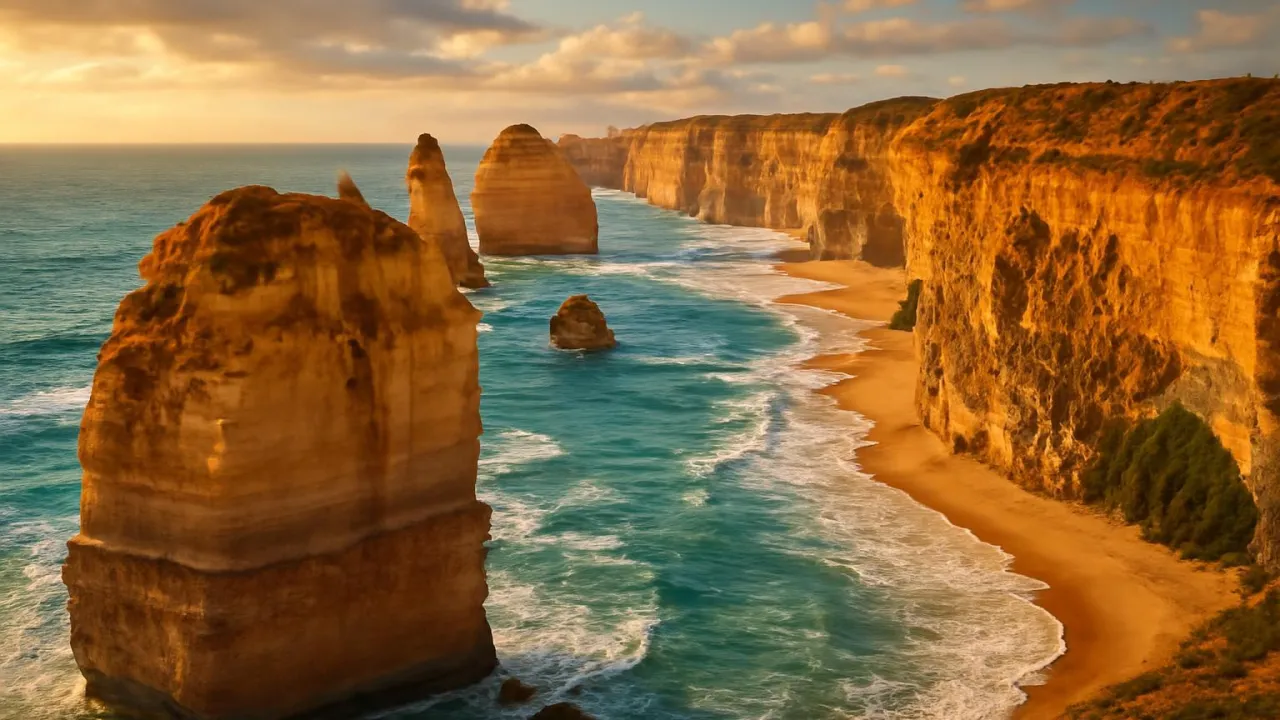
The tallest sea stack is as high as a 15-story building!
✨ Word Sparks (Grade 2 Glossary)
Tap 🔊 to hear
limestone
A soft, pale rock from old sea life
spray
Tiny drops of water in the air
erode
To slowly wear away something
🪝
Have you ever heard the loud splash of waves hitting giant rocks?
1
Rock Towers by the Sea
The Twelve Apostles are tall rock stacks standing in the ocean. Waves crash and water all around them. The sun makes their yellow shine brightly.
2
Nature’s Builders
Wind and water slowly shaped these rocks over millions of years. The sea eroded the cliffs, leaving tall stacks behind. Each stack looks different and stands strong in the waves.
3
A Place to Explore
People visit to walk along safe paths and take pictures. The salty air and roaring ocean make it an exciting place. Visitors love to watch the waves and spot birds flying by.
These sea stacks formed naturally over 20 million years by wind and wave erosion!
✨ Word Sparks (Grade 3 Glossary)
Tap 🔊 to hear
erosion
Wearing away of rock by nature
limestone
Soft rock made from ancient sea life
monument
A special place or thing to remember
🪝
Can you imagine the thunderous sound of waves pounding giant stone towers by the sea?
1
Stone Giants of the Coast
The Twelve Apostles are huge sea stacks rising from the wild Southern Ocean. These dramatic towers were formed by the powerful forces of wind and wave . Over millions of years, the ocean carved arches and caves into the soft limestone cliffs. Eventually, parts of the cliffs collapsed, leaving behind tall, freestanding stacks.
2
How Erosion Shapes the Land
is when wind, water, or ice slowly wears away rock. At the Twelve Apostles, strong ocean waves crash against the cliffs, causing vibration and breaking pieces off. Rain and salty spray also help dissolve the . This natural process continues, so the sea stacks are always changing.
3
A Spectacular View
People visit the Great Ocean Road to see these amazing formations. There are safe viewing platforms and walking paths along the cliffs. Visitors hear the roar of the ocean and feel the cool, salty wind. Many take photos of the golden stacks glowing at sunset.
4
Wildlife and Wonder
Seabirds nest on the cliffs and stacks, soaring above the foamy waves. Sometimes, lucky visitors spot whales or dolphins swimming nearby. The Twelve Apostles are a protected natural , important to Australia’s heritage. They inspire awe with their size, beauty, and the story of how they were made.
1. What causes the limestone cliffs to form sea stacks?
2. Why are the Twelve Apostles always changing shape?
🤯 Mind-Blowing Fact • Grade 4
The tallest remaining stack rises 160 feet (48 meters) above the ocean waves!
✨ Word Sparks (Grade 4 Glossary)
Tap 🔊 to hear
erosion
Nature’s way of wearing down rocks
limestone
A soft rock from old sea creatures
vibration
A shaking movement caused by energy
🪝
What if you could stand on a cliff and watch the ocean slowly carve stone towers right before your eyes?
1
Nature’s Sculptors at Work
Along Australia’s southern coast, the Twelve Apostles stand as spectacular examples of ’s power. Over 20 million years, wind-driven waves and rain have battered the soft cliffs, gradually sculpting arches, caves, and finally, tall sea stacks. The process begins when waves create cracks and undercut the cliff, forming caves that eventually collapse. What remains are towering pillars, isolated from the mainland by the relentless forces of nature.
2
The Science of Sea Stacks
, the main rock here, forms from ancient marine life and is especially vulnerable to . The pounding surf causes and weakens the rock, while salty spray and rainwater chemically dissolve the limestone. This combination of mechanical and chemical erosion constantly reshapes the coastline, causing some stacks to fall and new ones to emerge over time.
3
A Living Landmark
The Twelve Apostles are part of Port Campbell National Park, attracting thousands of visitors each year. People walk along safe boardwalks and viewing platforms to marvel at the stacks’ golden color, especially at sunrise and sunset. The area is also home to seabirds, rare plants, and sometimes, migrating whales, making it a hotspot for both nature lovers and scientists.
4
Heritage and Wonder
Although called the Twelve Apostles, only seven main stacks remain standing today. The site is protected as a natural monument, highlighting Australia’s unique geology and the ongoing story of . The Twelve Apostles inspire awe and curiosity, reminding us how powerful and creative nature can be over millions of years.
1. Why does limestone erode more quickly than harder rocks?
2. Why do scientists call the Twelve Apostles a 'living landmark'?
🤯 Mind-Blowing Fact • Grade 5
Scientists estimate that the sea stacks erode at a rate of about 2 centimeters per year!
✨ Word Sparks (Grade 5 Glossary)
Tap 🔊 to hear
calcium carbonate
The mineral that makes up limestone
geomorphology
The study of how landforms are shaped
Cenozoic Era
The most recent age of Earth’s history
🪝
Imagine standing on a windswept cliff, hearing the thunder of waves as you watch nature sculpt massive stone pillars—how do these towers form and change over millions of years?
1
Australia’s Coastal Masterpiece
The Twelve Apostles are a world-famous collection of limestone sea stacks along Victoria’s Great Ocean Road, standing as a testament to the dynamic power of coastal erosion. These iconic pillars were not built by human hands but were sculpted by the relentless action of wind, rain, and the pounding Southern Ocean over more than 20 million years. Originally, the coastline was a continuous limestone cliff formed from the remains of ancient marine organisms during the . Over time, natural forces began to carve and reshape this coastline into the dramatic scene we see today.
2
The Physics of Erosion
Erosion at the Twelve Apostles involves both mechanical and chemical processes. The mechanical action occurs as powerful waves strike the base of the cliffs, causing vibration and fracturing the rock. Simultaneously, the slightly acidic rainwater and salty ocean spray chemically dissolve the in limestone, further weakening the structure. Gradually, cracks expand into caves, caves widen into arches, and when arches collapse, isolated sea stacks remain. This ongoing cycle means the landscape is constantly evolving, with stacks occasionally toppling and new formations emerging.
3
Quantitative Marvels
The tallest remaining stack soars approximately 160 feet (48 meters) above sea level, rivaling a 15-story building in height. Each stack is composed of layers of soft, pale limestone, and the remaining seven main stacks are separated from the mainland by up to 200 feet (60 meters) of swirling ocean. The entire region is a geological record of millions of years of marine life, climate shifts, and relentless natural forces. Scientists use precise measurements and drone surveys to monitor changes in the stacks’ dimensions and stability over time.
4
Cultural and Environmental Significance
The Twelve Apostles are protected within Port Campbell National Park and are recognized as a natural wonder of Australia. They are not only a major tourist attraction, drawing over a million visitors annually, but also a living laboratory for studying coastal and climate change. The area supports diverse wildlife, including nesting seabirds, rare coastal plants, and seasonal visits from southern right whales and dolphins. Indigenous communities have long valued this coastline for its natural beauty and spiritual meaning.
5
The Future of the Apostles
Despite their grandeur, the Twelve Apostles are temporary features in Earth’s ever-changing landscape. Erosion continues to shape, collapse, and sometimes create new sea stacks, reminding us that even the most impressive natural monuments are not permanent. Scientists predict that, over centuries, some stacks will disappear while new ones may form as the coastline retreats. The Twelve Apostles inspire awe, scientific curiosity, and a deep respect for the slow but unstoppable forces that shape our planet.