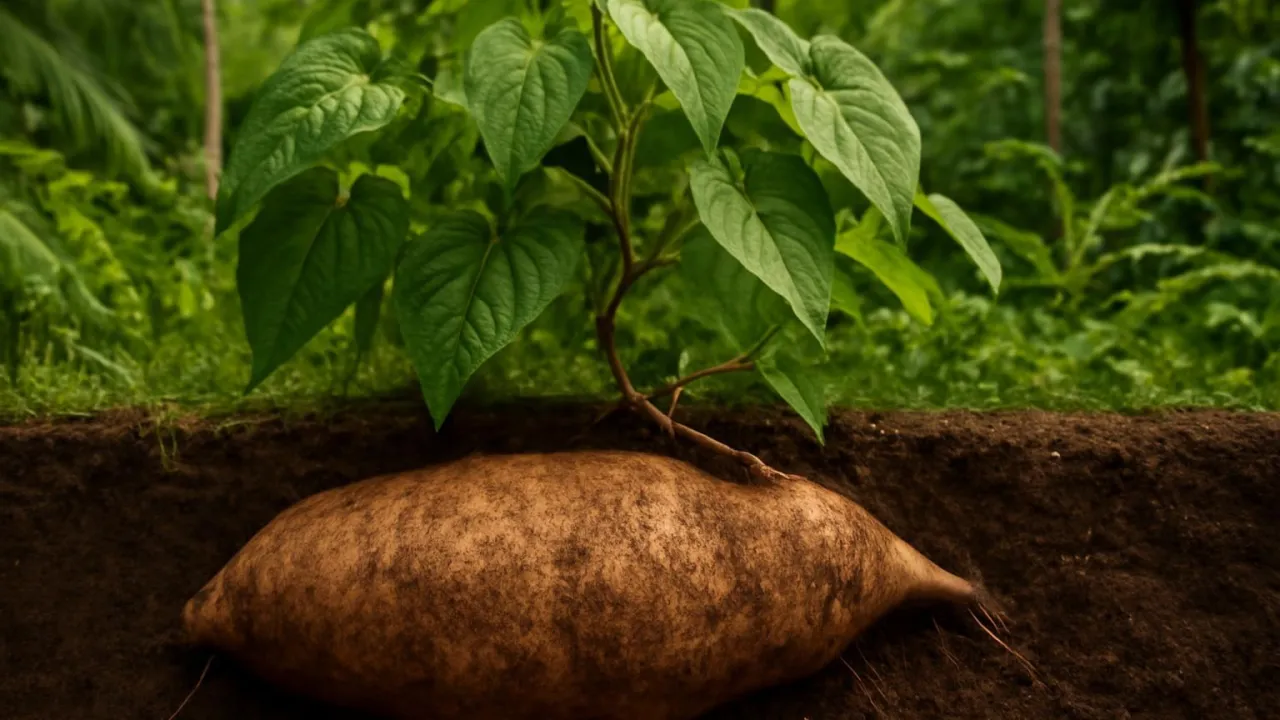
True yams grow under the soil, and their climb above ground. The yam can get very large, sometimes bigger than a football. Its skin is rough and brown, but inside, it is white or purple.
2
Where Yams Grow
Yams need warm weather and plenty of rain to grow well. They are mostly found in Africa and Asia, where the soil is . People plant yam pieces in the ground, and new plants sprout from them.
3
Yams on the Table
When yams are cooked, they taste sweet and soft, like potatoes. People eat yams boiled, mashed, or fried in many countries. Yams are a healthy food that gives us lots of energy.
What plant can hide a giant meal beneath your feet?
1
Meet the True Yam
True yams are not sweet potatoes, even though people sometimes mix them up. Yams are large, starchy that grow underground and can be longer than your arm. Their skin is rough and brown, while the inside can be white, yellow, or purple. Some yams can grow to be heavier than a small child.
2
How Yams Grow and Survive
Yams grow best in warm, rainy places like tropical Africa and Asia. Their long vines climb up poles or trees to reach sunlight, while the stores water and underground. This helps the yam survive dry times and regrow each year. Farmers plant pieces of yam tuber, and each piece can grow into a new plant.
3
Yams and People
Yams are an important food in many cultures, especially in Africa and the Caribbean. They are cooked in many ways—boiled, roasted, or mashed—and provide lots of energy because they are full of . Yams are celebrated in festivals, and some countries even have special yam holidays.
4
A Botanical Surprise
Did you know true yams are not related to sweet potatoes? Yams belong to the Dioscorea family, while sweet potatoes are from a different plant group. True yams are a real , but sweet potatoes are actually swollen roots.
The largest yam ever recorded weighed more than 130 pounds—almost as much as a seventh grader!
✨ Word Sparks (Grade 4 Glossary)
Tap 🔊 to hear
photosynthesis
How plants make food from sunlight.
carbohydrates
Nutrients that give us energy.
tropical
Warm, rainy places near the equator.
🪝
Could you lift a yam that weighs as much as you do?
1
Yam Giants Below the Surface
True yams, known scientifically as Dioscorea, can grow to astonishing sizes underground, sometimes reaching up to five feet in length. Their thick, rough skin protects the starchy tuber inside from insects and rot. The tuber acts as a food and water storage organ, allowing the plant to survive long dry seasons. Above ground, the yam produces long, climbing vines with heart-shaped leaves.
2
Where and How Yams Thrive
Yams are native to regions of Africa and Asia, but they are now grown in many warm, rainy places around the world. Farmers plant small pieces of tuber, called 'seed yams,' which sprout and grow into new plants each season. Yams need moist, well-drained soil and full sunlight to produce their giant tubers. The vines climb up poles or trees, which helps the leaves capture more sunlight for .
3
Yams in Culture and Cuisine
In many cultures, especially in West Africa and the Caribbean, yams are a staple food and a symbol of celebration. They are prepared in many ways, such as boiled, fried, or pounded into a dish called 'fufu.' Yams are rich in , which give people energy, and they also contain important nutrients like vitamin C and potassium. Some communities hold yam festivals to celebrate the harvest and honor this important crop.
4
Yams vs. Sweet Potatoes: The Big Mix-Up
Even though people often call sweet potatoes 'yams,' true yams and sweet potatoes are not closely related. True yams belong to the Dioscoreaceae family, while sweet potatoes are in the Convolvulaceae family. Yams are real tubers with dry, rough skin, but sweet potatoes are swollen roots with smooth, thin skin. This mix-up often happens in grocery stores, especially in the United States.
2. What is a main difference between yams and sweet potatoes?
🤯 Mind-Blowing Fact • Grade 5
A single true yam tuber can weigh more than the average fifth grader—over 130 pounds!
✨ Word Sparks (Grade 5 Glossary)
Tap 🔊 to hear
monocot
A type of plant with one seed leaf.
tuber
A thick plant part that stores food.
propagate
To make new plants from pieces.
🪝
Imagine digging up a plant so massive it weighs more than you!
1
True Yams: Underground Wonders
True yams, classified in the genus Dioscorea, are perennial climbing plants native to tropical Africa and Asia, but now cultivated globally in warm climates. Unlike sweet potatoes, which are often mistakenly called yams in the United States, true yams are , not roots, and can reach truly enormous sizes. The tuber’s rough, scaly skin protects its starchy, nutrient-rich interior from pests and decay, allowing it to survive months underground. Some yam varieties, such as Dioscorea alata, can grow up to five feet long and weigh over 130 pounds, making them some of the largest edible tubers on Earth.
2
Growth, Adaptation, and Survival Strategies
Yams thrive in tropical regions with annual rainfall exceeding 40 inches and temperatures between 77–86°F (25–30°C). Their underground store water and carbohydrates, enabling the plant to survive dry seasons and regrow each year from the same root system. Above ground, yam vines can climb over 30 feet (9 meters), using tendrils to anchor themselves to trees or supports. This vertical growth maximizes sunlight exposure for photosynthesis, while the heart-shaped leaves efficiently capture light and shed excess rainwater. Farmers yams by planting tuber pieces, each containing a bud or 'eye' that sprouts into a new vine.
3
Ecological and Human Importance
Yams play a vital ecological role in tropical agriculture, providing a reliable food source during dry periods and supporting soil health by preventing erosion. In West Africa, yams are a dietary staple, supplying up to 60% of daily calories for millions of people. The yam’s high carbohydrate content makes it an excellent energy food, and it also contains fiber, vitamin C, and potassium. Traditional yam festivals, such as Nigeria’s New Yam Festival, celebrate the harvest and the crop’s cultural significance. However, yams are vulnerable to pests like yam beetles and nematodes, which can damage crops and threaten food security.
4
Yams, Sweet Potatoes, and Botanical Surprises
Despite the common confusion, true yams (Dioscorea) and sweet potatoes (Ipomoea batatas) are not closely related. True yams are , sharing more in common with grasses and lilies, while sweet potatoes are dicots in the morning glory family. Yams are true with dry, bark-like skins, and sweet potatoes are swollen storage roots with smooth, edible skins. In the United States, orange-fleshed sweet potatoes are often labeled as 'yams,' but botanically, they are entirely different plants. This distinction matters for nutrition, farming, and understanding plant diversity.
5
Conservation, Science, and the Future of Yams
Wild yam species are threatened by habitat loss, overharvesting, and climate change, making conservation efforts increasingly important. Scientists study yam genetics to breed varieties that resist disease, tolerate drought, and produce higher yields, helping secure food supplies for growing populations. Yams have also played a role in medicine; some wild yams contain compounds used to make steroid hormones. As climate patterns shift, yams’ ability to store water and survive dry spells may become even more valuable for global agriculture. Preserving yam diversity is crucial for food security and scientific discovery.