🌌 COSMOS
🔭 China Manned Space Agency (CMSA) • Modular Orbital Outpost
VA Science SOL 1.6, 4.5, 4.6 (Solar System, Stars & Space Exploration)
Tiangong Space Station
China's Heavenly Palace Shining in Orbit
Grade 1 • Early Reader • 60 words
🌌 Cosmic Location & DistanceLow Earth Orbit • ~240 Miles (390 km) Altitude at 41.5° Inclination
🪐 Scale / Diameter182 ft (55.6 m) solar span • ~220,000 lbs (100 metric tons) docked
☄️ Composition & OrbitFlexible Gallium-Arsenide Solar Wings & Hall-Effect Ion Thrusters
⚡ Cosmic SparkSnapped three giant modules into a sleek orbital palace in just 19 months
🤯 Mind-Blowing Fact • Grade 1
Astronauts aboard Tiangong broadcast live 'Tiangong Classroom' science experiments—turning floating water drops into magnifying lenses for millions of kids on Earth!
✨ Word Sparks (Grade 1 Glossary)
Tap 🔊 to hear
palace
A grand, roomy home—even up in space
inchworm
A looping caterpillar that crawls end over end
orbit
Curved path circling high around Planet Earth
🪝
What does a brand-new 'Heavenly Palace' floating in space look like?
1
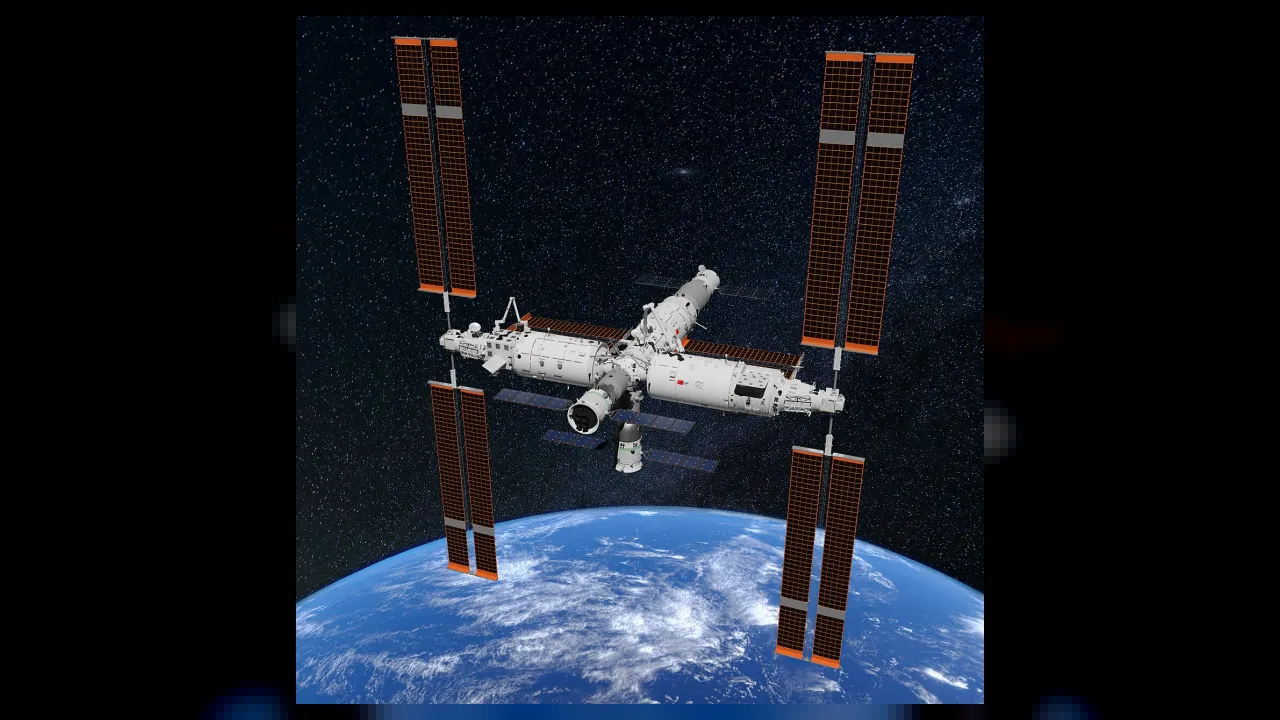
Shaped Like a Giant T
Look up at night! Shining like a bright moving star, China's Tiangong station glides smoothly across the dark sky.
2
Three Big Rooms
Its name means 'Heavenly .' Three white rooms link in a neat T-shape, with golden wings catching warm sunlight.
3
Walking Robot Arm
Outside crawls a smart robot arm just like an ! Inside, three astronauts sleep in cozy beds and tend green lettuce.
1. What letter of the alphabet are Tiangong's three connected modules shaped like?
2. How does Tiangong's outside robot arm move from one end of the station to the other?
🤯 Mind-Blowing Fact • Grade 2
Tiangong was the very first space station to come equipped with its own microwave oven so crews could enjoy piping-hot meals in seven minutes!
✨ Word Sparks (Grade 2 Glossary)
Tap 🔊 to hear
taikonaut
Astronaut flying in China's human spaceflight program
porthole
Strong round window on a ship or spacecraft
wireless
Sending computer signals through air without messy cords
🪝
How did engineers assemble an entire three-room space station in less than two years?
1
Harmony, Quest, and Dream
Beginning in April 2021, heavy Long March 5B rockets roared off a tropical island in southern China. First rose the Tianhe ('Harmony of the Heavens') living core, followed in 2022 by two big science labs: Wentian ('Quest') and Mengtian ('Dreaming')!
2
Private Bedrooms and Wi-Fi
Because Tiangong was designed with 2020s technology, hallways stay tidy without tangled cables! enjoy private phone-booth-sized bedrooms with round windows, headsets, and even a microwave oven for hot space meals.
3
Inchworm Robotics
Outside, a thirty-three-foot robotic arm teams up with a smaller arm to reach every corner during spacewalks.
1. How many main modules joined together between 2021 and 2022 to form Tiangong?
2. What kitchen treat did Tiangong bring to space station life for the first time?
🤯 Mind-Blowing Fact • Grade 3
When two Shenzhou crews hand over the keys to Tiangong, six taikonauts share the station together for nearly a week of bustling teamwork!
✨ Word Sparks (Grade 3 Glossary)
Tap 🔊 to hear
airlock
Sealed double-door chamber between cabin air and vacuum
drag
Gentle slowing force from thin upper atmosphere
CubeSat
Shoebox-sized miniature satellite launched into orbit
🪝
Why does Tiangong carry electric blue-glowing thrusters normally used on deep-space asteroid probes?
1
Fighting Whisper-Thin Air Drag
Even 240 miles above Earth, wispy traces of air gently tug space stations downward every day. Instead of burning tons of heavy rocket fuel to climb back up, Tiangong's Tianhe core fires four electric Hall-effect ion thrusters—pushing xenon gas atoms with electricity at ten times the fuel efficiency of chemical rockets!
2
Roll-Out Golden Solar Wings
Stretching 182 feet tip to tip, flexible gallium-arsenide solar wings thinner than a millimeter unroll like window blinds and convert over thirty percent of sunlight into electricity.
3
Cargo Airlock for Satellites
Inside the Mengtian lab sits a dedicated cargo : astronauts place experiments or tiny inside, and the robotic arm plucks them outside without anyone needing to put on a bulky spacesuit!
4
Shenzhou and Tianzhou Visits
Every six months, Shenzhou crew capsules swap three-person crews while automated Tianzhou freighters deliver fresh fruit and supplies.
1. Why are Tiangong's Hall-effect ion thrusters such a smart upgrade for a space station?
2. How does Mengtian's special cargo airlock save astronauts time and effort?
🤯 Mind-Blowing Fact • Grade 4
In 2024, four zebrafish lived aboard Tiangong inside a closed water-and-algae tank—teaching scientists how vertebrate balance systems adapt to weightlessness!
✨ Word Sparks (Grade 4 Glossary)
Tap 🔊 to hear
absolute zero
Coldest possible temperature where atomic motion nearly stops
Living community recycling air, water, and nutrients together
🪝
Why did physicists launch the coldest spot in the known universe aboard Tiangong to build a clock?
1
Stepping Stones Tiangong-1 and Tiangong-2
China's permanent orbital outpost didn't appear overnight. Engineers first tested automated rendezvous, orbital refueling, and life support aboard two smaller single-module prototypes—Tiangong-1 (2011) and Tiangong-2 (2016)—before launching the 22.5-ton Tianhe core module from Wenchang Space Launch Site in April 2021. Using built-in indexing arms similar in spirit to Mir's, Wentian and Mengtian docked nose-first and swung ninety degrees into their permanent symmetric T-junction in 2022.
2
Laser-Cooled Atoms and Einstein's Gravity
Packed inside the Mengtian laboratory are eight towering science racks, including a Cold System. On Earth, gravity pulls chilled atoms out of laser traps in fractions of a second; in Tiangong's microgravity, lasers cool rubidium and strontium atoms to a fraction above (-459.67 °F), building an ultra-precise clock projected to lose less than one second in billions of years—sharp enough to test Albert Einstein's general relativity and synchronize global timekeeping!
3
Closed-Loop Life Support and Rice Harvests
Regenerative life-support loops recycle over ninety percent of cabin water and condense exhaled carbon dioxide back into oxygen. In Wentian's biotechnology cabinets, plant biologists grew rice plants all the way from sprouted seeds to mature new grains for the first time in orbit, alongside zebrafish swimming inside a self-contained aquatic !
4
Co-Orbiting Telescope Partner Ahead
Tiangong's orbit is even designed to share space with Xuntian, a planned Hubble-class wide-field space telescope that can fly right over and dock with the station for astronaut upgrades and refueling!
1. Why can laser-cooled atomic clocks run even more accurately aboard Tiangong than on Earth?
2. What clever servicing trick is planned for China's upcoming Xuntian space telescope?
🤯 Mind-Blowing Fact • Grade 5
Inside Mengtian's materials furnace, static electricity levitates glowing droplets of molten metal in midair at 5,400 degrees Fahrenheit so scientists can cool ultra-pure alloys without ever touching a container wall!
✨ Word Sparks (Grade 5 Glossary)
Tap 🔊 to hear
gallium arsenide
High-efficiency semiconductor crystal used in spacecraft solar cells
levitation
Suspending an object midair using electric or magnetic forces
inclination
Tilt angle of an orbit relative to Earth's equator
🪝
How did compact, twenty-first-century engineering allow a hundred-ton space station to match the laboratory punch of giants four times its mass?
1
Compact Mass, High Scientific Density
At roughly 100 metric tons when joined by a Shenzhou crew vehicle and Tianzhou resupply freighter, China's Tiangong Space Station has about one-quarter the mass of the International Space Station—yet benefits from three decades of advances in materials, fiber-optic data buses, and power conversion. Launched across eleven precision missions in nineteen months (2021–2022), its symmetric T-configuration places six bedrooms, dual toilets, galleys, and twenty-plus standardized internal payload racks plus sixty-seven external exposure platforms into 340 cubic meters of habitable volume.
2
Triple-Junction Gallium Arsenide and Hall Thrusters
Powering high-temperature materials furnaces and superconducting magnets demands immense kilowattage without excessive atmospheric drag. Wentian and Mengtian each deploy twin 27-meter flexible triple-junction gallium-arsenide solar arrays delivering photoelectric efficiencies exceeding 30 percent on dual-axis gimbals, feeding lithium-ion batteries and four 80-millinewton Hall-effect electric thrusters on Tianhe that cut annual propellant resupply mass by thousands of kilograms.
3
Dual Robotic Arms and Feitian EVA Architecture
External maintenance pairs Tianhe's 10.2-meter seven-degree-of-freedom arm (25-ton capacity) with Wentian's nimble 5-meter precision arm; linked end-to-end, they span 15 meters across the hull while taikonauts in indigenous Feitian spacesuits exit Wentian's dedicated spacious airlock—setting a nine-hour single-spacewalk world record in December 2024!
4
Frontier Microgravity Physics and UN Experiments
Inside Mengtian, containerless electrostatic melts refractory alloys at 3,000 degrees Celsius without crucible contamination, two-phase fluid physics racks refine spacecraft cooling, and international experiments selected with the United Nations Office for Outer Space Affairs study gamma-ray bursts and space medicine.
5
Expandable Six-Module Future
Equipped with a forward multi-port node ready to accept three additional modules into a cross-shaped 180-ton complex, Tiangong stands poised for over fifteen years of continuous human presence in Low Earth Orbit.