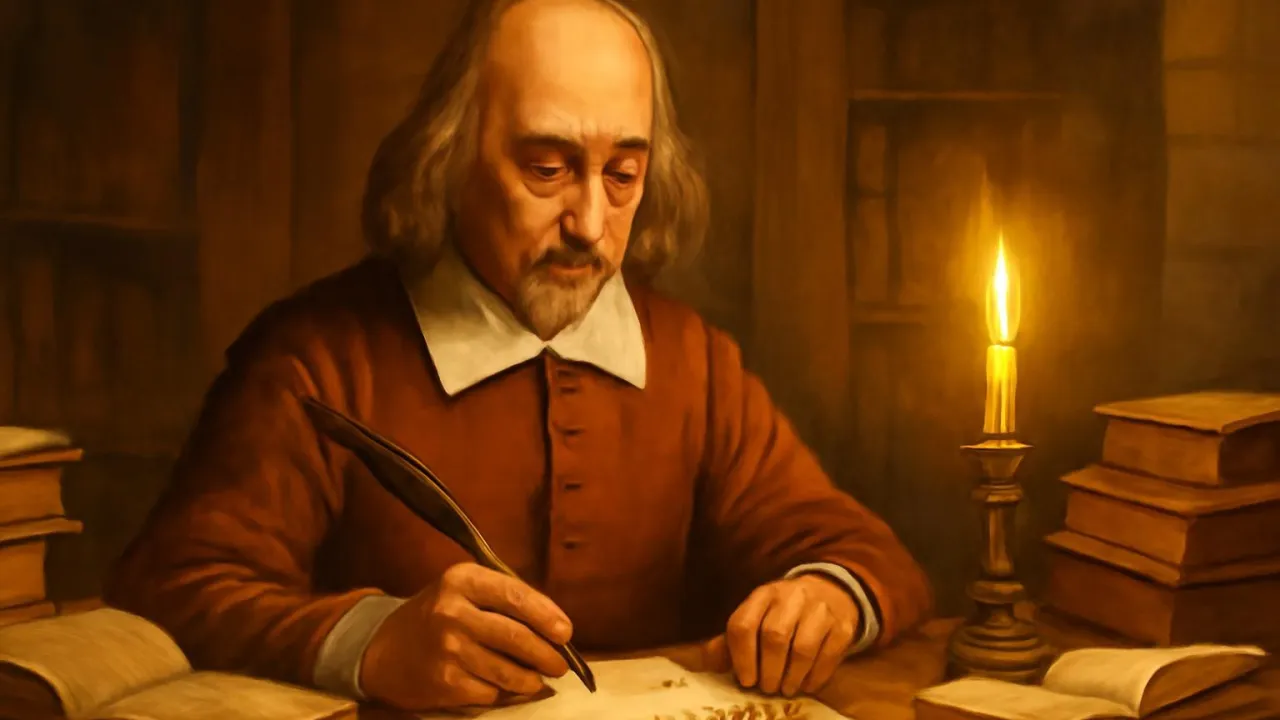
Thomas Hobbes wrote 'Leviathan' over 350 years ago!
✨ Word Sparks (Grade 2 Glossary)
Tap 🔊 to hear
curious
Wanting to know or learn more
peacefully
Living together without fighting
leaders
People who help guide others
🪝
Have you ever wondered why we follow rules?
1
A Boy Full of Questions
Young Thomas was always and loved to read books. He asked why people sometimes argued or took things. He wanted to know how everyone could live together .
2
Hard Thinking and Writing
Thomas studied hard and wrote down his thoughts in long books. He believed rules are important because they help people share and stay safe. He wanted everyone to understand why rules matter.
3
A Book Called Leviathan
His most famous book was called 'Leviathan,' which means something very big. In it, Thomas explained that strong rules and help keep peace. People still talk about his ideas today.
Hobbes’s book 'Leviathan' is still read by students around the world!
✨ Word Sparks (Grade 3 Glossary)
Tap 🔊 to hear
philosophy
The study of big ideas and questions
state of nature
A world without any rules
legacy
Something important left behind
🪝
Imagine a world where everyone did whatever they wanted!
1
A Child Who Loved Big Questions
Thomas Hobbes grew up in England, reading every book he could find. He wondered why people sometimes fought and how they could live together peacefully. His curiosity led him to study history, science, and government. Even as a child, he dreamed of helping people get along.
2
Discovering the Need for Rules
Hobbes believed that without rules, life would be wild and unsafe. He called this the ',' where everyone only cared for themselves. He thought strong rules and leaders could protect people from danger. This idea became the heart of his .
3
Writing 'Leviathan'
In 1651, Hobbes wrote his famous book, 'Leviathan.' He explained how governments should keep order and protect people. He used the word 'Leviathan' to describe a powerful ruler who could keep everyone safe. His book changed how people thought about laws and leadership.
4
A Lasting Legacy
Hobbes’s ideas about rules and government are still studied today. Many teachers and leaders discuss his thoughts in schools and universities. He helped people understand why societies need structure. His questions and answers shaped the world of .
Hobbes’s 'Leviathan' helped inspire the idea of a social contract in government.
✨ Word Sparks (Grade 4 Glossary)
Tap 🔊 to hear
social contract
An agreement to follow rules together
influential
Having a strong effect on others
democracy
A government where people have a say
🪝
What would happen if everyone made their own rules?
1
A Young Thinker in a Changing World
Growing up in 1600s England, Thomas Hobbes lived through wars and political chaos, which made him wonder about safety and order. He read ancient texts and learned from scientists, always asking what keeps people from fighting. Hobbes believed that understanding human nature was the key to peace. His early curiosity set him on a path to become a great philosopher.
2
The State of Nature and Social Contract
Hobbes imagined a 'state of nature,' where people acted only for themselves, leading to danger and fear. To avoid this chaos, he argued that people agreed to follow rules and accept leaders—a concept called the '.' Hobbes thought only a strong government could protect people and keep society peaceful. This idea was groundbreaking in political philosophy.
3
Leviathan: A Book That Changed Ideas
In 1651, Hobbes published 'Leviathan,' using the image of a giant sea monster to represent a powerful ruler. He wrote that governments must be strong to keep people safe from harm. His book explained how laws and leaders are created by the people’s agreement. 'Leviathan' became one of the most works ever written about government.
4
Hobbes’s Impact on the World
Hobbes’s ideas about the need for order and rules shaped how people think about government today. His theories influenced later philosophers, leaders, and even modern democracies. Schools and universities still teach his work to help students understand society. Hobbes’s big questions and bold answers changed the way people view law, power, and peace.
1. Why did Hobbes believe people needed a strong government?
2. What is the 'social contract'?
🤯 Mind-Blowing Fact • Grade 5
Hobbes’s phrase 'solitary, poor, nasty, brutish, and short' is still quoted in philosophy classes today.
✨ Word Sparks (Grade 5 Glossary)
Tap 🔊 to hear
political philosophy
The study of how societies are governed
authority
The power to make and enforce rules
controversial
Causing strong disagreement or debate
🪝
Why do societies need rules, and what happens if they break down?
1
A Childhood Shaped by Uncertainty
As a boy in 16th-century England, Thomas Hobbes witnessed wars and unrest that made him question how people could live together peacefully. He read classical works in Latin and Greek and became fascinated by the causes of conflict and cooperation among people. Hobbes’s early exposure to chaos inspired his lifelong quest to understand human nature. His curiosity and determination led him to study philosophy, mathematics, and science, always searching for answers to society’s biggest problems. These experiences deeply influenced his later theories about government and order. By the time he was an adult, Hobbes was already known for his sharp mind and big questions.
2
The State of Nature: A World Without Rules
Hobbes imagined a world he called the 'state of nature,' where there were no laws or leaders to keep people in check. In this condition, he argued, everyone would act for their own survival, leading to constant fear and danger. He famously described life in the state of nature as 'solitary, poor, nasty, brutish, and short.' Hobbes believed that humans are naturally equal in their ability to harm or help each other, which makes cooperation difficult without shared rules. His vivid descriptions helped people understand why order and safety cannot be taken for granted. The state of nature became a powerful idea in , influencing debates for centuries.
3
The Social Contract and the Leviathan
To escape the dangers of the state of nature, Hobbes argued that people form a 'social contract,' agreeing to obey common rules and accept a leader with enough power to enforce them. In his 1651 book 'Leviathan,' Hobbes used the image of a giant sea creature to symbolize a strong, unified government. He explained that only a powerful ruler or assembly could protect citizens and maintain peace. Hobbes’s social contract theory was revolutionary, suggesting that government’s comes from the people’s agreement, not from kings or gods. This challenged old ideas and inspired new ways of thinking about law and power. 'Leviathan' remains a foundational text in today.
4
Hobbes’s Influence on Modern Thought
Hobbes’s ideas about government, power, and human nature have had a lasting impact on philosophy, politics, and law. His theories influenced later thinkers like John Locke and shaped the development of modern democracies. Many countries adopted the idea that governments must protect citizens in exchange for their obedience to laws. Universities around the world continue to teach Hobbes’s work, and his questions about order and freedom remain important today. By showing why rules and leaders matter, Hobbes helped people understand the balance between liberty and security. His work is still debated by philosophers, politicians, and students everywhere.
5
A Legacy of Big Questions and Bold Answers
Thomas Hobbes’s life and writings remind us that asking difficult questions can change the world. His clear explanations of the need for rules and the dangers of chaos helped shape the modern understanding of society and government. Hobbes’s willingness to challenge old beliefs made him both famous and in his time. Today, his legacy lives on in discussions about justice, rights, and the responsibilities of leaders and citizens. Whether you agree with all his ideas or not, Hobbes’s work encourages everyone to think deeply about how we live together. The world is still learning from his bold vision for peace and order.