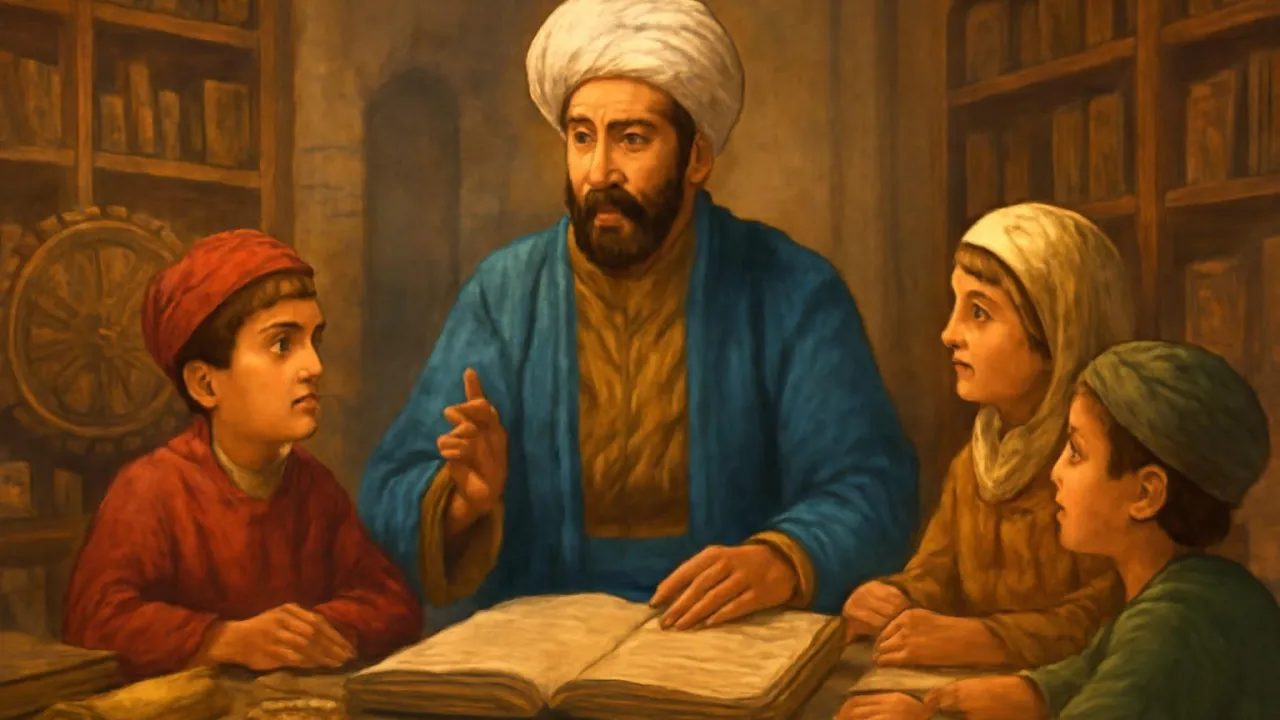
Al-Farabi wrote over 100 books about ideas and music.
✨ Word Sparks (Grade 2 Glossary)
Tap 🔊 to hear
fair
Treating everyone in a kind way.
science
Learning about how things work.
leader
A person who helps guide others.
🪝
Have you ever wondered how to make a city fair?
1
A Curious Boy
Al-Farabi grew up asking many questions about the world. He liked to read books and learn new ideas. He wanted to know how people could live together happily.
2
Learning and Music
He studied , math, and music every day. Al-Farabi played the ney, a flute that made soft music. He believed music and learning could help people be better.
3
Dreaming of Good Cities
Al-Farabi wrote about cities where everyone was kind and . He thought should care for all people. His ideas helped others think about how to make better places.
Al-Farabi could speak and write in several languages, including Arabic and Greek.
✨ Word Sparks (Grade 3 Glossary)
Tap 🔊 to hear
virtue
Doing what is right and good.
philosophy
Thinking about life and big ideas.
legacy
Something important left for others.
🪝
Can you imagine a city where everyone helps each other?
1
A Young Thinker
As a boy, Al-Farabi loved to ask questions about life and learning. He spent hours reading books about science, math, and . His curiosity made him want to understand how people and cities worked. He dreamed about making the world a kinder place.
2
The Power of Music
Al-Farabi became skilled at playing the ney, a wooden flute. He believed music could help people feel peaceful and wise. He even wrote books about how music and emotions are connected. His musical ideas influenced many other thinkers.
3
Building a Virtuous City
Al-Farabi wrote a famous book called 'The Virtuous City.' In it, he described a place where leaders are wise and everyone works together. He used words like '' and '' to explain his ideas. His city was a model for fairness and happiness.
4
A Lasting Legacy
Al-Farabi's ideas spread across many lands and centuries. He helped shape the way people think about government and community. Other philosophers called him 'the Second Teacher' after Aristotle. His work still inspires people who want to build better societies.
Al-Farabi built a special instrument called the 'qanun' to study music and sound.
✨ Word Sparks (Grade 4 Glossary)
Tap 🔊 to hear
harmony
Different things working well together.
logic
Thinking in clear, careful steps.
citizen
A person who lives in a city or country.
🪝
What would it take to design a city where wisdom and kindness rule?
1
Curiosity in the Golden Age
Growing up in Central Asia during the Islamic Golden Age, Al-Farabi was surrounded by scholars and new ideas. He studied in great cities like Baghdad, learning philosophy, science, and music from the best teachers. His endless curiosity led him to master many subjects, including mathematics, , and languages. This rich environment inspired him to ask how people could live together in .
2
Music, Science, and Philosophy
Al-Farabi believed that music, science, and philosophy were all connected in making people wise. He played the ney flute and wrote detailed books on how music affects emotions and thinking. His scientific studies included astronomy and , which helped him solve complex problems. By blending these fields, Al-Farabi showed that learning could help create a better world.
3
The Virtuous City Blueprint
In his famous book 'The Virtuous City,' Al-Farabi described a city led by wise, just rulers who cared for everyone. He explained that a truly great city needs who practice virtue and work together for the common good. He used philosophy to show how leaders should be chosen for their wisdom, not just their power. His ideas influenced both Islamic and European thinkers for centuries.
4
A Teacher for All Times
Al-Farabi became known as 'the Second Teacher,' just after Aristotle, because of his huge impact on philosophy. He wrote over one hundred works, many of which were studied in universities across the world. His thinking helped shape ideas about government, education, and community. Today, Al-Farabi is remembered as a bridge between ancient and modern ways of thinking.
Al-Farabi’s books were used as textbooks in universities across the Middle East and Europe for centuries.
✨ Word Sparks (Grade 5 Glossary)
Tap 🔊 to hear
treatise
A long, careful book about one topic.
ethics
Ideas about what is right and wrong.
contribution
Something important someone adds to the world.
🪝
Imagine a city where every citizen strives for wisdom and justice—how would you build it?
1
A Scholar in a Golden Age
In the bustling cities of the Islamic Golden Age, Al-Farabi stood out as a brilliant scholar who mastered philosophy, science, and music. He was born in Farab, in present-day Kazakhstan, and traveled to great centers of learning like Baghdad, where he studied under renowned teachers. Al-Farabi’s curiosity led him to learn several languages, including Arabic, Persian, and Greek, allowing him to read and translate important ancient texts. His deep understanding of Aristotle and Plato helped him bridge Eastern and Western philosophies, making him a key figure in the history of ideas. He believed that learning should serve humanity by promoting harmony and understanding.
2
Blending Science, Logic, and Melody
Al-Farabi’s work was remarkable for connecting music, logic, and science into a unified vision of knowledge. He played the ney flute and invented the qanun, a stringed instrument, to explore the mathematics of sound. In his , he explained how music could influence emotions and even the character of a society. Al-Farabi also wrote extensively about logic, helping future scholars understand how to reason clearly and solve complex problems. His scientific studies included astronomy and mathematics, fields in which he made lasting . By combining these disciplines, Al-Farabi showed that wisdom is found by linking different ways of knowing.
3
The Blueprint for a Virtuous City
One of Al-Farabi’s most influential works, 'The Virtuous City,' described a society governed by wise and just leaders who put the common good above personal gain. He argued that true leadership comes from knowledge, virtue, and a desire to help others, not from wealth or power alone. In his city, every citizen has a role in creating harmony and justice, and education is the key to building a better community. Al-Farabi’s ideas about government and influenced both Islamic and European thinkers, including Thomas Aquinas and Maimonides. His vision of a virtuous society remains a model for those who dream of fairness and peace.
4
Legacy Across Cultures and Centuries
Al-Farabi became known as 'the Second Teacher,' second only to Aristotle, because of his enormous impact on philosophy and science. He wrote over one hundred works, many of which were studied in medieval universities from Spain to Persia. His commentaries on Aristotle helped preserve and explain ancient Greek philosophy for later generations. Al-Farabi’s blend of rational thinking, ethical teaching, and appreciation for the arts made him a bridge between cultures and eras. Today, his writings are still read by students of philosophy, political science, and music.
5
Inspiration for Future Thinkers
Al-Farabi’s life teaches us that curiosity, kindness, and wisdom can shape a better world. He showed that asking big questions and seeking knowledge in many fields helps us understand ourselves and our communities. His belief in the power of education, fair leadership, and the arts continues to inspire people who want to make their cities and countries more just. By dreaming of a virtuous city, Al-Farabi encouraged generations to work together for peace and understanding. His legacy reminds us that every person can help build a brighter future through learning and compassion.