🎵 INSTRUMENTS
🎶 Struck & Shaken Membranophone / Idiophone • Percussion
VA Music, Fine Arts & Sound Physics SOL 5.5
Tambourine
Shimmering Jingles That Dance on Every Beat
Grade 3 • Fluent • 169 words
🎶 Instrument Family & OriginPercussion family • Ancient Mesopotamia, Egypt, and Mediterranean traditions
🪵 Materials & Range20–30 cm wooden hoop with skin head and metal jingles • Bright, crisp, unpitched shimmer
🔊 How Sound Is MadeHand taps, shakes, or thumb friction vibrate the drumhead and clash paired metal jingles
⚡ Signature Sound SparkBlends a warm drum thump and sparkling metallic jingle inside one light handheld hoop
🤯 Mind-Blowing Fact • Grade 1
People in ancient Egypt and Greece danced with jingling tambourines more than three thousand years ago!
✨ Word Sparks (Grade 1 Glossary)
Tap 🔊 to hear
frame
The round wooden ring holding everything together
jingles
Small shiny metal circles that clink together
beat
A steady pulse you clap or march to
🪝
How can one small wooden circle boom like a drum and jingle like tiny bells at the same time?
1
Shake, Tap, Jingle!
Ching, ching, boom! Hear that bright, happy sound? Shake a wooden ring in the air. Tiny metal discs crash and shine! Tap the tight top with your hand. You just woke up a tambourine!
2
Inside the Hoop
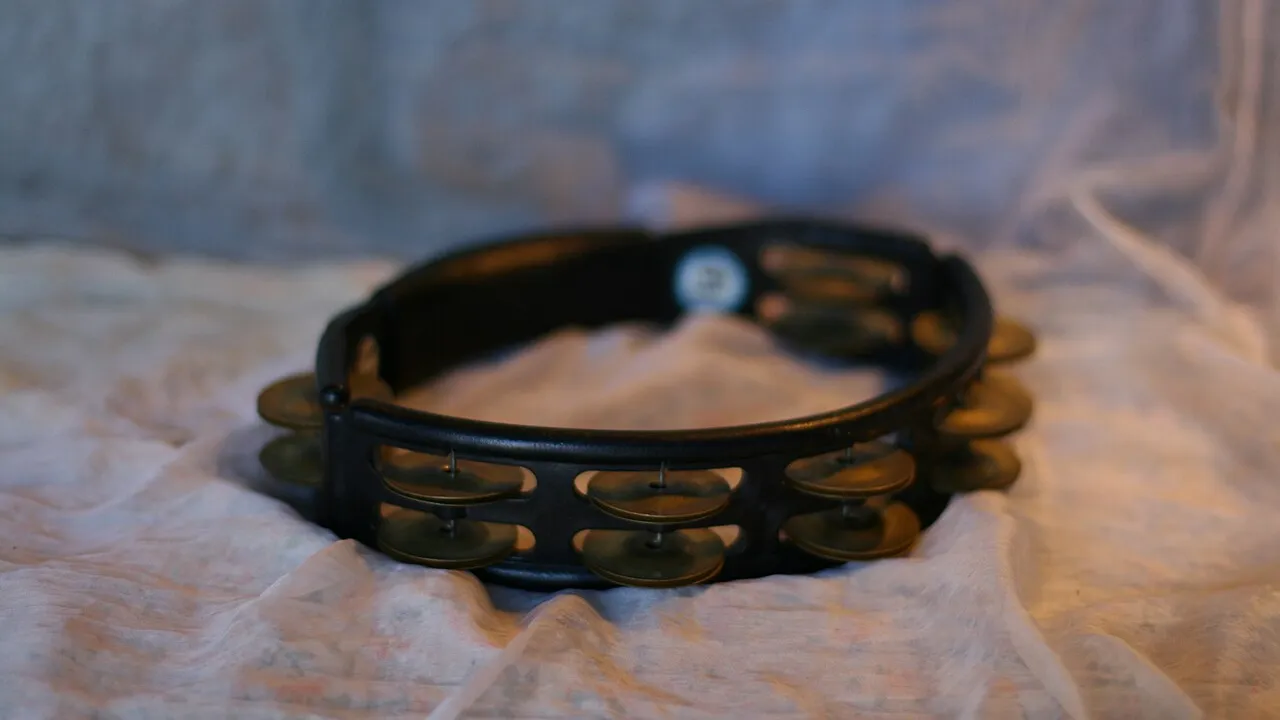
Look around the curved wood . Pairs of shiny metal circles sit in small slots. Some hoops have a smooth drum skin on top. Others are open rings you just shake.
3
Keep the Beat
Clap it on your knee or shake it fast. Every wiggle makes crisp music that helps dancers step in time.
1. What happens when you shake a tambourine in the air?
2. Do all tambourines have a flat drum skin stretched across the top?
🤯 Mind-Blowing Fact • Grade 2
The little metal discs in a tambourine's rim have a special musical name—they are called zils!
✨ Word Sparks (Grade 2 Glossary)
Tap 🔊 to hear
zils
Paired metal discs mounted inside tambourine slots
drumhead
Tight skin stretched across a drum's top
rhythm
A pattern of short and long musical beats
🪝
What secret lets one handheld hoop sound like both a drum and a pocketful of silver coins?
1
A Sparkle in the Rhythm
Ching-a-ling, thump! Imagine holding a whole section in one hand while a band plays. When you shake this round wooden hoop, tiny metal pairs leap together and scatter bright silver sparks of sound across the room.
2
Drum Skin Meets Metal Zils
A classic tambourine blends two instruments into one lightweight circle. Stretched drum skin across the top gives a warm, bouncy thump when tapped with your fingers. Around the wooden rim, small metal discs called hang loosely on thin pins inside narrow slots.
3
Many Ways to Play
Musicians hold the frame with one hand and tap, shake, or bounce it against a palm. Even a gentle wrist twist makes the jingles chatter in lively patterns for folk dances, parades, and concert songs.
1. What are the small paired metal discs set into the wooden rim called?
2. Why does a headed tambourine sound like two instruments at once?
🤯 Mind-Blowing Fact • Grade 3
Concert percussionists rub a thin ring of beeswax near the edge of the drumhead so their thumb can bounce smoothly for sizzling thumb rolls!
✨ Word Sparks (Grade 3 Glossary)
Tap 🔊 to hear
percussion
Instruments sounded by striking, shaking, or scraping
membrane
A thin, stretched skin that vibrates for sound
friction
Grip and rubbing force between two touching surfaces
🪝
How can a light wooden ring cut clearly through the roar of seventy loud orchestra instruments?
1
One Hoop, Two Sound Worlds
Shhh-ching! Before you even spot the player at the back of the orchestra, a crisp metallic shimmer slices right through the violins and brass. How can such a small handheld hoop cut through seventy loud instruments at once?
2
Membrane and Jingles Working Together
This clever instrument combines a stretched with clashing metal jingles. When your fingertips strike the tight drumhead, air waves pulse outward with a crisp pop. At the exact same instant, vibrations race into the curved wooden shell and jolt pairs of bronze or brass discs called zils.
3
Secret Tricks of the Thumb Roll
Orchestral players do much more than tap and shake the frame. By pressing a slightly damp thumb along the edge of the drumhead, makes the skin skip rapidly beneath the thumb. That buzzing vibration sets every jingle spinning in a smooth, sizzling roll!
4
Ancient Roots Around the Globe
People in ancient Mesopotamia, Egypt, and Greece played frame drums with jingles during festivals thousands of years ago. Today, close cousins like the Middle Eastern riq and Brazilian pandeiro drive joyful, dancing rhythm in concerts across every continent.
1. How does a percussionist create a smooth 'thumb roll' on a tambourine?
2. Which instrument is a close cousin of the tambourine played in Brazil?
🤯 Mind-Blowing Fact • Grade 4
Mozart was one of the first major classical composers to write tambourine parts into European orchestral music during the late 1700s!
✨ Word Sparks (Grade 4 Glossary)
Tap 🔊 to hear
membranophone
An instrument making sound with a stretched skin
idiophone
An instrument whose solid body vibrates directly
timbre
The unique tone color of a musical sound
🪝
Why do orchestra builders mix copper, bronze, and silver alloys inside a single tambourine frame?
1
Cutting Through a Full Symphony
Picture ninety musicians roaring at full volume during an Italian carnival dance—yet one crisp, glittering burst from the back row rises effortlessly above every horn and string! That unmistakable sparkle belongs to the tambourine, a compact percussion marvel engineered for instant projection.
2
The Physics of Frame, Head, and Zils
Acoustically, a headed tambourine unites two sound-making families inside a single circular wooden shell about twenty-five centimeters wide. Its tight calfskin or synthetic head acts as a , vibrating up and down when struck to create a focused punch. Meanwhile, double rows of slotted openings hold pairs of curved metal discs called zils, which act as —objects that make sound when their own solid material vibrates. Because brass, copper, and German silver produce different high-frequency overtones, builders mix metals to craft dark, warm, or icy-bright .
3
Mastering Rolls, Knees, and Fist Strokes
Skilled percussionists change volume and texture by shifting how they hold and strike the hoop. For whisper-soft passages, players rest the tambourine on one raised knee and tap the wooden rim lightly with stiff fingertips so the zils barely kiss. For thunderous fast rhythms, they alternate striking the head against a knee and an open fist. Even wilder is the friction roll, where beeswax or rosin applied near the rim helps a sliding thumb bounce dozens of times per second.
4
From Ancient Temples to Global Grooves
Carved stone reliefs from ancient Mesopotamia and painted vases from Greece show dancers spinning with jingling frame drums over three thousand years ago. Traveling along Mediterranean trade routes, the instrument branched into virtuoso relatives such as the Arabic riq, the Indian kanjira, and modern headless rock tambourines heard in pop and gospel anthems.
1. Why do instrument makers choose different metals like bronze, copper, or German silver for zils?
2. How do orchestral players perform extremely fast, loud rhythms on a tambourine?
🤯 Mind-Blowing Fact • Grade 5
Despite being called 'German silver,' the bright metal alloy used in crisp orchestral zils contains zero actual silver—it is a blend of copper, nickel, and zinc!
✨ Word Sparks (Grade 5 Glossary)
Tap 🔊 to hear
organology
The scientific study and grouping of musical instruments
alloy
Metal made by blending two or more elements
overtones
Higher frequencies ringing above a main musical sound
🪝
How does a twenty-five-centimeter hoop exploit high-frequency acoustics and stick-slip physics to outshine an entire orchestra?
1
Small Hoop, Mighty Acoustic Presence
What happens when a single flick of the wrist unleashes a cascade of high-frequency bright enough to pierce an entire romantic symphony orchestra? Standing at the intersection of drum craft and metallurgy, the tambourine proves that acoustic power depends far more on frequency spectrum than on sheer physical size.
2
Dual Organology: Membranophone Meets Idiophone
In the Hornbostel-Sachs system of musical instrument classification, a headed tambourine occupies two categories simultaneously. Its taut calfskin, goatskin, or synthetic Mylar head functions as a single-headed frame drum—a struck membranophone typically spanning 20 to 30 centimeters (8 to 12 inches) in diameter. Cut into the steam-bent hardwood shell are staggered slots housing steel pins, each threading pairs of slightly cupped metal discs known as zils or jingles. These clashing discs behave as shaken and struck idiophones whose collisions radiate crisp frequencies above 3,000 hertz, an acoustic zone where few orchestral instruments compete.
3
Metallurgy and Timbral Tailoring
Concert percussionists choose specific combinations the way painters select pigments. Hand-hammered phosphor bronze and copper zils yield a warm, smoky shimmer suited to Spanish or French orchestral scores like Bizet's Carmen, whereas chromium or German silver (a nickel-copper-zinc alloy) delivers a biting, crystalline snap ideal for brisk marches. Crimping the edges of each disc introduces irregular contact points, preventing airlock when two flat circles clap together and enriching the metallic sustain.
4
Virtuoso Articulation and Friction Mechanics
Executing rapid sixteenth-note passages at extreme dynamics demands ingenious choreography. For delicate pianissimo patterns, a player supports the shell horizontally on a cushioned knee and articulates lightly near the rim with both hands. At fortissimo speeds, alternating knee-and-knuckle strokes cut travel distance in half. Sustained rolls rely either on rapid axial wrist rotation—a shake roll—or on stick-slip friction, where a thumb glides across a thin ring of beeswax or rosin coated onto the perimeter of the head, driving continuous membrane oscillations.
5
Millennia of Cultural Evolution
Archaeological artifacts trace jingling frame drums back to Bronze Age Mesopotamia, Pharaonic Egypt, and the ancient Greek tympanon, where women musicians led sacred processions and seasonal celebrations. Across centuries of trade and migration, that timeless blueprint blossomed into virtuoso regional cousins—from the classical Arabic riq with ten precision brass zil pairs to Brazil's syncopated pandeiro, South India's kanjira, and the headless half-moon tambourines driving modern gospel and rock recordings.