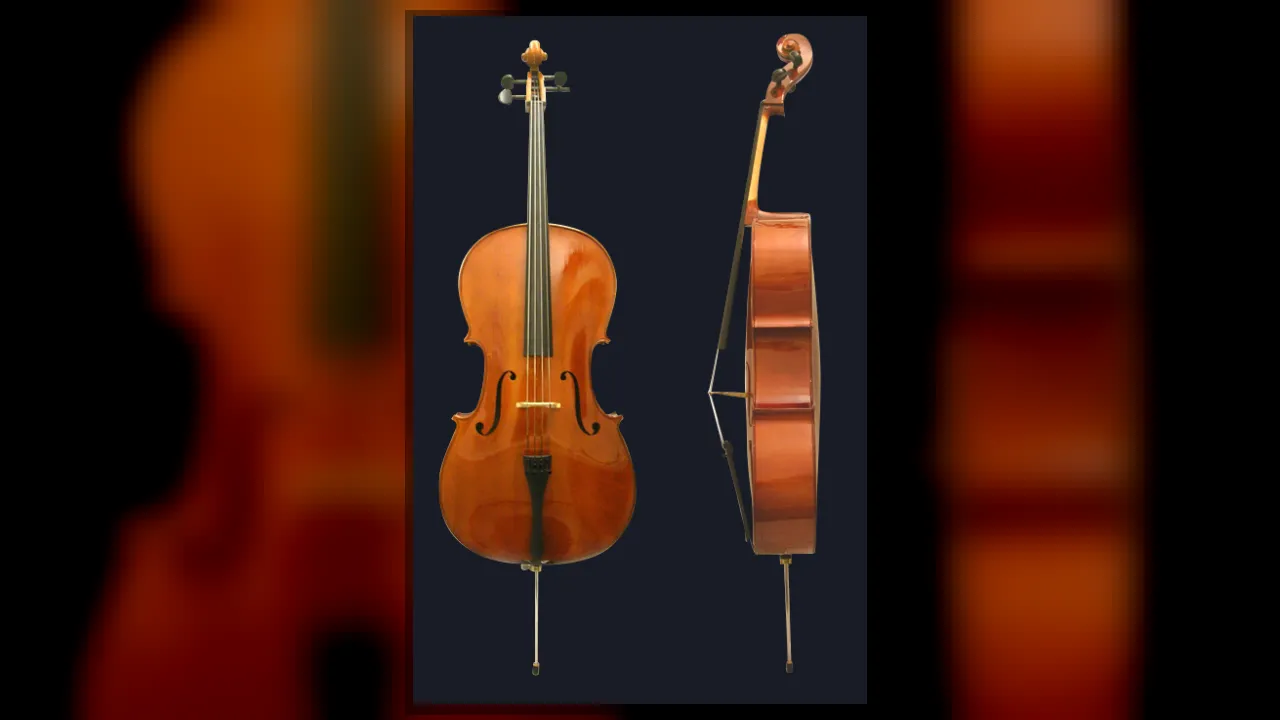
🪵 Materials & RangeSpruce, Maple & Steel Endpin (~120 cm Tall) • 4+ Octaves (C2 to E6+)
🔊 How Sound Is MadeSeated player draws a heavy horsehair bow horizontally across thick strings resting over a tall wooden soundbox
⚡ Signature Sound SparkClosest instrument in pitch and warmth to the adult human singing voice—rumbling deep basslines and soaring high melodies alike
🤯 Mind-Blowing Fact • Grade 1
'Cello' is actually a nickname—its full Italian name is 'violoncello,' which funny enough means 'little big viola'!
✨ Word Sparks (Grade 1 Glossary)
Tap 🔊 to hear
endpin
Bottom metal rod resting on the floor
rumble
Make a deep, rolling, low sound
upright
Standing straight up from the ground
🪝
Why do you sit in a chair and hug this big wooden instrument instead of tucking it under your chin?
1
Vroom, Hum, Sing!
Bvooom! Feel the wooden stage floor gently beneath your shoes! A seated musician hugs a tall, shining instrument and glides a bow across thick strings.
2
Standing on One Pin
Way too big for your chin, a cello stands between your knees. A shiny metal rod at the bottom rests on the floor.
3
Warm Like a Voice
Its deep strings purr low like a sleepy bear, yet climb high to sing sweet songs just like a human voice!
1. How does a musician hold a cello while playing?
2. What is the cello's full original Italian name?
🤯 Mind-Blowing Fact • Grade 2
The oldest surviving cello in the world—called 'The King'—was carved by Andrea Amati in Cremona, Italy around 1560 for the royal court of France!
✨ Word Sparks (Grade 2 Glossary)
Tap 🔊 to hear
chord
Three or more notes sounding together
scroll
Curved spiral carved atop the pegbox
bass
Deepest, lowest musical pitch range
🪝
How did adding one simple sliding spike on the bottom change cello playing forever?
1
Feel the Floor Vibrate
Sit in the front row when twelve cellos bow a low together—you can actually feel the warm sound waves tickle your ribs! Standing about four feet tall from to floor, the cello sings deeper than both the violin and viola.
2
Before the Floor Spike
Crafted in 1500s Italy by Andrea Amati, early cellos had no bottom spike at all! For three hundred years, players had to squeeze the heavy wooden body up off the floor using only their calves!
3
Freedom With the Endpin
In the mid-1800s, Belgian cellist Adrien-François Servais popularized the retractable floor endpin. Suddenly hands and shoulders relaxed, letting cellists leap smoothly from rumbling notes all the way up to soaring melodies—and vibrations even traveled straight into the wooden stage!
1. Before the metal floor endpin became popular in the 1800s, how did cellists hold their instrument off the floor?
2. How do you pronounce the word 'cello' in English?
🤯 Mind-Blowing Fact • Grade 3
When airplanes fly concert cellists around the world, the delicate cello cannot go in baggage—the musician actually buys the cello its very own window seat right next to them, often booked as 'Mr. Cello'!
✨ Word Sparks (Grade 3 Glossary)
Tap 🔊 to hear
octave
Eight-note span doubling or halving vibration speed
Why do listeners everywhere say the cello sounds more like a real human singer than any other instrument?
1
Matching the Human Voice
Hum the lowest note you can reach, and then sing your brightest high note! From deep baritone rumbles up to clear soprano highs, the cello's four- span overlaps every adult human singing voice—and its large spruce-and-maple chamber shapes warm vowel-like tones.
2
One Octave Below the Viola
Look at a cello's four thick metal-wound strings: C, G, D, and A. Those are the exact same letter names as a viola's strings, tuned one full (eight scale notes) lower! Stradivari perfected its 30-inch back length around 1707 so cellists could reach big intervals cleanly.
3
Stage Floor as a Giant Speaker
When the cello's steel or carbon-fiber endpin plants into a hollow wooden concert stage, something cool happens: vibrations travel down the rod and turn the entire stage floor into an extra !
4
From Bach Suites to Movie Epics
Johann Sebastian Bach transformed the cello from a background bass helper into a solo star with his six unaccompanied Cello —and today cellists shine in symphonies, rock bands, and sweeping adventure movie soundtracks.
1. How are a cello's four strings (C–G–D–A) related to a viola's four strings?
2. Which Baroque composer wrote six famous solo suites that proved the cello could shine all by itself without accompaniment?
🤯 Mind-Blowing Fact • Grade 4
To reach dazzling high notes near the bridge, cellists bring their left thumb out from behind the neck and lay it sideways across the strings like a movable bridge—a daring technique called 'thumb position'!
✨ Word Sparks (Grade 4 Glossary)
Tap 🔊 to hear
thumb position
Pressing left thumb across strings for high notes
tenor clef
C-clef placing Middle C on fourth line
resonance
Natural amplification when vibrations match cavity size
🪝
How does one seated cellist weave deep basslines, rich chords, and soaring soprano solos all inside the same piece?
1
Deep Air Volume and Tall Ribs
Watch the opening sweep of Edward Elgar's Cello Concerto or Bach's G-Major Prelude: a sturdy, shorter bow (about 71.5 cm long, shorter yet heavier than a violin's 74.5-cm bow!) bites into the thick C2 string vibrating just 65.4 times per second. Five-inch-deep maple ribs enclose roughly ten times the air volume of a violin, empowering rich low-frequency waves to roll effortlessly across 2,500-seat halls.
2
Stradivari's 'Forma B' Standardization
Sixteenth-century Italian 'church bass' cellos were originally built over 80 centimeters long in body—powerful for slow basslines, yet clumsy for rapid passages. Around 1707, Antonio Stradivari introduced his sleeker 'Forma B' mold (~75.5 cm body length), striking an ideal balance between thunderous bass and nimble left-hand agility that remains the global blueprint today.
3
Thumb Position and Three Musical Clefs
Because a cello spans more than four octaves—from C2 (65.4 Hz) past E6 (1,318 Hz)—no single musical clef can hold its range! Cellists fluently sight-read bass clef for low foundations, for middle melodies, and treble clef when resting the side of their left thumb right on top of the strings ('') as a movable nut high up near the bridge.
4
Bridging Classical, Global, and Cinema Worlds
Championed globally by Pablo Casals, Mstislav Rostropovich, Jacqueline du Pré, and Yo-Yo Ma's Silk Road Ensemble, the cello anchors orchestral basslines alongside double basses while singing unforgettable themes from Star Wars to modern acoustic-rock cello quartets.
1. Why must orchestral and solo cellists learn to read THREE different musical clefs (bass, tenor, and treble)?
2. How does a cello bow compare in length and weight to a violin bow?
🤯 Mind-Blowing Fact • Grade 5
Fine cellos resonate so powerfully around the note F or F-sharp that the string and wooden top actually steal energy back and forth from each other—creating a funny stuttering warble called a 'wolf note' that players tame with a tiny brass weight!
✨ Word Sparks (Grade 5 Glossary)
Tap 🔊 to hear
wolf note
Stuttering warble when string matches body resonance
basso continuo
Baroque bassline foundation supporting upper melodies
coupled oscillator
Two vibrating parts trading energy back forth
🪝
Why does a cello battle a quirky acoustic 'wolf note' when its own wood resonates TOO enthusiastically—and how do physicists tame it?
1
Evolution from Basso Continuo to Virtuoso Voice
Evolving in 16th-century northern Italy alongside the violin—exemplified by Andrea Amati's c. 1560 royal instruments—the violoncello ('small violone') initially supplied Baroque harmonic foundations alongside harpsichords. When Bologna masters replaced stiff plain gut low strings with flexible silver-wire-wound gut around 1660, Antonio Stradivari was able to trim oversized 80-centimeter bodies down to his agile 1707 'Forma B' (~75.5 cm), unleashing solo repertoire from Boccherini and Bach to Dvořák and Shostakovich.
2
String Scaling, Tension, and Mechanical Impedance
Tuned in perfect fifths an octave below the viola—C2 (65.4 Hz), G2 (98.0 Hz), D3 (146.8 Hz), and A3 (220.0 Hz)—modern cello strings carry roughly 500 to 600 newtons (~120–135 pounds) of total tension across a ~69-centimeter vibrating scale length. Tall Belgian- or French-pattern maple bridges act as high-leverage mechanical transformers, rocking side-to-side over an asymmetric bass bar and spruce soundpost to drive a deep (~12 cm rib height) resonant cavity whose Helmholtz air mode (A0) sits near F#2–G2 (~92–98 Hz).
3
Physics of the Infamous 'Wolf Note'
Ironically, finest concert cellos vibrate so freely that near F3 or F#3 (~175–185 Hz), the bowed string's frequency collides directly with the top plate's strongest main wood resonance! Energy sloshes violently back and forth between string and spruce top in coupled-oscillator beating, fracturing clean Helmholtz motion into a stuttering, howling warble nicknamed a '.' Luthiers tame the wolf without deadening tone by clamping a small brass-and-rubber mass ('wolf eliminator') onto the afterlength string below the bridge or attaching a tuned magnetic resonator inside the bout to split the offending peak.
4
Formant Overlap With Human Vocal Acoustics
Acoustic spectral analyses confirm why listeners instinctively hear a human singer inside the cello: not only does C2–C6 span bass, baritone, tenor, alto, and mezzo-soprano fundamentals, its broad body resonances between 200 Hz and 1,200 Hz mirror human chest and pharyngeal vocal-tract formants.
5
Modern Materials and Extended Sonic Frontiers
Today, woven carbon-fiber cellos shrug off outdoor humidity swings from deserts to glaciers while titanium endpins, tungsten-core strings, percussive col legno bowing, natural harmonics soaring past A6, and multi-track loop pedals carry the cello into limitless 21st-century soundscapes.