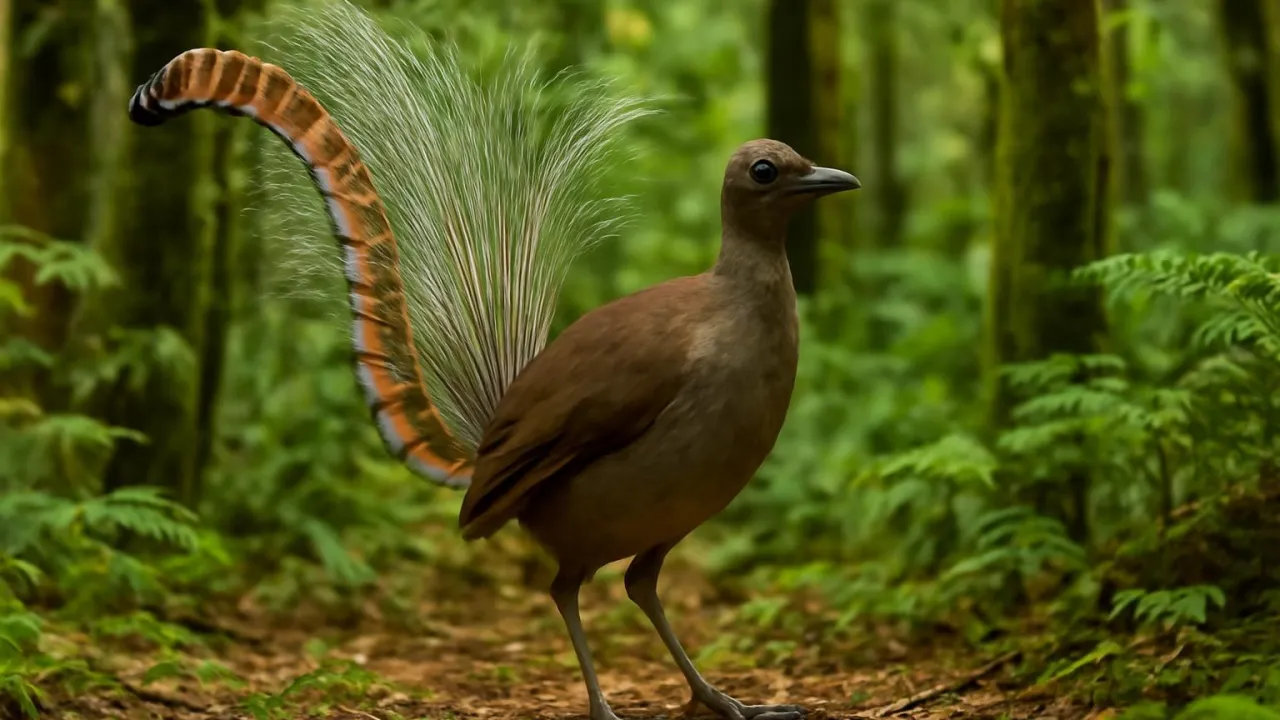
Superb lyrebirds can imitate over 20 different sounds in a single song!
✨ Word Sparks (Grade 2 Glossary)
Tap 🔊 to hear
mimic
To copy sounds or actions
feathers
Soft parts that cover a bird's body
forest
A place with many trees and animals
🪝
Have you heard a bird that sounds like a camera or a chainsaw?
1
Sound Imitator
The superb lyrebird can copy many sounds it hears in the . It other birds, animals, and even machines. This helps it attract mates and scare away rivals.
2
Dancing Tail
Its tail are shaped like a lyre, a musical instrument. When it dances, the bird spreads its tail wide and shakes it to show off. This dance helps the lyrebird find a partner.
3
Forest Home
The lyrebird lives mostly in dense of southeastern Australia. It spends much time on the ground searching for insects and spiders to eat. The forest provides shelter and food.
A superb lyrebird’s song can include over 20 different sounds in just one performance!
✨ Word Sparks (Grade 3 Glossary)
Tap 🔊 to hear
mimicry
Copying sounds or actions to survive
camouflage
Blending in to hide from others
invertebrates
Animals without backbones like insects
🪝
How does a superb lyrebird use its tail to survive and attract mates?
1
Master of Mimicry
The superb lyrebird is famous for its ability to mimic many sounds in its environment. This includes other birds’ calls, camera clicks, and even chainsaws. Such adaptation helps it confuse predators and impress mates during courtship. Its vocal skills are a key survival trait.
2
Tail Feathers and Display
Its tail feathers are shaped like a lyre, which is a stringed musical instrument. When the male lyrebird performs, it fans its tail wide and shakes it to create a visual display. This display works together with its song to attract females. The tail also helps with in leaf litter.
3
Forest Habitat
Superb lyrebirds live in dense eucalyptus forests of southeastern Australia. They spend much time on the forest floor searching for insects, spiders, and other small . The forest provides nutrients and shelter, supporting their complex behaviors. Their presence is important for the ecosystem’s balance.
4
Life Cycle and Behavior
Lyrebirds build nests on the ground using sticks and leaves. Females lay eggs and raise chicks alone while males focus on singing and dancing. Juveniles learn by listening to adults over many months. This learning is essential for their future survival and mating success.
Superb lyrebirds can imitate human noises so well that people often mistake them for real machines or other birds!
✨ Word Sparks (Grade 4 Glossary)
Tap 🔊 to hear
adaptation
A change that helps survival
symbiotic
A helpful relationship between living things
deforestation
Cutting down many trees
🪝
Why is the superb lyrebird’s mimicry important for its role in the forest ecosystem?
1
Complex Vocal Mimicry
The superb lyrebird’s ability to mimic sounds is a remarkable that helps it communicate within its dense forest habitat. By copying other birds and even human-made noises, it can confuse predators and competitors, which increases its chances of survival. This vocal skill also plays a critical role in mating rituals, where males perform elaborate songs and dances to attract females.
2
Ecological Role and Food Web
As a ground-dwelling bird, the lyrebird helps control insect populations by feeding on insects and spiders. This predation supports the forest’s health by keeping pest numbers balanced. Additionally, by disturbing leaf litter while foraging, lyrebirds help recycle nutrients, which benefits plant growth and other forest animals, creating a relationship.
3
Geographic Distribution and Habitat
Superb lyrebirds are native to southeastern Australia, primarily inhabiting moist eucalyptus forests. These forests provide dense cover and abundant food sources necessary for their survival. Human activities like logging and land clearing threaten their habitat, which impacts their population and the forest ecosystem’s stability.
4
Conservation and Human Impact
Efforts to protect superb lyrebird habitats include establishing national parks and reserves that limit . Education about their ecological importance helps reduce human disturbances. Conservation programs also monitor populations to ensure these birds continue to thrive in their natural environment despite ongoing habitat changes.
The superb lyrebird’s syrinx and brain allow it to mimic over 20 sounds with perfect clarity in one song!
✨ Word Sparks (Grade 5 Glossary)
Tap 🔊 to hear
syrinx
The bird’s voice box for making sounds
endemic
Found only in one special place
nutrient cycling
Nature’s way of recycling food and minerals
🪝
What biological features enable the superb lyrebird to mimic over twenty distinct sounds flawlessly?
1
Taxonomy and Scientific Classification
The superb lyrebird, scientifically named Menura novaehollandiae, belongs to the family Menuridae. It is one of two lyrebird species to Australia, classified under the order Passeriformes. This classification highlights its evolutionary adaptations for complex vocalizations and ground-dwelling behavior. Understanding its taxonomy helps scientists study its ecological niche and evolutionary history.
2
Physiological Mechanics of Vocal Mimicry
The lyrebird’s , a specialized vocal organ, allows it to produce a wide range of sounds with remarkable clarity and volume. Its brain has advanced auditory and vocal control regions that enable precise sound replication. This physiological specialization supports their ability to mimic natural and artificial sounds, which is rare among birds. The superb lyrebird’s vocal learning is considered one of the most complex among avian species.
3
Conservation Status and Historical Context
Although not currently endangered, superb lyrebird populations face threats from habitat loss due to logging and urban development. Conservation efforts include habitat protection through national parks and public education about their ecological importance. Historically, lyrebirds were first described by European naturalists in the 19th century, sparking scientific interest in their unique behaviors.
4
Ecological Impact and Symbiotic Relationships
By feeding on insects and disturbing leaf litter, superb lyrebirds contribute to and pest control within their forest ecosystems. Their foraging behavior benefits plant growth and supports other animals indirectly. Additionally, their vocal mimicry may influence the behavior of other species, creating complex interspecies communication networks in their habitat.
5
Quantitative Comparisons and Unique Traits
Superb lyrebirds can mimic over twenty different sounds in a single song lasting up to five minutes. They measure up to 94 centimeters tall and weigh about 1.2 kilograms. Their tail feathers, which resemble a lyre, span nearly 50 centimeters when fully fanned. These impressive physical and behavioral traits make them one of the most extraordinary songbirds worldwide.