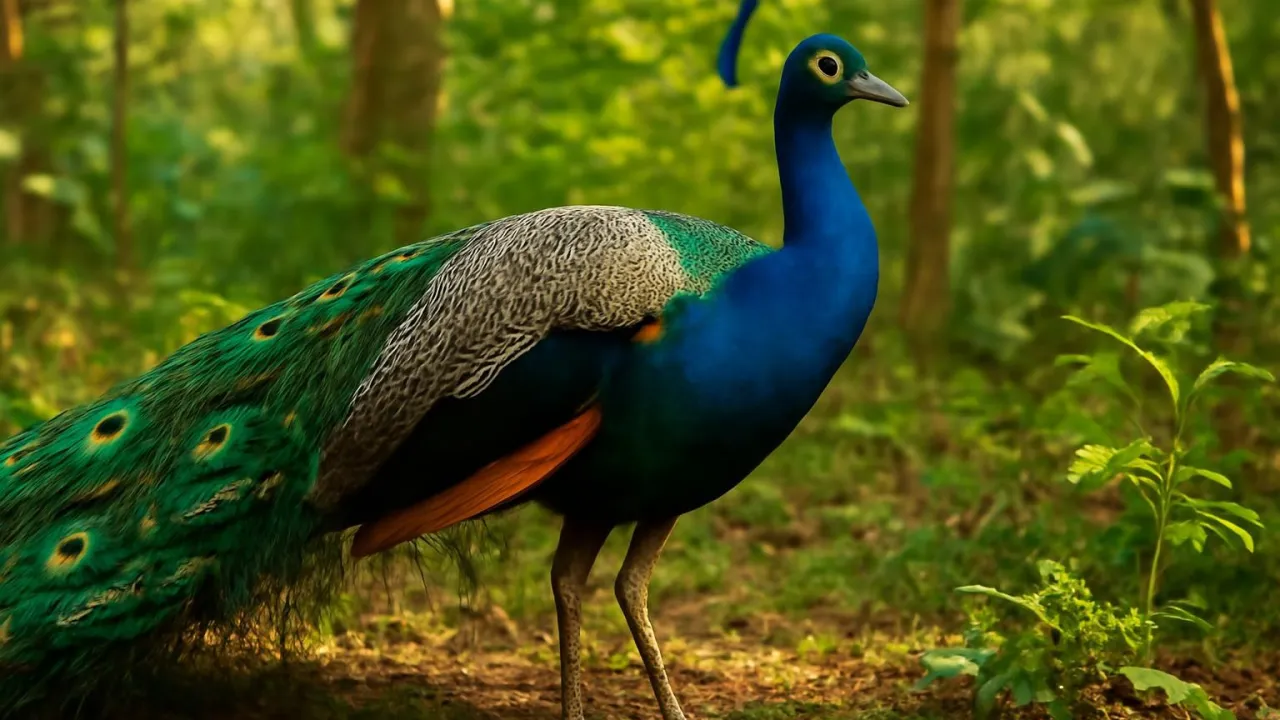
A peacock’s tail can have over 200 eye spots that shine in the sunlight.
✨ Word Sparks (Grade 2 Glossary)
Tap 🔊 to hear
habitat
The place where animals live and grow
peachick
A baby peafowl bird
feathers
Soft parts that cover a bird’s body
🪝
Did you know the peacock’s tail can spread wide like a big fan?
1
Where Peafowls Live
Indian peafowls live in forests and near farms. They like warm places with trees and grass. They often stay on the ground to find food. They also roost in trees at night for safety.
2
How They Grow
Baby peafowls are called . They grow slowly and learn to walk fast. Adult males have bright blue feathers and big tails. Females have duller colors to help them hide.
3
Amazing Tail Feathers
The male peacock’s tail has many eye-like spots. It spreads the tail wide to attract mates. The tail is very colorful and shiny. It can be longer than the bird’s body length.
The peacock’s tail can contain more than 200 eye spots called ocelli that reflect light brilliantly.
✨ Word Sparks (Grade 3 Glossary)
Tap 🔊 to hear
camouflage
Colors or patterns that help hide animals
ocelli
Eye-shaped spots on peacock feathers
omnivore
An animal that eats plants and animals
🪝
Have you ever wondered why the peacock’s tail is so colorful and big?
1
Habitat and Behavior
Indian peafowls live in forests and open farmlands across South Asia. They spend much time on the ground searching for food. Their habitat provides shelter and water sources needed for survival. These birds are active during the day and roost in trees at night.
2
Life Cycle and Growth
Peafowls hatch from eggs laid in shallow ground nests hidden in grass. The young birds, called peachicks, rely on their mother for food and protection. As they grow, their feathers develop colors and patterns that help with . Males develop the large tail feathers used in courtship displays.
3
Tail Feathers and Adaptation
The male peacock’s tail feathers have eye-shaped patterns called that dazzle females. This colorful display is an adaptation for attracting mates. The feathers also help the bird appear larger to predators. This form of and display balances survival and reproduction.
4
Diet and Survival
Indian peafowls are that eat seeds, insects, and small animals. Their diet provides nutrients needed for energy and feather growth. They forage mostly on the ground but can fly short distances to escape danger. Their strong legs help them run quickly when threatened.
1. What is the name for the eye-shaped spots on peacock feathers?
2. Why do male peacocks have big colorful tails?
🤯 Mind-Blowing Fact • Grade 4
Despite its bright tail, the peacock can fly short distances to escape predators quickly when needed.
✨ Word Sparks (Grade 4 Glossary)
Tap 🔊 to hear
ecosystem
A community of living things and their environment
reproduction
Making babies to keep a species alive
conservation
Protecting animals and plants from harm
🪝
How does the Indian peafowl’s colorful tail affect its role in the ecosystem?
1
Habitat and Geographic Range
Indian peafowls inhabit forests, farmlands, and grasslands mainly in South Asia, including India and Sri Lanka. Their ability to adapt to different environments allows them to thrive near human settlements. Seasonal changes influence their feeding and breeding behaviors within these regions, shaping their survival strategies.
2
Tail Display and Mating Success
The male’s extravagant tail display plays a crucial role in attracting females for mating, increasing reproductive success. This display also signals health and genetic quality to potential mates. However, the large tail can make the bird more visible to predators, creating a trade-off between survival and .
3
Ecosystem Role and Food Web
Indian peafowls contribute to their by controlling insect populations and dispersing seeds through their diet. They serve as prey for larger predators such as leopards and large birds of prey. Their presence supports biodiversity and helps maintain balanced food webs in their habitats.
4
Human Impact and Conservation
Though common in many areas, habitat loss and hunting have reduced peafowl populations in some regions. efforts include habitat protection and legal safeguards. In India, the peafowl is the national bird and enjoys cultural significance, promoting its protection and awareness among people.
1. Why does the peacock’s tail display help with reproduction?
2. What role do peafowls play in their ecosystem?
🤯 Mind-Blowing Fact • Grade 5
A peacock’s tail can reach up to 5 feet long and contains microscopic structures that create shimmering colors.
✨ Word Sparks (Grade 5 Glossary)
Tap 🔊 to hear
sexual selection
Choosing mates by showing special traits
iridescence
Colors that change when light shines on them
habitat fragmentation
Breaking wildlife homes into smaller parts
🪝
What makes the Indian peafowl’s tail an extraordinary example of sexual selection in birds?
1
Taxonomy and Scientific Context
The Indian peafowl, scientifically named Pavo cristatus, belongs to the Phasianidae family, which includes pheasants and junglefowl. This species is native to the Indian subcontinent and has been introduced to other parts of the world. It is the national bird of India and is culturally significant across many regions.
2
Physiological Mechanics of the Tail Display
The male peacock’s tail, or train, consists of elongated upper tail coverts featuring iridescent ocelli. These feathers can be fanned out using specialized muscles to create a large, eye-catching display. The results from microscopic structures that reflect light, producing vivid colors without pigments.
3
Conservation and Historical Significance
Though widespread, Indian peafowl populations face threats from and hunting in some areas. Conservation programs focus on habitat preservation and legal protection. Historically, peafowls have been depicted in art and mythology, symbolizing beauty and pride for thousands of years.
4
Ecological Role and Quantitative Comparisons
Indian peafowls contribute to their ecosystems by controlling insect populations and aiding seed dispersal. They typically weigh between 8 to 13 pounds (3.5 to 6 kilograms) and stand about 3.3 to 4.9 feet (1 to 1.5 meters) tall. Their tail feathers can reach lengths up to 5 feet (1.5 meters), nearly matching their body length.
5
Behavioral Adaptations and Survival Strategies
Peafowls use their loud calls to communicate and warn of predators, which can reach up to 100 decibels. Their strong legs enable rapid running speeds of up to 10 miles per hour (16 kilometers per hour). Despite the tail’s size, peacocks can fly short distances to escape threats, balancing display and survival.