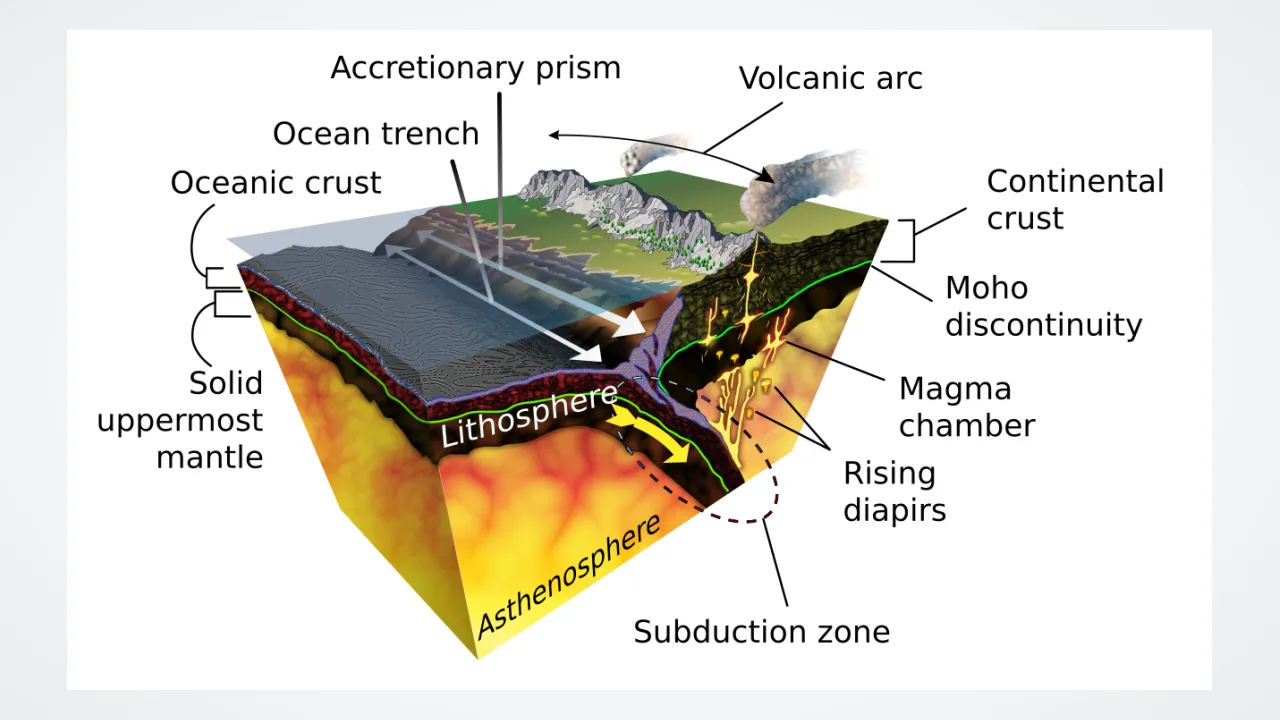
🌋 Where It FormsOcean Trenches Down to 660+ km Into Earth's Mantle
💎 Key PropertiesDense Basaltic Slab Sinking at 2–10 cm Per Year
⚡ Planet Earth SparkRecycles old ocean floor while building Earth's deepest trenches and tallest volcanic arcs
🤯 Mind-Blowing Fact • Grade 1
Planet Earth recycles its old ocean floor underground, just like a giant slow-motion conveyor belt!
✨ Word Sparks (Grade 1 Glossary)
Tap 🔊 to hear
recycle
To break down old material and reuse it.
trench
A very deep, narrow ditch under the ocean.
crust
The hard outer layer of rock on Earth.
🪝
Where does old ocean floor go when new rock pushes it aside?
1
Diving Under the Edge
Slide a flat sheet of paper under a thick book. Deep under the sea, Earth's rocky floor does the very same trick! Heavy ocean rock dives under lighter land rock.
2
Deep Ditches in the Sea
Right where the floor bends down, a deep ditch forms in the ocean. Fish that glow in the dark swim in that super deep !
3
Recycling Old Rock
Way down deep, hot Earth melts part of the rock. Steam and lava rise up to build tall volcanoes on land!
1. What happens when heavy ocean rock meets lighter land rock?
2. What forms on the ocean floor right where the diving rock bends downward?
🤯 Mind-Blowing Fact • Grade 2
Because subduction recycles ocean plates so steadily, almost no seafloor anywhere on Earth is older than 200 million years!
✨ Word Sparks (Grade 2 Glossary)
Tap 🔊 to hear
collide
To bump or crash straight into something else.
dense
Packed tightly together and heavy for its size.
mantle
The thick, hot rocky layer beneath Earth's crust.
🪝
If new seafloor is made every day, why isn't Planet Earth growing bigger like a balloon?
1
Earth's Rock Recycler
Imagine two giant conveyor belts meeting head-on, and one belt tucks neatly underneath the other. Earth stays the exact same size because old ocean floor dives back inside the planet at places called subduction zones!
2
Heavy Meets Light
Ocean plates are packed tight and heavy, while continent plates are thicker and lighter. When they , the heavier ocean plate bends downward and sinks slowly into the hot layer below.
3
Trenches, Quakes, and Cones
This slow dive creates three big wonders at once. First, it carves a deep underwater trench. Second, scraping rocks trigger big earthquakes. Third, rising melted rock builds a line of steaming volcanoes!
1. Why doesn't Earth get bigger even though new seafloor forms all the time?
2. Which plate sinks when an ocean plate and a continent plate collide?
🤯 Mind-Blowing Fact • Grade 3
Scientists using earthquake waves like X-rays have spotted ancient sunken ocean plates resting more than 600 kilometers deep inside Earth's mantle!
✨ Word Sparks (Grade 3 Glossary)
Tap 🔊 to hear
convergent
Moving toward each other and colliding head-on.
buoyant
Light enough to float above denser material below.
tsunami
Huge ocean waves triggered by underwater earthquakes.
🪝
How can a cold slab of ocean floor sink hundreds of kilometers underground and spark fiery volcanoes?
1
Clash at a Convergent Boundary
Deep beneath crashing Pacific waves, two massive tectonic plates press slowly together at a boundary. Neither plate stops moving. Instead, the colder, denser oceanic plate bends downward and plunges into Earth's hot mantle, creating a powerful subduction zone.
2
Carving Abyssal Trenches
Right where the sinking slab flexes downward, the seafloor drops into a shadowy V-shaped canyon called an ocean trench. Off Guam, the Mariana Trench plunges nearly 11,000 meters—the deepest spot in any ocean!
3
Water Unlocks Magma
As the wet oceanic crust sinks deeper, squeezing pressure forces trapped seawater out of its minerals. Rising into the super-hot mantle above, that water helps solid rock melt into magma, which bubbles upward to build volcanic chains like the Andes Mountains.
4
Scraping Rocks and Giant Waves
Sinking slabs do not glide smoothly. Rough plates lock together for years before snapping free in strong earthquakes that can lift seawater into ocean-crossing .
1. What type of plate boundary creates a subduction zone?
2. Which South American mountain range rose above an active subduction zone?
🤯 Mind-Blowing Fact • Grade 4
The gravitational tug of heavy sinking slabs—called 'slab pull'—is actually the main engine dragging Earth's giant tectonic plates across the globe!
✨ Word Sparks (Grade 4 Glossary)
Tap 🔊 to hear
slab pull
Gravity pulling a dense sinking plate into mantle.
basalt
Dark, dense volcanic rock forming the ocean floor.
accretionary wedge
Seafloor sediment scraped up along a trench edge.
🪝
Why is the oldest ocean floor on Earth less than 200 million years old while continents hold rocks 4 billion years old?
1
Solving the Missing-Crust Mystery
When oceanographers first dated rocks drilled from the deep seafloor, they uncovered a startling puzzle: while continental interiors preserve granite nearly four billion years old, almost all oceanic crust is younger than 200 million years! Subduction zones solve that mystery. Acting as planet-wide recycling chutes at convergent boundaries, they return aging oceanic crust into the mantle just as fast as mid-ocean ridges create new crust.
2
Density Rules the Dive
Density determines which plate goes under. Continental crust is composed mostly of light granitic rock, whereas oceanic crust consists of iron- and magnesium-rich that grows colder, thicker, and denser as it ages away from a ridge. Whether an oceanic plate meets a buoyant continent (like the Juan de Fuca Plate diving under Oregon and Washington to build the Cascades) or a younger, warmer oceanic plate (forming island arcs like Japan), the denser slab always subducts.
3
Accretionary Wedges and Flux Melting
As the descending slab slides downward, the overriding plate scrapes soft mud, sand, and seafloor fossils off its top like a snowplow, piling up a crumpled ridge called an . Deeper down—around 100 kilometers—heat drives water from the slab into the overlying mantle, triggering flux melting that feeds explosive volcanoes.
4
Slab Pull: Engine of Plate Tectonics
Geophysicists discovered that the heavy sinking slab doesn't just get pushed from behind—gravity tugs it downward like a wet tablecloth sliding off a table! This force, called , is the strongest driver of plate motion on Earth.
1. What happens when two oceanic plates collide at a convergent boundary?
2. What force do scientists consider the strongest driver moving tectonic plates across Earth?
🤯 Mind-Blowing Fact • Grade 5
Deep inside a subduction zone, crushing pressure squeezes ordinary dark ocean basalt into eclogite—a super-heavy rock sparkling with red garnets and bright green minerals!
✨ Word Sparks (Grade 5 Glossary)
Tap 🔊 to hear
Wadati-Benioff zone
Slanted band of earthquakes tracing a sinking plate.
eclogite
Ultra-dense garnet rock formed from squeezed ocean crust.
megathrust
Giant locked fault interface inside a subduction zone.
🪝
How did tracking progressively deeper earthquakes beneath Japan prove that whole slabs of seafloor plunge 660 kilometers into Earth?
1
Discovering Wadati-Benioff Zones
In the early twentieth century, Japanese seismologist Kiyoo Wadati and American geophysicist Hugo Benioff mapped earthquake depths near ocean trenches and noticed an unmistakable diagonal pattern. Shallow tremors clustered right beside the trench, intermediate quakes occurred farther inland, and deep-focus earthquakes—down to 660 kilometers—struck directly beneath volcanic chains and back-arc seas. Known today as , these slanted seismic planes provided smoking-gun proof that rigid lithospheric plates plunge deep into Earth's mantle at subduction zones.
2
Metamorphism and the Eclogite Engine
Subduction begins when aging oceanic lithosphere cools and thickens until its overall density exceeds that of the underlying asthenosphere. As the basaltic crust descends past 40 to 60 kilometers depth, crushing pressures rearrange its minerals into —a dazzling red-and-green rock packed with garnet and pyroxene that is significantly denser than surrounding mantle peridotite. This mineral transformation amplifies negative buoyancy, generating powerful 'slab pull' forces that propel global plate tectonics at 2 to 10 centimeters per year.
3
Volatile Cycling and Continental Growth
Subduction zones also operate as Earth's master chemical factory. Hydrous minerals like serpentine and chlorite carry seawater and carbonate sediments downward; between 80 and 150 kilometers depth, dehydration reactions release superheated fluids into the mantle wedge. Resulting flux melting produces silica-rich, calc-alkaline magmas that cool into granitic batholiths or erupt through stratovolcanoes, steadily manufacturing new continental crust over billions of years.
4
Megathrusts and Cascadia
Near the surface, friction locks the plate interface along a shallowly dipping fault called a . In North America's Cascadia Subduction Zone—stretching 1,000 kilometers from Northern California to Vancouver Island—the Juan de Fuca Plate has been locked beneath North America since January 1700, accumulating strain monitored closely by coastal GPS stations.
5
Planetary Habitability
Without subduction recycling carbon, water, and nutrients between surface oceans and the deep interior, Earth's long-term climate thermostat could stall—making subduction zones one of the hidden keys to a habitable planet.