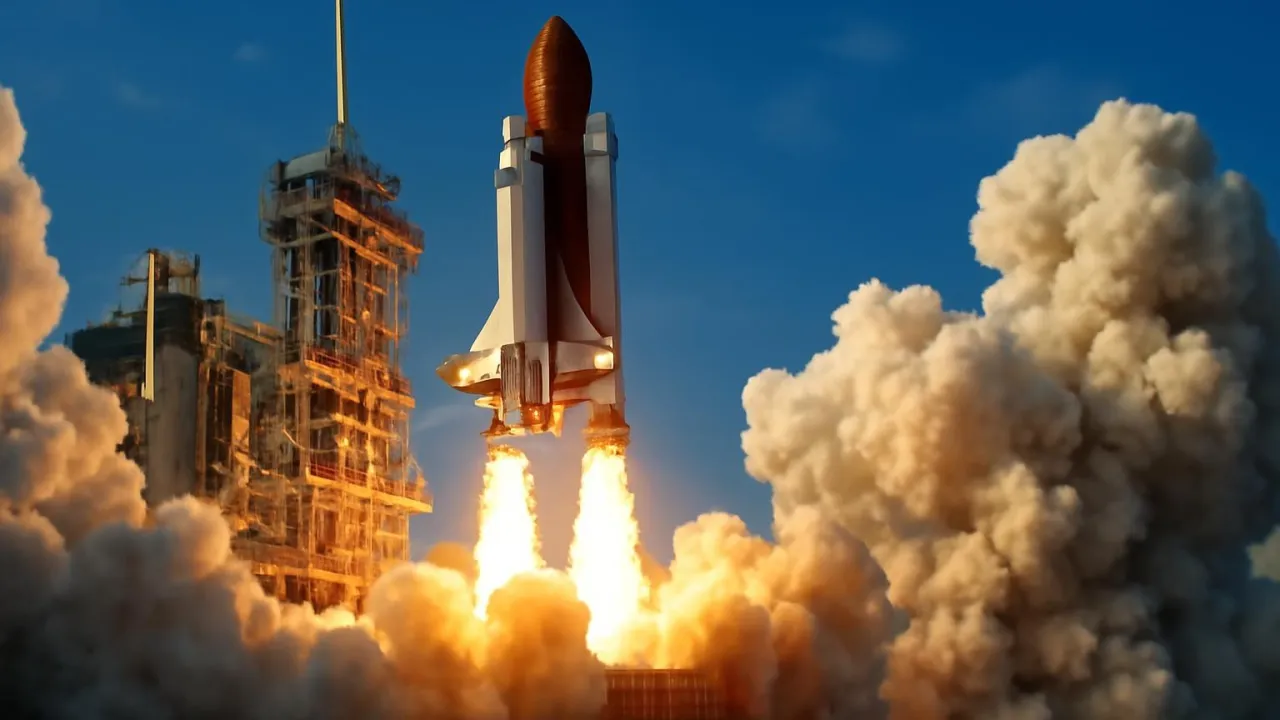
The space shuttle was the first spacecraft that could be used again and again!
✨ Word Sparks (Grade 2 Glossary)
Tap 🔊 to hear
fuel
Something burned to make energy
mission
A special job or trip
zero gravity
Floating with no weight
🪝
What would it feel like to ride a rocket into space?
1
Riding the Rocket
The space shuttle blasts off with a huge rumble and bright flames. Astronauts sit tight as the shuttle zooms into the sky. The engines burn strong to push it up. Soon, the shuttle reaches space and floats above Earth.
2
A Flying Space Plane
The shuttle has big wings and a pointed nose, so it can glide back to land. After the , it returns to Earth, gliding down like an airplane. People watch and cheer as it lands safely. The shuttle can be used again for more trips.
3
Bringing Back Space Treasures
Inside, astronauts work, eat, and sleep in . They fix satellites and do science experiments in space. The shuttle brings back rocks, tools, and even pieces of space stations. It helps us learn more about our universe.
Each shuttle had over 24,000 special tiles to protect it from burning up!
✨ Word Sparks (Grade 3 Glossary)
Tap 🔊 to hear
vibration
A fast shaking motion
cargo bay
Big space for carrying things
reusable
Can be used many times
🪝
Imagine watching a giant rocket with wings soar into the sky—how does it come back?
1
A Rocket and a Plane
The space shuttle launches with thunderous as its rocket engines ignite. Astronauts feel powerful acceleration as they ride into orbit around Earth. Unlike earlier rockets, the shuttle has large wings and looks a bit like an airplane. After its mission, it returns by gliding through the atmosphere to land on a runway.
2
How It Works
The shuttle uses solid rocket boosters and a main engine to blast off. Once in space, it releases satellites or carries astronauts to space stations. Its can hold large objects, like telescopes or scientific equipment. When finished, the shuttle re-enters Earth's atmosphere using heat-resistant tiles to survive the intense heat.
3
Life in Orbit
Inside, astronauts float in zero gravity and perform experiments. They study how plants grow or how fluids move in space. The shuttle's cabin has air, food, and special sleeping bags for the crew. Sometimes, astronauts repair satellites or build parts of the International Space Station.
4
Changing Space Travel
Before the shuttle, rockets could only be used once and fell back to Earth. The shuttle was , making space travel less expensive and more frequent. It helped launch the Hubble Space Telescope and build the space station. The shuttle inspired new ideas for future spacecraft.
1. What protects the shuttle from heat during re-entry?
2. What is one job astronauts do on the shuttle?
🤯 Mind-Blowing Fact • Grade 4
The shuttle orbiter could circle the entire Earth in just 90 minutes!
✨ Word Sparks (Grade 4 Glossary)
Tap 🔊 to hear
orbiter
Part that flies in space and returns
aerodynamic
Shaped to move easily through air
microgravity
Very weak gravity, almost floating
🪝
What if you could ride a machine that blasts off like a rocket but lands like a plane?
1
A New Kind of Spacecraft
When the space shuttle launched, it created a thunderous vibration that could be felt for miles around. Its design was unique, combining rocket boosters, a fuel tank, and an with wings. The shuttle’s main engines and solid rocket boosters worked together to lift it into orbit. Once in space, the orbiter separated and circled the Earth at speeds over 17,000 miles per hour.
2
Engineering Marvels
The shuttle’s heat-resistant tiles, covering its belly and nose, protected it from temperatures hotter than molten lava during re-entry. Its cargo bay could carry satellites, telescopes, or even parts for the International Space Station. After completing its mission, the shuttle glided through the atmosphere, using its shape and wings to land on a runway. This reusability set it apart from earlier spacecraft, which could only be used once.
3
Life and Work in Orbit
Astronauts aboard the shuttle performed experiments in , from growing crystals to studying fluid behavior. They also repaired satellites, such as the famous Hubble Space Telescope, and helped build the space station. The shuttle’s cabin supported up to seven crew members with air, food, and special sleeping quarters. Missions could last from a few days to over two weeks, depending on the job.
4
A Legacy of Discovery
From 1981 to 2011, five shuttles completed 135 missions, changing how we explore space. The shuttle program made launching satellites and building space stations faster and more affordable. It inspired new spacecraft designs and international teamwork in space science. Even after its retirement, the shuttle’s impact continues to shape our journey beyond Earth.
The shuttle’s main engines could empty a 500,000-gallon fuel tank in just 8.5 minutes!
✨ Word Sparks (Grade 5 Glossary)
Tap 🔊 to hear
thermal protection
Special shields that block extreme heat
delta-shaped wings
Wings shaped like a triangle for gliding
payload
The cargo or equipment carried by a spacecraft
🪝
What engineering breakthroughs allowed a spacecraft to launch vertically and land like an airplane?
1
A Bold Step in Aerospace Innovation
When the space shuttle’s engines ignited, the ground trembled and a cloud of steam and smoke billowed skyward. Unlike earlier expendable rockets, the shuttle was designed as a partially reusable spacecraft, combining solid rocket boosters, an external fuel tank, and an orbiter with . Its maiden flight in 1981 marked the first time humans launched into orbit in a vehicle that could return and fly again. This engineering leap made regular access to space possible for scientists, engineers, and astronauts.
2
Engineering and Physics at Work
The shuttle’s launch relied on the combined thrust of two solid rocket boosters and three liquid-fueled main engines, generating over 7 million pounds of force. Once the boosters separated, the orbiter and fuel tank continued into orbit, where the orbiter’s maneuvering engines allowed precise positioning. For re-entry, the shuttle used thousands of silica-based tiles to withstand temperatures exceeding 1,600 degrees Celsius caused by atmospheric friction. Its aerodynamic design enabled controlled gliding and safe runway landings at speeds over 200 miles per hour.
3
Life, Science, and Repairs in Microgravity
Inside the shuttle, up to seven astronauts conducted experiments in biology, physics, and material science under microgravity conditions. The shuttle’s spacious pressurized cabin and large cargo bay enabled the deployment and repair of satellites, including the Hubble Space Telescope. Astronauts used robotic arms to capture, fix, or release , demonstrating advanced engineering and problem-solving skills. These missions provided crucial knowledge for building and maintaining the International Space Station.
4
A Lasting Legacy in Exploration
Over thirty years, the shuttle fleet—Columbia, Challenger, Discovery, Atlantis, and Endeavour—completed 135 missions, fundamentally transforming human spaceflight. The shuttle made it possible to launch, retrieve, and repair satellites, assemble space stations, and foster international collaboration in space. Its reusable design reduced costs and increased mission frequency, although each orbiter required extensive refurbishment between flights. The shuttle’s successes and challenges continue to inform the design of next-generation spacecraft.
5
Inspiring the Future of Space Travel
After its retirement in 2011, the shuttle’s influence remains visible in modern space vehicles, such as SpaceX’s Dragon and NASA’s Orion. Its blend of rocket propulsion, aerodynamic flight, and reusable systems set new standards for engineering and scientific achievement. The shuttle’s missions inspired a new generation of scientists, engineers, and explorers around the world. Its story reminds us that bold ideas and teamwork can turn science fiction into reality, opening new frontiers for humanity.