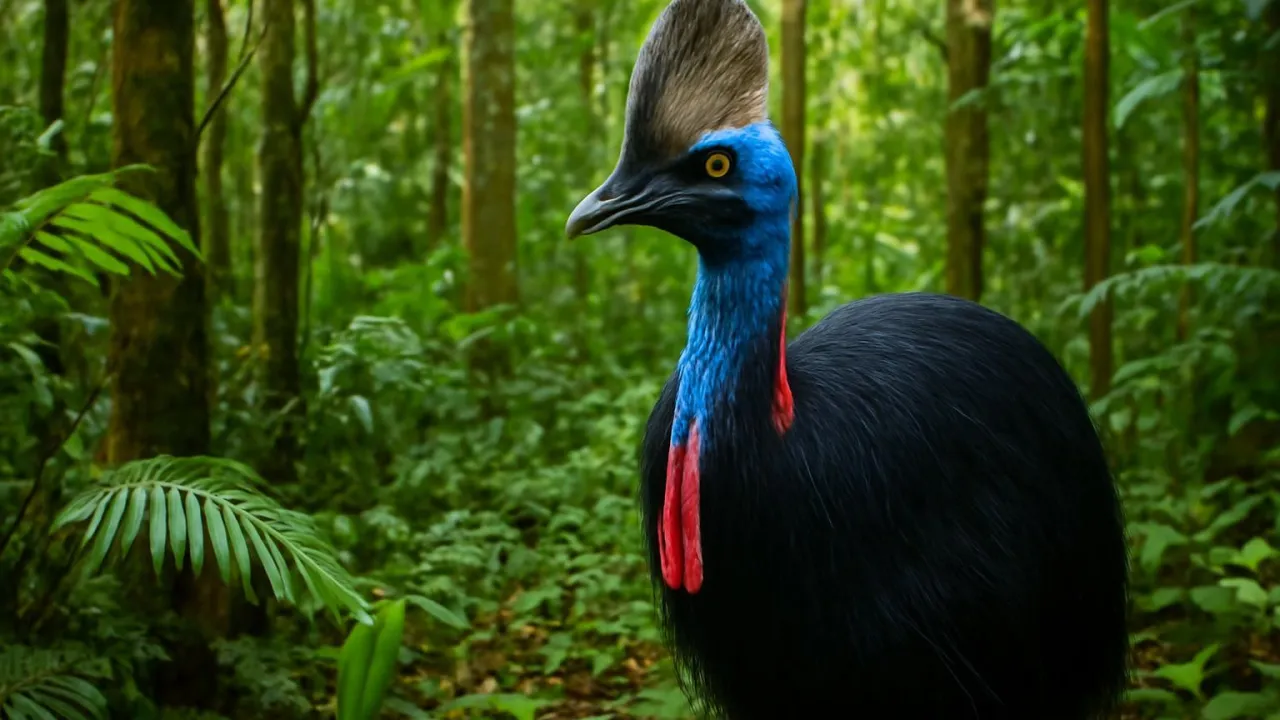
Southern cassowaries can run up to 30 miles per hour to escape danger!
✨ Word Sparks (Grade 2 Glossary)
Tap 🔊 to hear
rainforest
A warm forest with many trees and rain
predator
An animal that hunts other animals
feathers
Soft covers that help birds fly and keep warm
🪝
Have you ever seen a bird with a helmet and bright blue skin?
1
A Bird with a Helmet
The southern cassowary has a hard helmet on its head that helps it push through thick plants. It has bright blue skin on its neck and head that shines in the sunlight. Its body is covered with black that look soft but are very strong.
2
Living in the Rainforest
This bird lives in the tropical of New Guinea and Australia where it finds many fruits to eat. It walks on strong legs and can run very fast to escape danger. The cassowary also uses its sharp claws to protect itself from .
3
Growing Up Strong
Baby cassowaries look different from adults because they have brown with stripes. As they grow, their feathers turn black and their skin becomes bright blue. This helps them blend into the dark forest and stay safe from enemies.
The southern cassowary’s casque is made of keratin, the same material as human hair and nails!
✨ Word Sparks (Grade 3 Glossary)
Tap 🔊 to hear
camouflage
Colors that help animals hide in nature
pollination
Helping plants make seeds by spreading pollen
adaptation
A body change that helps survival
🪝
Did you know the southern cassowary uses a helmet to move through thick forest plants?
1
Helmet and Camouflage
The cassowary wears a hard casque, or helmet, that helps it push through dense forest undergrowth. Its bright blue skin and black feathers provide in shady rainforest areas. This helps the bird avoid predators and move quickly.
2
Diet and Role in the Forest
Southern cassowaries eat mostly fruit, but they also eat small animals and insects for nutrients. They help spread seeds by eating fruit and passing seeds in their droppings, which helps new plants grow. This makes them important for rainforest and plant growth.
3
Life Cycle and Growth
Young cassowaries have striped brown feathers that help with while they grow. As they mature, their feathers turn black and their skin becomes bright blue and red. This change helps adult birds blend into the dark forest and signals maturity to others.
4
Powerful Defense
Cassowaries have strong legs with sharp claws that can deliver powerful kicks to predators. This defense helps them survive in a forest filled with threats. Their speed and strength are vital for their survival and protection.
Southern cassowaries can disperse seeds of more than 100 rainforest plant species, shaping their forest home!
✨ Word Sparks (Grade 4 Glossary)
Tap 🔊 to hear
ecosystem
All living things and their home together
deforestation
Cutting down many trees in forests
disperse
To spread seeds or animals far away
🪝
How does a giant bird with a helmet shape the rainforest where it lives?
1
Helmet and Movement
The southern cassowary’s large casque, or helmet, is a unique adaptation that allows it to move easily through dense rainforest vegetation by pushing aside thick plants. This feature reduces resistance and helps the bird travel quickly to find food and escape predators. Its helmet also protects the bird’s head from branches and thorns while it moves through the forest.
2
Ecosystem Role and Seed Dispersal
Cassowaries play a vital role in their by eating a wide variety of fruits and dispersing seeds through their droppings. This seed dispersal supports forest regeneration and biodiversity, making cassowaries essential for maintaining healthy tropical rainforests. Many plant species depend on cassowaries to spread their seeds far from the parent tree, which helps the forest grow stronger.
3
Geographic Distribution and Habitat
These birds are native to the tropical rainforests of northeastern Australia and New Guinea, where humid and warm climates provide ideal conditions. Human activities like and road building threaten their habitat, affecting their population and the balance of the . Conservation efforts are important to protect both the cassowary and its rainforest home.
4
Defense Mechanisms and Survival
The cassowary’s powerful legs and sharp claws serve as strong defense mechanisms against predators. They can run up to 30 miles per hour and deliver deadly kicks, which help them survive in a competitive and dangerous environment. These adaptations make the cassowary one of the most formidable birds in the rainforest.
2. Why are cassowaries important to the rainforest?
🤯 Mind-Blowing Fact • Grade 5
Southern cassowaries disperse seeds from more than 100 plant species, supporting rainforest health and diversity!
✨ Word Sparks (Grade 5 Glossary)
Tap 🔊 to hear
keystone species
An animal that helps keep its home balanced
endozoochory
Seed spreading by animals eating and dropping seeds
keratin
Protein that makes hair, nails, and bird helmets
🪝
What makes the southern cassowary a keystone species in tropical rainforests?
1
Scientific Classification and Unique Features
The southern cassowary (Casuarius casuarius) belongs to the Casuariidae family and is one of the largest flightless birds in the world. Its distinctive casque is composed of , the same protein found in human hair and nails, which provides structural support and protection. This helmet-like casque grows continuously and can reach lengths up to seven inches.
2
Physiological Mechanics and Movement
This bird’s powerful legs enable it to sprint at speeds up to 30 miles per hour and deliver kicks with claws up to five inches long. These claws are sharp and curved, making them effective weapons against predators. The cassowary’s muscular legs also help it navigate dense rainforest terrain with remarkable agility and balance.
3
Ecological Role and Conservation Status
As a , the southern cassowary plays a critical role in seed dispersal for over 100 plant species, maintaining rainforest biodiversity and ecosystem health. However, habitat loss due to deforestation, vehicle collisions, and invasive species threaten their populations. Conservation programs in Australia and New Guinea focus on protecting cassowary habitats and reducing human-wildlife conflicts.
4
Botanical Interactions and Seed Dispersal
Cassowaries consume large fruits whole and disperse seeds through , a process where seeds pass intact through their digestive system. This mutualistic relationship supports the reproduction of many rainforest plants and maintains genetic diversity. Some seeds require passage through the cassowary’s gut to germinate successfully, highlighting the bird’s essential role in forest regeneration.
5
Quantitative Comparisons and Adaptations
Adult southern cassowaries can weigh up to 130 pounds (60 kilograms) and stand nearly six feet (1.8 meters) tall. Their casque can grow up to seven inches (18 centimeters) long, and their claws are among the sharpest in the animal kingdom. These features make the cassowary a formidable presence in its rainforest environment, combining size, strength, and specialized adaptations.