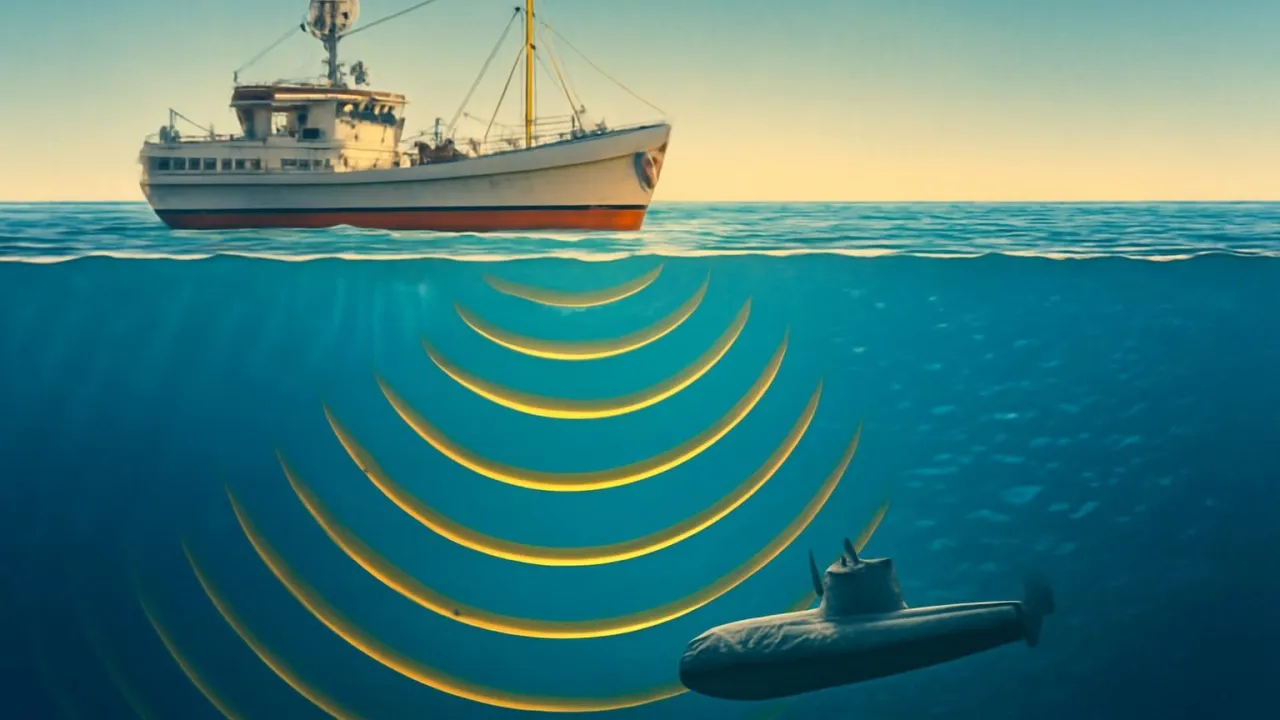
The word 'sonar' comes from combining 'sound' and 'navigation'!
✨ Word Sparks (Grade 2 Glossary)
Tap 🔊 to hear
echo
A sound that comes back
navigation
Finding your way somewhere
waves
Ripples that move through water or air
🪝
What if you could see with your ears under the sea?
1
Sound Waves Underwater
A ship sends a loud beep deep into the ocean. The sound bounces off fish or rocks, then returns as an . People listen to the echo to learn what is below.
2
Finding Hidden Things
Sonar helps people find submarines, schools of fish, or even shipwrecks. Fishermen use sonar to catch more fish, and scientists use it to study the sea. The tells them where things are hiding.
3
How Sonar Works
Sonar stands for Sound and Ranging. It uses sound instead of light, since light does not travel far in water. The helps make a picture of the underwater world.
Sound waves can travel over 1,500 meters per second in seawater—about five times faster than in air!
✨ Word Sparks (Grade 3 Glossary)
Tap 🔊 to hear
vibration
A fast, tiny back-and-forth movement
echo
A sound that bounces back to you
navigation
Finding your way using clues
🪝
Have you ever wondered how ships find hidden things deep underwater?
1
The Ocean’s Secret Messenger
Imagine standing on a ship and hearing a sharp ping across the waves. That sound is a sonar signal traveling through the water. The signal bounces off objects like fish, rocks, or submarines. When it returns, it creates an echo that tells us what is below.
2
How Sonar Sees with Sound
Sonar stands for Sound and Ranging, and it works by sending out called sound waves. These waves move quickly through water, much faster than they do in air. When the waves hit something, they bounce back, creating an . Special machines measure how long the echo takes to return.
3
Making Maps of the Deep
Sonar helps people make maps of the ocean floor and find hidden shipwrecks. Scientists use sonar to study underwater volcanoes and sea animals. Fishermen use it to locate schools of fish, making their work much easier and faster.
4
From War to Science
Sonar was first invented during World War I to detect enemy submarines. The first working sonar device was made by Paul Langevin and Constantin Chilowsky in France. Today, sonar is used for ocean research, , and even by some animals like dolphins and whales.
The deepest part of the ocean, the Mariana Trench, was mapped using sonar technology!
✨ Word Sparks (Grade 4 Glossary)
Tap 🔊 to hear
acoustic
Related to sound or hearing
pulse
A single quick movement or signal
echolocation
Finding things by listening for echoes
🪝
What if you could map the ocean floor without ever seeing it?
1
A Ping in the Deep
On a quiet ship, a sharp 'ping' is sent into the ocean, traveling swiftly through the water. This sound wave, or , spreads outward until it strikes something solid, like a submarine or the seafloor. The wave then bounces back as an echo, which is picked up by the sonar receiver. By measuring the time it takes for the echo to return, scientists can calculate how far away the object is.
2
How Sonar Reveals Hidden Worlds
Sonar stands for Sound Navigation and Ranging, and it uses principles to explore underwater environments. Since light cannot travel far through water, sonar relies on the speed and clarity of sound waves. These waves can reveal the shape, size, and even the texture of objects beneath the surface. Sonar images help create detailed maps of underwater landscapes.
3
From Submarines to Science
The first practical sonar system was developed by Paul Langevin and Constantin Chilowsky during World War I to detect enemy submarines. Over time, sonar technology became essential for naval navigation, fishing, and scientific research. Modern sonar systems use advanced electronics to detect shipwrecks, underwater volcanoes, and schools of fish with remarkable accuracy.
4
Sonar’s Global Impact
Sonar has changed how humans interact with the ocean, making underwater exploration much safer and more precise. It has helped scientists discover new marine species and map the deepest parts of the sea. Even some animals, like dolphins and whales, use natural sonar, called , to find food and navigate in dark waters.
1. Why is sonar better than light for underwater exploration?
2. What else uses echolocation like sonar?
🤯 Mind-Blowing Fact • Grade 5
Modern multibeam sonar systems can map over 10,000 square kilometers of seafloor in a single day!
✨ Word Sparks (Grade 5 Glossary)
Tap 🔊 to hear
transducer
A device that changes energy into sound
frequency
How fast a sound wave vibrates
biomimicry
Copying nature’s ideas for inventions
🪝
Imagine plunging a sound into the ocean and revealing a hidden world—how does sonar make this possible?
1
The Science of Sound Beneath the Waves
A sonar system begins with a , which emits a focused acoustic pulse, or 'ping,' into the water. This sound wave travels at approximately 1,500 meters per second in seawater—nearly five times faster than in air—due to water’s higher density and molecular structure. When the pulse encounters an object, such as a submarine, shipwreck, or the seafloor, it reflects back as an echo. The sonar receiver detects the echo, and by precisely measuring the time interval between the original ping and the returning echo, the system calculates the distance to the object using the formula: distance = (speed of sound in water × time) ÷ 2.
2
Engineering and Evolution of Sonar Technology
The concept of using sound to detect underwater objects was first realized during World War I by French physicist Paul Langevin and Russian engineer Constantin Chilowsky. Early sonar systems, called ASDIC by the British, used quartz crystals to generate and detect high- sound waves. Over the decades, sonar technology advanced with the development of side-scan and multibeam sonar, allowing for detailed three-dimensional mapping of vast ocean areas. Today, sophisticated digital signal processing enables sonar to distinguish between different types of fish, underwater terrain, and even detect tiny objects on the ocean floor.
3
Applications Across Science, Safety, and Exploration
Sonar is indispensable for naval navigation, submarine detection, and search-and-rescue operations. Marine biologists use sonar to track whale migrations, study fish populations, and monitor underwater habitats. Oceanographers rely on sonar to map the seafloor, revealing underwater volcanoes, canyons, and the dramatic topography of the Mariana Trench. Archaeologists use sonar to discover ancient shipwrecks and lost cities submerged beneath the sea.
4
Physics Principles: Reflection, Refraction, and Absorption
Sonar operates on fundamental physics principles, including reflection (echoes), refraction (bending of sound waves), and absorption (loss of sound energy). The clarity and range of sonar signals depend on water temperature, salinity, and pressure, which affect how sound waves travel. High- sonar provides sharp images but travels shorter distances, while low-frequency sonar can penetrate deeper but produces less detail. Engineers must carefully choose frequencies based on the mission’s needs.
5
Sonar’s Enduring Impact on Our World
Since its invention, sonar has revolutionized our understanding of Earth’s oceans, making previously invisible places accessible for study and exploration. Sonar technology continues to evolve, powering autonomous underwater vehicles and inspiring new discoveries in marine science. The principles behind sonar have even influenced medical imaging, such as ultrasound, and have inspired in robotics, based on how dolphins and bats use echolocation in nature.