🌌 COSMOS
🔭 Binary Star System (A0mA1Va + DA2) • Alpha Canis Majoris
VA Science SOL 1.6, 4.5, 4.6 (Solar System, Stars & Space Exploration)
Sirius (Dog Star)
Nighttime's Brightest Diamond and Its Heavy Pup
Grade 2 • Developing • 114 words
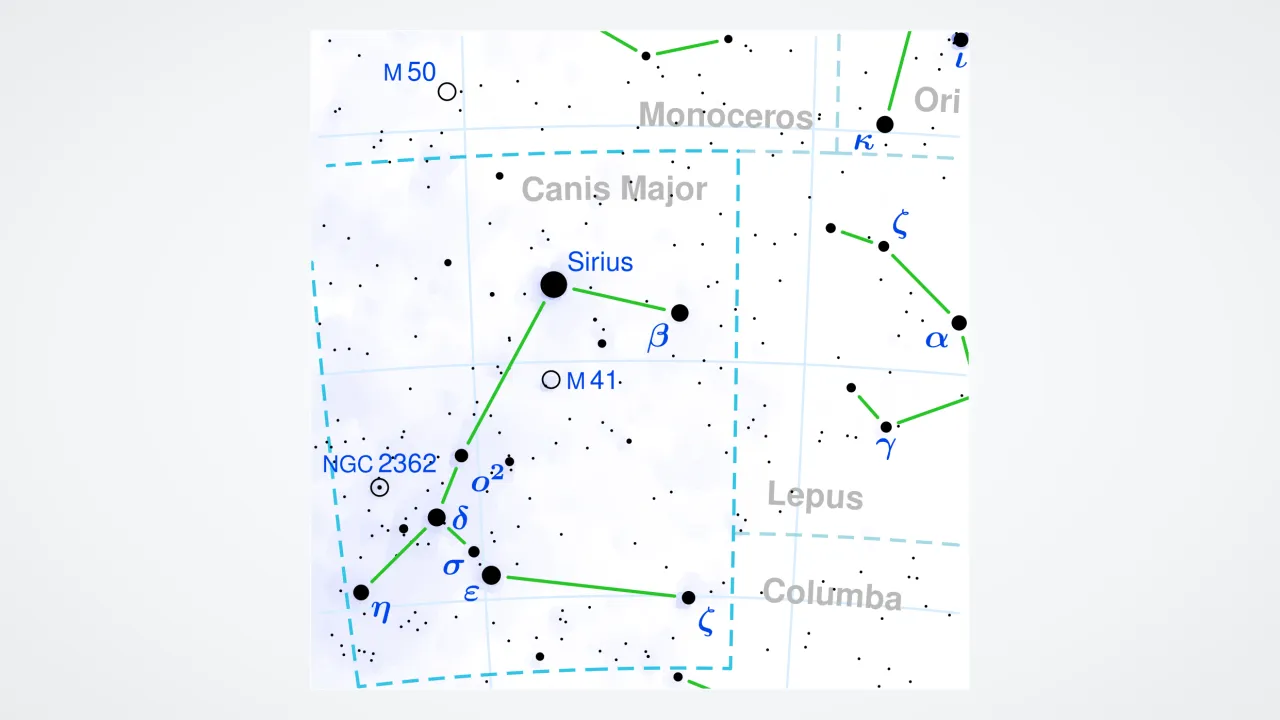
🌌 Cosmic Location & DistanceCanis Major Constellation • 8.6 light-years (50.5 trillion mi) from Earth
🪐 Scale / DiameterSirius A: 1.48M mi (2.4M km) wide • Sirius B: 7,500 mi (12,000 km) Earth-sized white dwarf
☄️ Composition & Orbit25× Sun-bright blue-white star + ultra-dense white dwarf • 50.1-year shared orbit
⚡ Cosmic SparkBrightest star in Earth's entire night sky, paired with a tiny companion as heavy as our Sun
🤯 Mind-Blowing Fact • Grade 1
People call hot July and August weather the 'dog days of summer' because ancient skywatchers noticed the Dog Star rising right alongside the morning Sun!
✨ Word Sparks (Grade 1 Glossary)
Tap 🔊 to hear
twinkle
To flash and shimmer in Earth's moving air
Dog Star
Fun nickname for bright Sirius in Big Dog
dazzling
Shining with super bright, sparkling light
🪝
Which sparkling star wins first prize as the brightest star in the whole night sky?
1
Champion of the Winter Sky
Bundle up on a crisp winter night and look south! Flashing low in the sky shines a blue-white jewel. No other nighttime star glows brighter than Sirius, the famous !
2
Twinkling Rainbow Colors
Moving air high above Earth bends its fierce starlight. That makes this bright star flash red, blue, and white like a disco ball!
3
Hiding a Tiny Pup
Right beside the giant star orbits a tiny partner nicknamed the Pup, only as wide as Earth!
1. What special title does Sirius hold in Earth's night sky?
2. What is the fun nickname of the tiny Earth-sized star orbiting Sirius?
🤯 Mind-Blowing Fact • Grade 2
A single teaspoon of material scooped from tiny companion star Sirius B would weigh as much as a full-grown African elephant on Earth!
✨ Word Sparks (Grade 2 Glossary)
Tap 🔊 to hear
white dwarf
Super-dense Earth-sized core of an old star
horizon
Line where Earth and sky seem to meet
Canis Major
Latin name meaning Great Dog star pattern
🪝
How did one sparkling star tell farmers in ancient Egypt when to plant their crops?
1
Collar of the Great Dog
Follow the three bright stars of Orion's Belt downward across the winter sky, and they point straight to the collar of , the Great Dog! Shining just 8.6 light-years from Earth, this blue-white beacon pumps out twenty-five times more light than our Sun.
2
Ancient Egypt's Calendar Star
Thousands of years ago, ancient Egyptians watched eagerly for this star—which they called Sopdet—to peek above the dawn each summer. Its morning return warned them that the Nile River was about to flood and bring rich soil for farming!
3
Heavyweight Little Pup
Orbiting every fifty years beside bright Sirius A is Sirius B—a dead star core called a that squeezes our Sun's full weight into an Earth-sized ball!
1. Which famous star pattern acts like an arrow pointing straight down to the Dog Star?
2. What yearly event did the dawn rising of Sopdet signal in ancient Egypt?
🤯 Mind-Blowing Fact • Grade 3
Telescope maker Alvan Graham Clark wasn't even hunting for new stars in 1862—he spotted Sirius B by surprise while testing the largest refracting lens in the world!
✨ Word Sparks (Grade 3 Glossary)
Tap 🔊 to hear
magnitude
Number scale astronomers use to rank star brightness
luminous
Giving off a huge amount of bright light
deduce
To figure out an answer using smart clues
🪝
How did an astronomer discover an invisible Earth-sized star just by watching the Dog Star wiggle?
1
Why It Outshines Every Other Star
Shining at -1.46—nearly twice as bright as runner-up Canopus—the Dog Star wins the brightness crown for two big reasons. Not only is blue-white Sirius A intrinsically 25 times more than our Sun, it also sits right in our cosmic neighborhood just 8.6 light-years away!
2
The Mystery Wiggle of 1844
In 1844, German mathematician Friedrich Bessel noticed that as the Dog Star drifted across the sky over decades, its path traced a gentle wavy line instead of a straight ruler edge. Bessel deduced that an unseen heavy companion must be tugging it back and forth every 50 years!
3
Testing a Lens Reveals the Pup
Eighteen years later, in January 1862, American telescope maker Alvan Graham Clark pointed a brand-new 18.5-inch lens at the Dog Star to test its sharpness—and spotted faint Sirius B hiding right in the glare!
4
Role Reversal in Cosmic History
Astrophysicists realized tiny Sirius B actually started life as a five-solar-mass blue giant—bigger and brighter than Sirius A—before shedding its outer gas 120 million years ago!
1. What two reasons explain why the Dog Star looks brighter than any other star in Earth's night sky?
2. How did Friedrich Bessel know in 1844 that Sirius had a hidden partner before anyone saw it?
🤯 Mind-Blowing Fact • Grade 4
In Chandra X-ray Telescope photos, tiny white dwarf Sirius B outshines giant Sirius A completely because its leftover ember surface sizzles at 45,000°F (25,000 K)!
✨ Word Sparks (Grade 4 Glossary)
Tap 🔊 to hear
degeneracy pressure
Quantum push stopping crushed electrons from overlapping
zenith
Point in the sky directly above your head
refracting lens
Curved glass lens bending starlight to focus
🪝
Why does tiny Sirius B glow hotter than its giant partner in X-rays despite having zero nuclear fuel left?
1
Scorching Names Across Ancient Cultures
Derived from the ancient Greek word Seirios—meaning 'glowing' or 'scorcher'—Alpha Canis Majoris captivated civilizations worldwide. While Greeks linked its dawn appearance with sweltering late-summer heat and Polynesians steered ocean voyages beneath 'Takurua' as a star over Tahiti, modern astrophysics revealed a stunning physical laboratory just 8.6 light-years from Earth.
2
Quantum Physics Holds Up the Pup
In normal stars like 2.06-solar-mass Sirius A, outward heat pressure from hydrogen fusion balances inward gravity. Inside burnt-out Sirius B, fusion stopped roughly 120 million years ago! Packing 1.02 solar masses into a carbon-oxygen sphere 7,500 miles wide—slightly narrower than Earth—gravity crushes matter to three million times water's density. Only a quantum physics rule called electron keeps the Pup from collapsing further!
3
Why X-Ray Cameras Flip the Picture
Through backyard telescopes, Sirius A outshines Sirius B ten thousand to one. Yet point NASA's Chandra X-ray Observatory at the pair, and their roles flip completely! Sirius B's 45,000-degree-Fahrenheit leftover heat blazes like a lighthouse in soft X-rays while 17,500-degree Sirius A looks like a faint sidekick.
4
Drifting Closer for 60,000 Years
Gliding gradually closer to our Solar System at 5.5 kilometers per second, the Dog Star will steadily brighten over the next 60,000 years before drifting away again.
1. What keeps Earth-sized Sirius B from collapsing under its enormous Sun-like weight?
2. Why does tiny Sirius B outshine giant Sirius A in Chandra X-ray images?
🤯 Mind-Blowing Fact • Grade 5
Surface gravity on white dwarf Sirius B is roughly 350,000 times stronger than Earth's gravity—so intense that Hubble measured escaping starlight stretched redder just as Albert Einstein predicted!
✨ Word Sparks (Grade 5 Glossary)
Tap 🔊 to hear
Chandrasekhar limit
1.4-Sun mass ceiling before white dwarfs collapse
scintillation
Rapid color flashing and twinkling from turbulent air
surface gravity
Downward pull felt right at a star's outer edge
🪝
How did a perplexing stellar spectrum in 1915 expose degenerate quantum matter and test Einstein's general relativity just 2.64 parsecs from Earth?
1
Edmond Halley, Friedrich Bessel, and Invisible Astrometry
Sirius has anchored observational breakthroughs for three centuries. In 1718, Edmond Halley compared ancient star positions recorded by Hipparchus and Ptolemy against contemporary measurements and discovered that Sirius, Arcturus, and Aldebaran had shifted noticeably across the sky—shattering the ancient dogma of immutable 'fixed stars.' In 1844, Friedrich Wilhelm Bessel analyzed oscillatory residuals in Sirius's proper motion across Canis Major (2.64 parsecs away) to predict an unseen massive companion in a 50.1-year eccentric orbit (semimajor axis ~20 AU), dramatically verified optically by Alvan Graham Clark in 1862.
2
Walter Adams and the 1915 White Dwarf Shock
Astronomers initially assumed faint 8.4-magnitude Sirius B must be a cool, dim red star. Then in 1915, Mount Wilson spectroscopist Walter Sydney Adams dispersed Sirius B's faint light without contamination from dazzling -1.46-magnitude Sirius A and gasped: Sirius B displayed the scorching 25,000-kelvin spectrum of a blue-white star! Combining high surface brightness per square centimeter with tiny total luminosity proved Sirius B spanned barely 12,000 kilometers—packing 1.018 solar masses inside Earth's volume at a mean density exceeding two metric tons per cubic centimeter.
3
Fermi-Dirac Statistics and Gravitational Redshift
Sirius B's baffling density spurred Ralph Fowler in 1926 to apply newly minted Fermi-Dirac quantum statistics, demonstrating that degenerate electrons support white dwarfs against gravity—a theory Subrahmanyan Chandrasekhar soon extended by adding special relativity to derive the famous 1.4-solar-mass limit. Meanwhile, extreme on Sirius B (~350,000 times Earth's g) stretches escaping photons by an unmistakable 80.65-km/s gravitational redshift, measured cleanly by the Hubble Space Telescope as a textbook confirmation of general relativity.
4
Metallic-Line Am Chemistry of Sirius A
Meanwhile, 2.06-solar-mass Sirius A (spectral class A0mA1Va) exhibits unusually strong iron and heavy-element absorption lines—likely enriched both by radiative levitation in its calm outer envelope and by ancient mass transfer when Sirius B's 5-solar-mass progenitor swelled into an asymptotic giant branch star ~120 million years ago.
5
Atmospheric Scintillation Mechanics
Because Sirius combines unmatched apparent brightness with a southerly -16.7° declination, turbulent refractive pockets in Earth's troposphere prismatically split its pinpoint wavefront into vivid crimson, emerald, and sapphire flashes.