🌌 COSMOS
🔭 Jupiter I • Innermost Galilean Moon
VA Science SOL 1.6, 4.5, 4.6 (Solar System, Stars & Space Exploration)
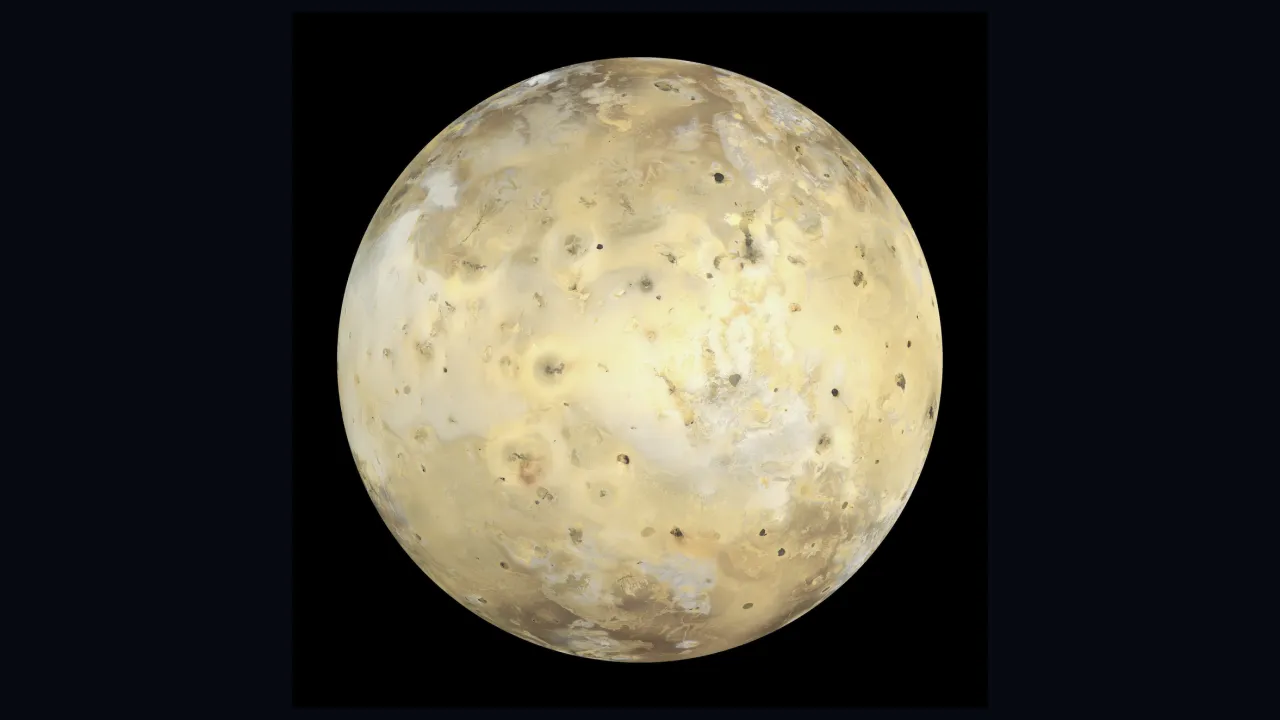
Io
Sulfur-Colored Moon With Four Hundred Volcanoes
Grade 2 • Developing • 99 words
🌌 Cosmic Location & DistanceOrbits Jupiter • 262,000 mi (421,700 km) from Jupiter's center
🪐 Scale / Diameter2,264 mi (3,643 km) diameter • Slightly bigger than Earth's Moon
☄️ Composition & OrbitSilicate Rock, Molten Magma & Iron Core • 1.77-Earth-day orbit
⚡ Cosmic SparkMost volcanically active world in the Solar System with 400+ live volcanoes!
🤯 Mind-Blowing Fact • Grade 1
Io has more active erupting volcanoes than any other moon or planet in our entire Solar System!
✨ Word Sparks (Grade 1 Glossary)
Tap 🔊 to hear
volcano
an opening spraying hot melted rock
plumes
tall fountains of gas and dust
lava
melted glowing rock flowing above ground
🪝
Which colorful moon looks just like a giant cheese pizza?
1
The Pizza Moon!
Sizzle, pop, boom! Orbiting close to giant Jupiter spins a bright yellow, orange, and red moon! Meet Io—nicknamed the 'pizza moon' because colorful patches cover every inch!
2
Fountains of Lava
Over four hundred live bubble and spray across Io! Giant umbrella shoot miles up into dark space.
3
Zero Old Craters
Fresh flows cover old dents super fast. That keeps Io's colorful ground looking brand-new!
1. Why do kids and scientists say Io looks like a giant pizza?
2. Why won't you find old asteroid craters on Io?
🤯 Mind-Blowing Fact • Grade 2
Volcanic plumes on Io shoot up to 300 miles into space—higher than the International Space Station orbits above Earth!
✨ Word Sparks (Grade 2 Glossary)
Tap 🔊 to hear
sulfur
bright yellow mineral found near volcanoes
flexing
bending back and forth repeatedly
fainter
dimmer and weaker from far away
🪝
Why is tiny Io bursting with lava so far away from the warm Sun?
1
Squeezed Like Playdough!
Out near Jupiter, sunlight is twenty-five times than on Earth—so why isn't Moon-sized Io frozen solid? Bend a metal paperclip or squish cold clay rapidly in your hands and feel it turn warm! Giant Jupiter pulls on one side of Io while neighbor moons Europa and Ganymede tug from the other side, Io's insides nonstop!
2
Rainbow Sulfur Colors
gas and frost act like nature's paint set across Io's plains, turning white, pale yellow, bright orange, brick red, or jet black depending on temperature!
3
Umbrella Plumes 200 Miles High
Weak gravity lets volcanic fountains arc 200 miles into space before snowing frost back down!
1. What heats up the inside of Io to power 400 active volcanoes?
2. What paints Io bright shades of yellow, orange, red, and white?
🤯 Mind-Blowing Fact • Grade 3
Every 42 hours as Io orbits Jupiter, tidal gravity flexes Io's solid rock ground up and down by 330 feet—taller than the Statue of Liberty!
✨ Word Sparks (Grade 3 Glossary)
Tap 🔊 to hear
navigation
guiding a spacecraft along the right path
patera
a wide saucer-shaped volcanic crater basin
thrust
pushed upward with tremendous force
🪝
How did a sharp-eyed NASA engineer discover the first live volcano beyond Earth in 1979?
1
Linda Morabito's Eagle-Eyed Catch!
In March 1979, young NASA engineer Linda Morabito brightened a Voyager 1 photo of Io to spot background stars—and gasped! Rising off the curve of Io's edge glowed a crescent-shaped umbrella cloud 160 miles tall! For the first time in history, humanity had caught an active volcano erupting on another world!
2
Solid Ground Tides
Earth's Moon pulls liquid ocean tides up a few feet at the beach. On Io, Jupiter's monster gravity lifts and drops Io's SOLID ROCK ground by more than 300 feet—as tall as a thirty-story skyscraper—every single 42-hour orbit!
3
Giant Lava Lake Loki Patera
Io's grandest volcano, Loki , holds a horseshoe-shaped lake of bubbling molten lava 125 miles across—wider than the state of Maryland!
4
Tall Non-Volcanic Mountains
Surprisingly, Io's tallest peak—Boösaule Montes, rising nearly eleven miles high—is not a volcano, but a tilted block of rock skyward as piled-up lava squeezes the crust below!
1. Who spotted the first active volcanic plume beyond Earth in a 1979 Voyager 1 photo?
2. What is Loki Patera on Io?
🤯 Mind-Blowing Fact • Grade 4
Every 42 hours when Io passes into Jupiter's dark shadow, temperatures plunge and almost its entire sulfur-dioxide atmosphere freezes solid onto the ground!
✨ Word Sparks (Grade 4 Glossary)
Tap 🔊 to hear
Laplace
three-moon 4:2:1 orbital rhythm around Jupiter
ultramafic
extra-hot magnesium-rich lava from deep mantles
amps
units measuring the strength of electric current
🪝
How does Io power a two-million-amp electric wire straight into Jupiter's auroras?
1
The 4:2:1 Laplace Orbital Dance
Why hasn't Jupiter's gravity pulled Io's orbit into a smooth circle where flexing would stop? Blame a cosmic rhythmic dance called the resonance! For every one orbit Ganymede completes around Jupiter, Europa completes exactly two, and innermost Io completes exactly four! Regular gravitational nudges whenever the moons line up force Io's 42.5-hour path to stay slightly oval—pumping 100 trillion watts of tidal friction heat straight through its rocky mantle!
2
An Atmosphere That Freezes Every Eclipse
Volcanoes puff a whisper-thin sulfur-dioxide (SO2) atmosphere around Io. Yet once every 42 hours, Io slips into giant Jupiter's cold shadow for two hours! Plunging temperatures make 80 percent of Io's entire sky freeze solid onto the ground as white frost—until returning sunlight sublimates the sky back into gas!
3
Plasma Torus and Cosmic Power Cord
Jupiter's spinning magnetosphere strips one metric ton of volcanic sulfur and oxygen atoms off Io every single second, inflating a glowing doughnut of charged particles called the Io Plasma Torus! Even wilder, an invisible magnetic 'flux tube' connects Io directly to Jupiter's poles, carrying millions of of electric current that paint a glowing footprint inside Jupiter's auroras!
4
Ultra-Hot Ancient-Style Lava
Infrared sensors on Galileo and Juno measured Io's silicate lavas glowing past 2,900 °F (1,600 °C)—hotter than modern Hawaiian lava and resembling 'komatiite' lavas that flowed on baby Earth billions of years ago!
1. What keeps Io's orbit slightly oval so tidal heating never stops?
2. What happens to Io's thin sulfur-dioxide atmosphere whenever Io passes into Jupiter's shadow?
🤯 Mind-Blowing Fact • Grade 5
In 1676, astronomer Ole Rømer proved for the first time in history that light has a finite speed simply by timing Io's eclipses behind Jupiter!
✨ Word Sparks (Grade 5 Glossary)
Tap 🔊 to hear
dissipation
turning mechanical flexing into internal heat
lithosphere
the rigid outer rocky shell of worlds
calderas
wide collapsed volcanic basins holding lava
🪝
How did tiny Io first let humanity measure the speed of light in 1676—and what did Juno's 2024 gravity flybys reveal beneath its crust?
1
Ole Rømer's Speed-of-Light Clock
Long before spacecraft revealed Io's volcanoes, Galileo's innermost moon solved one of physics' deepest questions: is light instantaneous, or does it travel at a finite speed? In 1676 at the Paris Observatory, Danish astronomer Ole Rømer timed hundreds of Io eclipses disappearing behind Jupiter's shadow. Rømer noticed eclipses arrived roughly eleven minutes 'early' when Earth orbited near Jupiter and eleven minutes 'late' when Earth sat on the far side of the Sun! Realizing light needed ~16.5 minutes to cross Earth's orbital radius, Rømer proved light travels at a finite cosmic speed (~300,000 km/s)!
2
Tidal Dissipation Prediction Confirmed
Just three days BEFORE Voyager 1 flew past Io in March 1979, physicists Stanton Peale, Patrick Cassen, and Reynolds published a bold theoretical paper in Science calculating that forced orbital eccentricity (0.0041) from the 4:2:1 Laplace resonance with Europa and Ganymede must dissipate roughly 10¹⁴ watts of tidal heat inside Io—predicting runaway volcanism! Seventy-two hours later, Linda Morabito's discovery of 300-kilometer umbrella plumes above Pele and Loki delivered one of the fastest theoretical triumphs in space history.
3
Heat-Pipe Tectonics and Subduction-Free Resurfacing
Unlike inner icy Galilean moons, Io lost virtually all primordial water early on, leaving a high-density (3.53 g/cm³) silicate body wrapping an ~900-kilometer metallic iron-sulfide core. Depositing roughly one centimeter of global lava and pyroclastics per year buries older layers rapidly downward—compressing cold until blocks snap along reverse faults to uplift jagged 17.5-kilometer peaks like Boösaule Montes through 'heat-pipe tectonics.'
4
Juno's 2023–2024 Close Flybys Settle the Magma Ocean Question
For years, geophysicists debated whether a global molten magma ocean sloshed 50 kilometers beneath Io's crust. In December 2023 and February 2024, NASA's Juno spacecraft skimmed just 1,500 kilometers above Io's roaring ! Precise tidal-deformation tracking published in Nature (late 2024) demonstrated Io does NOT harbor a shallow global magma ocean; instead, tidal energy melts localized magma chambers inside a mostly solid, sponge-like silicate mantle.
5
Electrodynamic Engine of the Jovian System
Swept at 57 kilometers per second by Jupiter's co-rotating magnetosphere, Io's stripped SO2 ions feed the glowing Io Plasma Torus while driving a three-million-ampere Alfvénic current circuit that illuminates a permanent ultraviolet footprint in Jupiter's polar auroras.