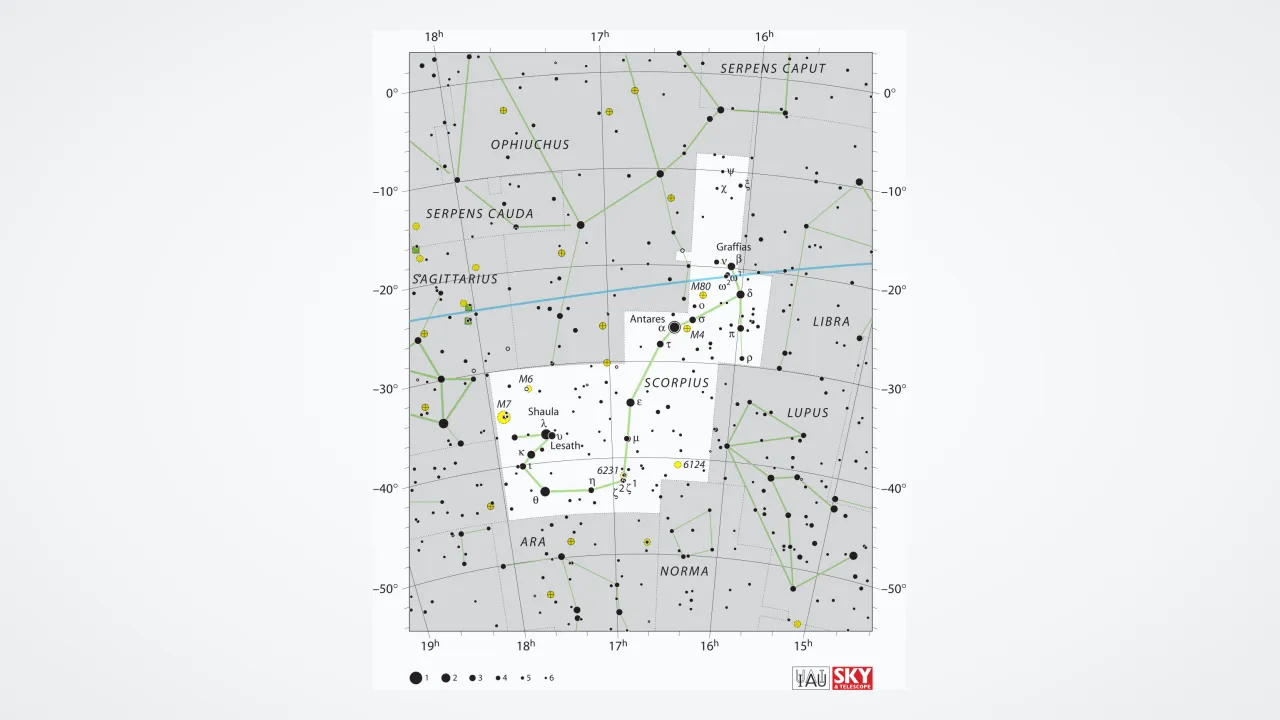
1. What glowing star shines like a fiery red heart in the middle of Scorpius?
2. What ocean tool did Polynesian wayfinders see in the curved stars of Scorpius?
🤯 Mind-Blowing Fact • Grade 2
Twin stars named Shaula and Lesath shine side by side right at the sharp tip of the Scorpion's stinger—nicknamed the 'Cat's Eyes'!
✨ Word Sparks (Grade 2 Glossary)
Tap 🔊 to hear
rival
a close match competing in brightness
zodiac
sky band where Sun and planets travel
star cluster
sparkling group of stars born together
🪝
Why did ancient stargazers name Scorpius's brightest star 'the Rival of Mars'?
1
One Constellation That Looks Like Its Name
Many constellations take lots of imagination to picture, yet Scorpius really looks like a giant scorpion! Three stars form its front claws, fiery Antares marks its heart, and a long J-shaped curve of bright stars forms its curled stinger tail.
2
Rivaling the Red Planet
Because Scorpius sits along the path planets travel across the sky, rusty-red Mars passes near Antares every two years. Ancient Greeks named the star Antares—meaning ' of Mars'—because both shine with nearly the same orange-red color!
3
Swimming in Star Clusters
Scorpius sits right beside the thick, glowing center of our Milky Way, packing its borders with sparkling .
1. Why does the name 'Antares' mean 'Rival of Mars'?
2. Why are Orion and Scorpius never up in the night sky at the exact same time?
🤯 Mind-Blowing Fact • Grade 3
If our Sun were the size of a basketball, giant Antares in Scorpius would be wider than two whole basketball courts!
✨ Word Sparks (Grade 3 Glossary)
Tap 🔊 to hear
globular cluster
tightly packed ball of ancient stars
sounding rocket
short-flight science rocket testing upper space
companion star
smaller star orbiting a larger partner
🪝
What happens when you aim binoculars toward Scorpius, right beside the bustling downtown core of our Milky Way?
1
Gateway to the Galactic Center
Spread a blanket outside on a clear July night and look toward the southern horizon, where the Milky Way swells into a bright, misty cloud. Right beside our galaxy's bustling center curls Scorpius! Viewers in Australia, South America, and Southern Africa see the Scorpion climb straight overhead in winter.
2
Colossal Red Supergiant Antares
At 550 light-years away, Antares is a bloated red supergiant nearly 700 times wider than our Sun! Even more exciting, telescopes reveal a hot blue-white , Antares B, orbiting through its outer wind—appearing emerald green by contrast beside giant orange Antares.
3
Butterflies and Ancient Star Balls
Just beside Antares glows Messier 4, one of the closest globular star clusters to Earth—a dense ball of 100,000 ancient stars over 12 billion years old! Near the stinger sit two young open clusters: the Butterfly Cluster (M6) and Ptolemy's Cluster (M7).
4
First X-Ray Star Discovery
In 1962, a launched above Earth's air discovered Scorpius X-1, the very first cosmic X-ray source ever found beyond our Sun!
1. What kind of star grouping is Messier 4, sitting right next to bright red Antares?
2. What historic astronomy breakthrough happened in Scorpius during a 1962 rocket flight?
🤯 Mind-Blowing Fact • Grade 4
Radioactive iron-60 atoms found frozen in deep Pacific Ocean seafloor crusts actually rained down on Earth two million years ago from nearby supernova explosions in the Scorpius-Centaurus star group!
✨ Word Sparks (Grade 4 Glossary)
Tap 🔊 to hear
ecliptic
yearly path the Sun traces across stars
Local Bubble
giant cavity around our Sun carved by supernovae
wayfinding
traditional ocean navigation using stars and swells
🪝
Why does the Sun spend fewer than seven days inside Scorpius each year while spending weeks in neighboring constellations?
1
Trimmed Claws Along the Ecliptic
Long ago in Babylonian astronomy, the Scorpion's outstretched claws reached much wider across the sky! Roman astronomers later snipped those front stars into their own separate constellation, Libra (the Scales)—which is why Libra's brightest stars still carry Arabic names meaning 'Northern Claw' and 'Southern Claw.' Today, the path of the Sun clips only the narrow northern corner of Scorpius for about six days every November.
2
The Nearest Massive Star Nursery
Nearly all the hot blue-white stars outlining Scorpius's head and curved stinger—including Shaula, Graffias, and Dschubba—belong to the Scorpius-Centaurus OB Association. Sitting just 380 to 470 light-years away, this sprawling family is the closest massive-star nursery to our Solar System! Shockwaves from supernovae inside this group millions of years ago even swept interstellar gas past our own Sun, carving the '' we orbit inside today.
3
A Neutron Star Feeding Frenzy
Hidden 9,000 light-years away inside the constellation blazes Scorpius X-1. Though faint to backyard eyepieces, it outshines every star in X-rays except our Sun! A city-sized neutron star rips gas off a companion star, heating an accretion disk to tens of millions of degrees.
4
Wayfinding Across the Pacific
Across Polynesia, master navigators steered double-hulled voyaging canoes thousands of miles without compasses by watching Mānaiakalani—Maui's great fishhook—arc steadily across tropical skies.
1. Why do the brightest stars in neighboring Libra have ancient Arabic names meaning 'Northern Claw' and 'Southern Claw'?
2. What surprising souvenir from ancient Scorpius-Centaurus supernovae did geologists find at the bottom of Earth's oceans?
🤯 Mind-Blowing Fact • Grade 5
Hidden inside Scorpius's globular cluster Messier 4 orbits PSR B1620-26 b—nicknamed 'Methuselah'—an ancient exoplanet nearly 12.7 billion years old, almost three times older than Earth!
✨ Word Sparks (Grade 5 Glossary)
Tap 🔊 to hear
photosphere
visible light-emitting outer surface of a star
X-ray binary
neutron star or black hole pulling partner gas
convection
churning loops of rising hot and sinking gas
🪝
How did astronomers map boiling convection cells across the face of distant Antares—the sharpest surface portrait ever taken of any star beyond our Sun?
1
Jewel of the Inner Milky Way
Sweeping across 497 square degrees just west of Sagittarius and the galactic bulge, Scorpius frames one of the richest stellar fields visible from Earth. While mid-northern observers watch the Scorpion skim low above summer southern horizons, observers across Australia, Aotearoa New Zealand, Africa, and South America view its luminous J-shaped spine wheel directly through the zenith—honored in Māori star lore as Te Matau-a-Māui and in Javanese and Andean traditions as a palm tree or cosmic serpent.
2
Interferometric Imaging of Antares
Dominating the constellation at magnitude 1.0 is Alpha Scorpii—Antares—an M1.5Iab red supergiant roughly twelve to fifteen times as massive as our Sun and radiating 75,000 solar luminosities across infrared and visible wavelengths. In 2017, astronomers linked four telescopes at ESO's Very Large Telescope Interferometer in Chile to synthesize a virtual 200-meter mirror, producing the most detailed surface velocity map ever achieved for any star outside our Solar System! Giant upwelling plumes of turbulent gas swirl across Antares's bloated alongside hot B2.5V companion Antares B orbiting 529 astronomical units away.
3
Upper Scorpius and Rho Ophiuchi Clouds
Surrounding Antares stretches the Upper Scorpius subgroup of the Scorpius-Centaurus OB Association—an 11-million-year-old stellar cohort just 420 light-years away where vivid reflection nebulae glow yellow, blue, and crimson around Rho Ophiuchi. Because Upper Scorpius recently dispersed its birth gas while retaining warm debris disks, exoplanet hunters use it to watch rocky planet formation in real time.
4
Compact Objects and Globular Relics
Scorpius also anchors high-energy astrophysics: Riccardo Giacconi's June 1962 Aerobee rocket flight detected low-mass Scorpius X-1 (earning the 2002 Nobel Prize), while globular cluster Messier 4—just 7,200 light-years away—harbors PSR B1620-26 b ('Methuselah'), a 12.7-billion-year-old planet orbiting a pulsar-white-dwarf binary!
5
Galactic Neighborhood Impact
Through stellar winds and past core-collapse supernovae that sculpted our Sun's 300-light-year Local Bubble, Scorpius remains dynamically intertwined with our own Solar System's interstellar environment.