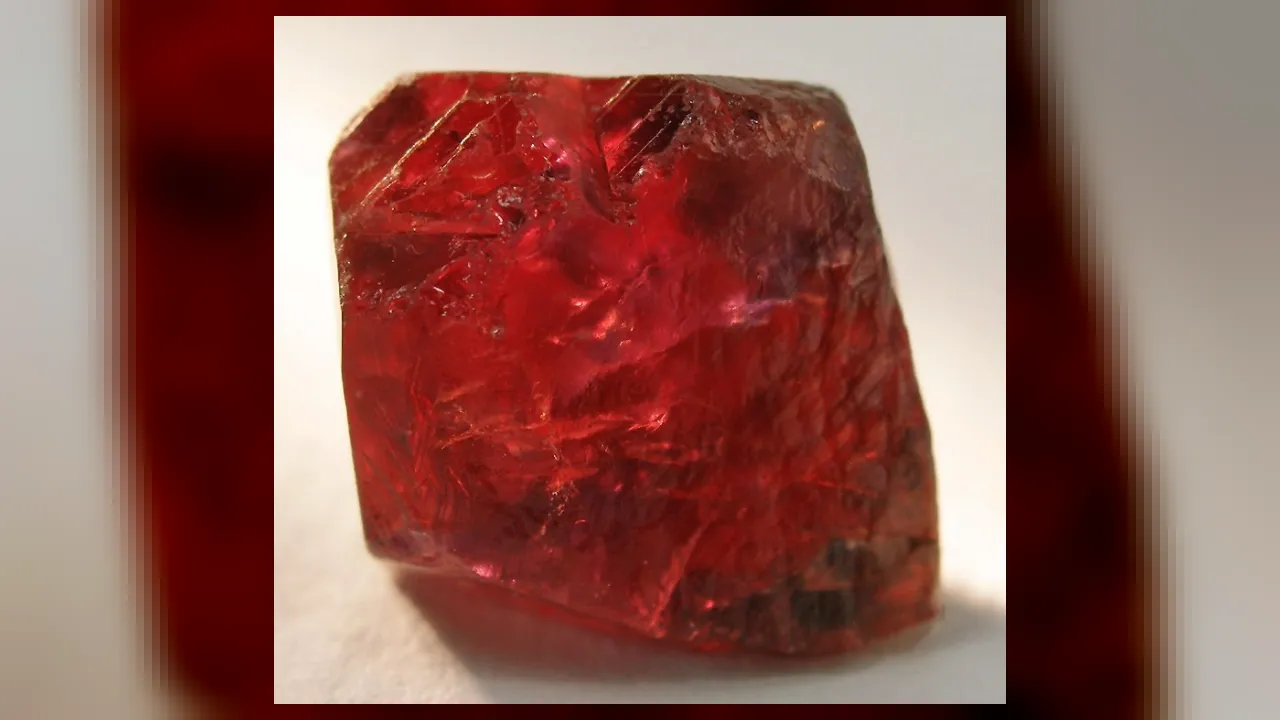
2. Which natural mineral is the ONLY one harder than a ruby?
🤯 Mind-Blowing Fact • Grade 2
In 1960, physicist Theodore Maiman built the world's very first working laser using a rod of lab-grown ruby!
✨ Word Sparks (Grade 2 Glossary)
Tap 🔊 to hear
corundum
The super hard mineral family of rubies
chromium
A shiny metal element that turns rubies red
marble
Smooth pale rock changed by heat underground
🪝
Did you know that red rubies and blue sapphires are actually crystal twins?
1
Secret Crystal Twins
Set a bright red gem beside a deep blue sapphire and you might think they are total strangers. Surprise! Both stones belong to the exact same mineral family called .
2
A Pinch of Chromium
Pure has no color at all, looking just like clear ice. When a tiny pinch of a metal called slips into the growing crystal, the stone turns rich crimson red and earns the name ruby.
3
Hidden in White Marble
Many famous rubies grow inside snowy white high in mountain ranges across Asia and Africa. Rain and rushing streams wash loose crystals into river gravel where careful searchers spot their bright red flash.
1. Which blue gemstone belongs to the exact same corundum family as ruby?
2. What tiny metal ingredient gives a ruby its bright red color?
🤯 Mind-Blowing Fact • Grade 3
Watchmakers place tiny synthetic ruby rings inside mechanical watches because hard, smooth ruby bearings let gears spin for decades without wearing down!
✨ Word Sparks (Grade 3 Glossary)
Tap 🔊 to hear
fluoresce
To glow brightly when hit by ultraviolet light
metamorphic
Rock transformed by intense heat and pressure
bearing
A smooth support that helps parts spin easily
🪝
Why are big, clear rubies even rarer in nature than big diamonds?
1
A Picky Recipe Inside Earth
Picture two colliding continents crumpling giant layers of limestone into gleaming white marble. For a ruby to grow, aluminum and oxygen must team up with rare chromium—while keeping common iron and silicon away! Because iron ruins ruby's bright glow and silicon builds other minerals instead, big clear rubies are extra rare.
2
Number Nine Toughness
On the Mohs Hardness Scale, ruby ranks a mighty nine out of ten. Unlike diamond, corundum has no weak splitting planes, making rubies remarkably tough against bumps in rings and precision watch .
3
Glowing Under Sunlight
Chromium does more than paint a ruby red—it also makes the crystal . Invisible ultraviolet rays in ordinary sunlight excite the chromium atoms, causing the stone to shine back with extra red light from within.
4
Six-Pointed Star Rubies
Some rubies trap microscopic silk-like needles of titanium mineral arranged in neat triangles. When a gem cutter domes the top smoothly, reflected light forms a magical six-rayed star that glides across the stone!
1. Why must iron stay away when high-quality glowing rubies form?
2. What creates the glowing six-pointed pattern inside a star ruby?
🤯 Mind-Blowing Fact • Grade 4
Large gem-quality rubies over five carats are so geologically scarce that they regularly command higher auction prices per carat than colorless diamonds!
✨ Word Sparks (Grade 4 Glossary)
Tap 🔊 to hear
asterism
A star-shaped light pattern on domed gems
cabochon
A gemstone polished into a smooth rounded dome
hexagonal
Built around a repeating six-sided crystal pattern
🪝
How did colliding continents in Asia cook ancient ocean shells into world-famous ruby mountains?
1
From Seafloor Limestone to Marble
Fifty million years ago, the Indian tectonic plate slammed northward into Asia, pushing up the towering Himalayas and neighboring mountain belts in Myanmar and Vietnam. Ancient seafloor limestone underwent intense regional metamorphism, recrystallizing into snowy marble. Where hot fluids leached silica out of aluminum-rich layers while leaving trace chromium behind, barrel-shaped ruby crystals grew inside the marble.
2
Why Chromium Creates Both Color and Glow
Ruby's chemical formula is aluminum oxide (Al2O3), where less than one percent of the aluminum ions are replaced by chromium. Those chromium ions absorb yellow-green and violet wavelengths of white light while transmitting rich red wavelengths. Better yet, absorbed ultraviolet energy re-emits as neon-red fluorescence, making marble-hosted rubies look almost lit by an internal battery.
3
Asterism and Crystal Symmetry
Studying mineral properties helps Earth science students connect atomic arrangement to visible traits. Because corundum crystallizes in the system, needle-like rutile inclusions align in three directions sixty degrees apart. Polishing the gem into a rounded dome called a produces —a crisp six-rayed star.
4
Flame-Fusion Lab Rubies and Lasers
In 1902, French chemist Auguste Verneuil melted powdered aluminum oxide and chromium in an upside-down torch to grow real synthetic rubies in hours. Decades later, engineers flashed intense light into a synthetic ruby cylinder, lining up chromium photons to fire history's first laser beam.
1. Which major tectonic event created the famous marble-hosted ruby deposits of Myanmar and the Himalayas?
2. How do gem cutters bring out the six-rayed star in a ruby filled with rutile needles?
🤯 Mind-Blowing Fact • Grade 5
High-pressure Earth scientists place a microscopic grain of ruby inside Diamond Anvil Cells as an optical pressure gauge because ruby's red laser glow shifts color slightly under millions of atmospheres of squeeze!
✨ Word Sparks (Grade 5 Glossary)
Tap 🔊 to hear
chromophore
An atom group that gives minerals their color
quench
To block or dampen light fluorescence inside crystals
coherent
Light waves marching in exact step together
🪝
Why does the exact same trace element turn corundum crimson red in ruby yet turn beryl lush green in emerald?
1
A Geochemical Paradox in the Crust
Imagine hunting for a mineral whose ingredients rarely share the same neighborhood in Earth's crust. Corundum (Al2O3) requires abundant aluminum and zero free silica—otherwise silica combines with aluminum to form common feldspars or micas instead. Meanwhile, trivalent chromium (Cr3+), the responsible for ruby's crimson color, normally resides in dark mantle-derived rocks rather than aluminum-rich continental sediments. Only rare tectonic collisions and metasomatic fluid zones bring aluminum and chromium together in silica-depleted rocks.
2
Crystal Field Splitting and Fluorescence
In pure corundum, tightly packed oxygen anions surround aluminum cations in octahedral coordination, creating a transparent crystal with Mohs hardness 9 and high density (4.0 grams per cubic centimeter). When slightly larger Cr3+ ions substitute for roughly one percent of the Al3+ ions, intense electrostatic pressure from the tight corundum lattice shifts chromium's electron energy levels. Curiously, the exact same Cr3+ ion inside beryl's looser lattice absorbs red wavelengths to create green emerald, whereas in ruby's compressed lattice it absorbs green and violet light to transmit vivid red alongside 694-nanometer red fluorescence.
3
Marble-Hosted Versus Basalt-Hosted Deposits
Geologists classify primary ruby deposits into two main environments. Marble-hosted rubies from Mogok in Myanmar or Luc Yen in Vietnam contain minimal iron, maximizing fiery red fluorescence. By contrast, basalt-hosted rubies from Thailand, Cambodia, and Madagascar crystallize alongside higher iron concentrations; Fe2+ and Fe3+ chromium fluorescence, yielding darker garnet-red stones.
4
Birth of Optical Physics and the Ruby Laser
In May 1960, Theodore Maiman placed a silver-coated synthetic Verneuil ruby rod inside a coiled photographic flashlamp. Optical pumping excited the chromium ions into population inversion, unleashing a pulse of 694.3-nanometer red laser light that revolutionized medicine, fiber optics, and planetary lidar.
5
Diamond Anvil Pressure Gauges
Ruby's 694-nanometer fluorescence peak shifts predictably toward longer wavelengths as surrounding pressure climbs. High-pressure physicists seal a microscopic speck of ruby inside every Diamond Anvil Cell and shine a laser on it to measure pressures reaching millions of atmospheres with pinpoint precision.