1. What funny toy did Comet 67P look like up close?
2. Why did little lander Philae bounce high after touching the comet?
🤯 Mind-Blowing Fact • Grade 2
Scientists figured out what Comet 67P would smell like from its gases: a stinky mix of rotten eggs, horse stables, and bitter almonds!
✨ Word Sparks (Grade 2 Glossary)
Tap 🔊 to hear
hibernate
To power down and rest to save energy
harpoon
Barbed anchor shot into ground to hold tight
nucleus
The solid icy rock heart of a comet
🪝
Why did engineers put their comet-chasing spacecraft to sleep for nearly three years?
1
A Long Deep-Space Nap
Imagine setting an alarm clock out near Jupiter's cold orbit! Launched by Europe's space agency in 2004, Rosetta swung past Earth and Mars to gain speed, then hibernated for thirty-one months where sunlight grew super dim.
2
Waking Up at Comet 67P
Right on schedule in 2014, Rosetta woke up and became the first spacecraft ever to orbit a comet! Soon it released washing-machine-sized Philae toward the two-mile-wide icy target.
3
Sniffing Ancient Ice
When Philae's anchor failed to fire, it bounced half a mile high before wedging beside a shady cliff—working sixty heroic hours to sniff ancient comet dust!
1. Why did Rosetta go into hibernation for thirty-one months during its trip?
2. How long did Philae manage to run experiments on the comet's surface before its battery ran down in the shade?
🤯 Mind-Blowing Fact • Grade 3
Just weeks before Rosetta ended its own mission with a gentle crash onto the comet in 2016, its camera finally spotted missing Philae wedged sideways in a dark crack!
✨ Word Sparks (Grade 3 Glossary)
Tap 🔊 to hear
amino acid
Tiny chemical molecule used to build living proteins
rendezvous
Meeting up at the same place and speed
coma
Fuzzy cloud of gas and dust around a comet
🪝
Why is landing on a four-billion-year-old comet like opening a frozen time capsule from our solar system's birth?
1
Named After Ancient Decoders
Just as Egypt's famous Rosetta Stone and Philae Obelisk helped historians read ancient hieroglyphs, the European Space Agency built Rosetta and Philae to unlock the frozen secrets of how planets formed 4.6 billion years ago.
2
Escorting a Living Comet
Reaching Comet 67P/Churyumov–Gerasimenko took four planet flybys and four billion miles of travel. For two years, Rosetta flew alongside the charcoal-dark nucleus, watching calm frozen cliffs erupt into dazzling jets of steam and dust as it neared the Sun.
3
Two Slow-Motion Bounces
On November 12, 2014, Philae drifted down for seven hours. Because neither its hold-down thruster nor its ice harpoons fired, it rebounded lazily across a kilometer of rough terrain before settling in a shadowy crack.
4
Building Blocks of Life
Even in shadow, instruments detected organic compounds, , and surprising puffs of oxygen gas trapped since before Earth existed!
1. Why were Rosetta and Philae named after famous archaeological artifacts from Egypt?
2. How did scientists finally find Philae's exact resting place after its bounce?
🤯 Mind-Blowing Fact • Grade 4
Comet 67P has so many tiny internal air pockets and pores that if you dropped the entire mountain-sized comet into a giant ocean, it would actually float like cork!
✨ Word Sparks (Grade 4 Glossary)
Tap 🔊 to hear
contact binary
Single two-lobed object formed when two bodies stick together
deuterium
Heavier form of hydrogen containing an extra neutron
planetesimal
Small ancient building block left over from planet formation
🪝
Did comets really fill Earth's oceans with water, or did Rosetta's chemical sniffer reveal a surprise?
1
Pioneering Deep-Space Solar Power
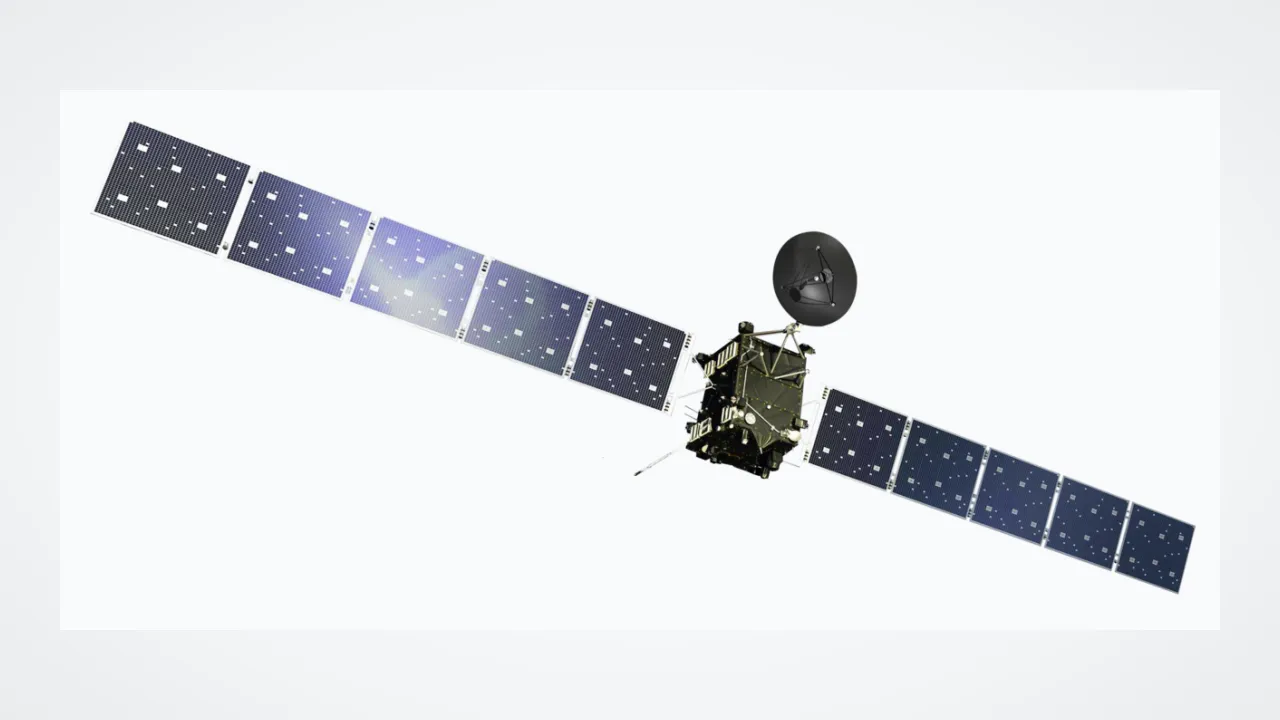
Prior missions venturing past the asteroid belt usually relied on nuclear generators, yet ESA equipped Rosetta with two colossal forty-six-foot wings holding high-efficiency low-intensity solar cells. Four precision gravity assists—three at Earth and one just 150 miles above Mars—slingshotted the craft outward to match Comet 67P's elliptical orbit, allowing it to glide alongside at mere walking speed in August 2014.
2
Anatomy of a Contact Binary
High-resolution OSIRIS cameras revealed 67P was a : two ancient icy that bumped gently together billions of years ago without shattering! Surprisingly, its interior turned out to be up to seventy-five percent empty pore space—less dense than cork and darker than coal.
3
Testing the Ocean-Water Hypothesis
One of Rosetta's biggest discoveries came from its ROSINA mass spectrometer, which measured the ratio of heavy to normal hydrogen in the comet's water vapor. Comet 67P held more than three times as much heavy water as Earth's oceans—suggesting water-rich asteroids, rather than Jupiter-family comets like 67P, likely delivered most of Earth's seas!
4
Ingredients for Prebiotic Chemistry
At the same time, discovering phosphorus and the amino acid glycine proved comets could still seed young rocky planets with essential ingredients for life.
1. What did Rosetta's measurement of heavy water (deuterium) in Comet 67P suggest about Earth's oceans?
2. How did Comet 67P get its famous two-lobed 'rubber duck' shape?
🤯 Mind-Blowing Fact • Grade 5
As Comet 67P swung past perihelion in August 2015, sunlight vaporized its ancient ice so fiercely that the comet blasted up to 220,000 pounds of gas and dust into space every single minute!
✨ Word Sparks (Grade 5 Glossary)
Tap 🔊 to hear
outgassing
Ices turning directly into streaming gas jets when warmed
tomography
Mapping an object's hidden interior using penetrating waves
primordial
Existing right from the earliest beginning of cosmic history
🪝
How do you orbit an irregular, gas-spitting iceberg whose gravity is weaker than a breeze—and land a robot on its spinning neck?
1
Decade-Long Ballistic Gymnastics
Previous comet encounters—like Giotto at Halley or Stardust at Wild 2—flashed past their targets at tens of thousands of miles per hour. Truly orbiting a comet nucleus required matching both its position and orbital velocity vector deep in space. Launched from Kourou in March 2004, ESA's three-ton Rosetta executed four planetary gravity assists, photographed asteroids Steins and Lutetia, survived thirty-one months of spin-stabilized hibernation 500 million miles from the Sun, and braked to walking pace beside Comet 67P/Churyumov–Gerasimenko in August 2014.
2
Navigating Microgravity and Outgassing Jets
Orbiting a four-kilometer contact binary weighing ten billion tons demanded constant recalculation: uneven gravity from its two lobes and roaring perihelion plumes shedding tons of water vapor and dust per second threatened to blow Rosetta off course or blind its star trackers with sparkling dust grains that looked like false stars.
3
Philae's Touchdown Odyssey at Agilkia and Abydos
During its seven-hour unpowered descent on November 12, 2014, the 100-kilogram Philae lander touched down at Agilkia at one meter per second. With its active cold-gas thruster inoperative and anchor harpoons unfired, Philae rebounded in 67P's microgravity for nearly two hours before coming to rest tilted inside a shadowed chasm named Abydos—still running radar right through the comet's porous interior and sniffing sixteen organic compounds!
4
Primordial Oxygen, Glycine, and Heavy Water
Overhead, Rosetta's ROSINA spectrometer astonished cosmochemists by detecting abundant free molecular oxygen (O2) frozen into the comet's ices before the solar system formed, alongside noble gases argon and xenon, phosphorus, glycine, and a deuterium-to-hydrogen ratio challenging comet-ocean models.
5
Final Resting Place Together
On September 30, 2016, as 67P receded back toward Jupiter's cold realm, Rosetta descended slowly onto the Ma'at pit region—transmitting close-up data until the exact instant its antenna touched ancient cometary dust forever.