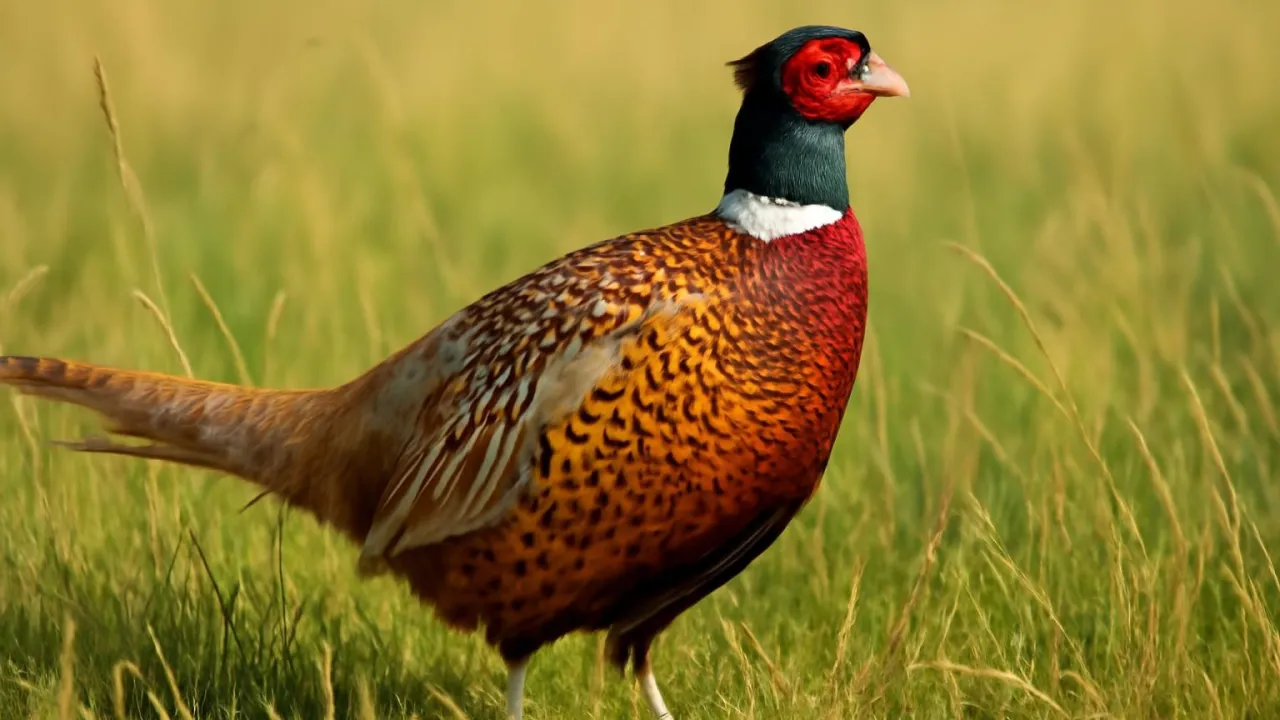
Male ring-necked pheasants have bright feathers to attract female birds during spring.
✨ Word Sparks (Grade 2 Glossary)
Tap 🔊 to hear
feathers
Soft coverings that help birds fly and stay warm
nest
A bird’s home where eggs are kept safe
insects
Small animals with six legs that birds eat
🪝
Have you ever seen a bird with a bright white ring around its neck?
1
Bright and Colorful Feathers
The ring-necked pheasant has bright red, gold, and green . It has a shiny white ring around its neck. Its tail feathers are long and pointed. These colors help it stand out in fields.
2
Where It Lives and Grows
Pheasants live in grasslands, farms, and open fields. They build on the ground hidden in tall grass. Baby pheasants hatch from eggs and grow fast. They like places with lots of plants and bugs.
3
What It Eats Every Day
Pheasants eat seeds, grains, , and small plants. They use their beaks to peck food from the ground. Eating insects gives them protein to grow strong. They need clean water to stay healthy.
The ring-necked pheasant’s white neck ring is a rare natural marker that helps identify males.
✨ Word Sparks (Grade 3 Glossary)
Tap 🔊 to hear
camouflage
Colors or patterns that help animals hide
predator
An animal that hunts other animals for food
nutrients
Food parts that help animals grow and stay healthy
🪝
Did you know the ring-necked pheasant uses its bright feathers to survive and attract mates?
1
Colorful Feathers and Camouflage
The male pheasant has bright, colorful feathers that attract females during mating. Its white neck ring is a unique feature that stands out. The female’s feathers are duller to provide from . This helps her hide while nesting.
2
Habitat and Nesting
Ring-necked pheasants live in grasslands and farmland where tall grasses provide shelter. They build nests on the ground hidden by plants to protect eggs from . Their habitat offers food and cover for raising chicks safely. This adaptation helps them survive in open areas.
3
Diet and Survival
These birds are omnivores that eat seeds, insects, and plants to get . Insects supply protein needed for growth and energy. Their strong beaks help them peck and forage efficiently on the ground. This diet supports their active lifestyle and reproduction.
4
Adaptations and Defense
Pheasants use and quick flight to escape like foxes and hawks. Their long tail feathers help balance during fast takeoffs. The bright colors of males warn rivals and attract mates. These adaptations improve their chances to survive and reproduce.
Ring-necked pheasants help control insect pests, benefiting farmers and ecosystems alike.
✨ Word Sparks (Grade 4 Glossary)
Tap 🔊 to hear
ecosystem
A community of living things and their environment
plumage
A bird’s feathers, especially colorful ones
conservation
Protecting animals and places to keep them safe
🪝
How do ring-necked pheasants survive and play important roles in their ecosystems?
1
Bright Feathers and Ecosystem Roles
Male ring-necked pheasants display bright feathers and a white neck ring to attract females and signal territory. Their colorful also warns rivals during mating seasons. These birds contribute to food webs by consuming seeds and insects, controlling insect populations. Their presence supports balance in grassland .
2
Habitat and Geographic Range
Originally from Asia, ring-necked pheasants now live in North America and Europe, thriving in farmland and grasslands. They prefer areas with tall grasses and shrubs for nesting and hiding. Human farming practices have expanded their habitats but also pose risks from pesticides. Their adaptability allows them to survive in diverse environments.
3
Diet and Food Web Impact
Pheasants eat a varied diet of seeds, grains, insects, and plants, which helps control insect populations and disperse seeds. This diet supports their energy needs for flight, mating, and raising chicks. They also serve as prey for predators like foxes, hawks, and coyotes, linking them to higher food chain levels. Their role is vital in maintaining balance.
4
Human Interaction and Conservation
Ring-necked pheasants are popular game birds, leading to hunting regulations to protect populations. Habitat loss from agriculture and urban development threatens some local groups. efforts include habitat management and hunting limits to ensure sustainable populations. Educating people about their ecological role helps support their survival.
1. Where did ring-necked pheasants originally come from?
2. Why do farmers like ring-necked pheasants?
🤯 Mind-Blowing Fact • Grade 5
Ring-necked pheasants can fly up to 30 miles per hour in short bursts to escape danger.
✨ Word Sparks (Grade 5 Glossary)
Tap 🔊 to hear
taxonomy
How scientists group and name living things
plumage
A bird’s feathers, often colorful and patterned
conservation
Efforts to protect animals and their habitats
🪝
What fascinating scientific traits help ring-necked pheasants thrive across continents and ecosystems?
1
Taxonomy and Scientific Classification
The ring-necked pheasant, scientifically named Phasianus colchicus, belongs to the Phasianidae family. This species is part of the Galliformes order, which includes heavy-bodied ground-feeding birds. It was first described in 1758 and has many subspecies adapted to different regions. Its helps scientists study its evolution and ecological roles.
2
Physiological Adaptations and Mechanics
Ring-necked pheasants have strong legs for rapid running and long tails for balance during flight. Their bright is produced by microscopic feather structures that reflect light. They have a unique vocal call used for communication and territorial defense. Their digestive system efficiently processes seeds and insects for energy.
3
Geographic Distribution and Habitat Preferences
Native to Asia, ring-necked pheasants have been introduced widely across North America and Europe. They thrive in temperate grasslands, agricultural fields, and wetlands with dense vegetation. Their habitat selection depends on availability of cover for nesting and food resources. Seasonal movements help them cope with temperature changes.
4
Conservation Status and Human Impact
Although not globally endangered, some populations face threats from habitat loss and hunting pressure. programs focus on habitat restoration and regulated hunting seasons to maintain stable populations. Agricultural pesticide use can reduce insect food sources, impacting pheasant survival. Public awareness campaigns promote coexistence with human land use.
5
Quantitative Comparisons and Ecological Role
Ring-necked pheasants measure 20 to 35 inches in length and weigh between 2 to 4 pounds. They can fly short distances at speeds up to 30 miles per hour to escape predators. Their diet includes over 50 percent seeds and 30 percent insects, supporting their energy needs. As prey for foxes and hawks, they are integral to food webs.