⚡ Cosmic SparkPours out 120,000 Suns of dazzling blue-white starlight—enough to light up a spooky nebula 40 light-years away
🤯 Mind-Blowing Fact • Grade 1
If you stood as close to Rigel as Earth is to our Sun, it would shine 120,000 times brighter than noon on a sunny summer day!
✨ Word Sparks (Grade 1 Glossary)
Tap 🔊 to hear
blue supergiant
Huge, fiercely hot star shining blue-white
sizzling
Blazing with extreme, fiery high heat
sibling
A brother or sister in one family
🪝
Why does Orion have an orange star on one shoulder and an icy-blue star on his foot?
1
Orion's Bright Blue Boot
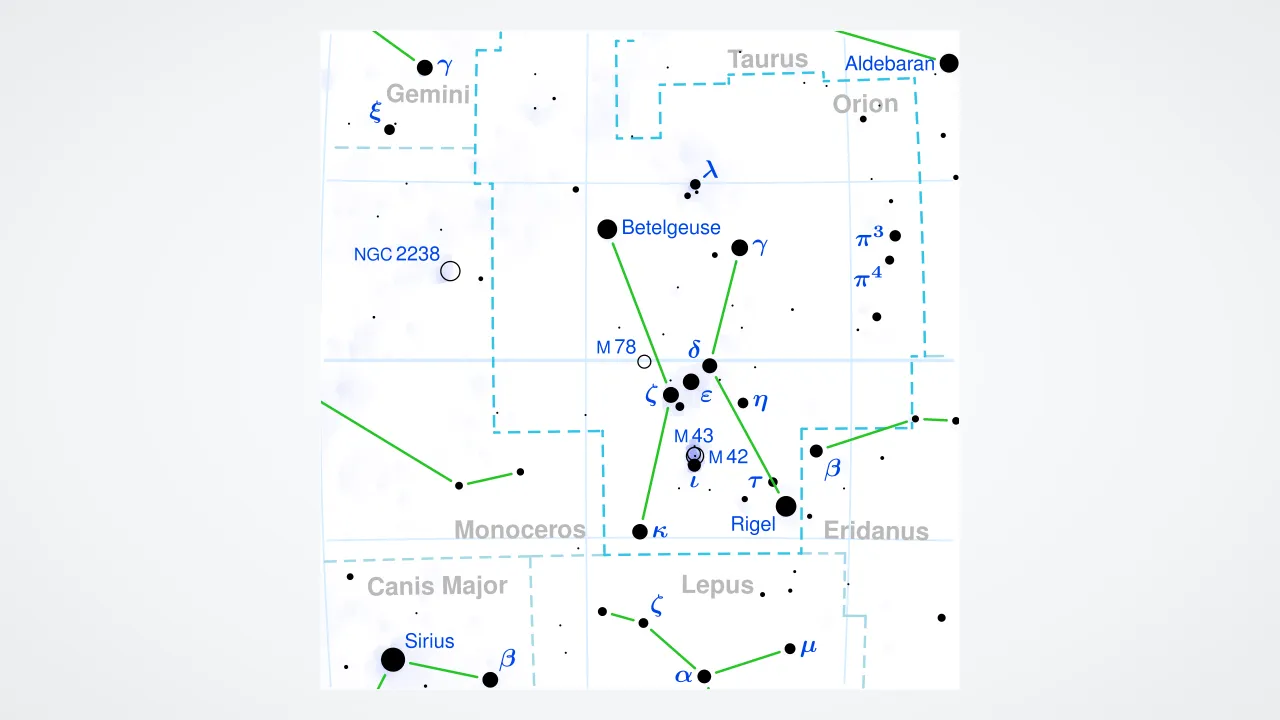
Look down from Orion's Belt to his bottom right corner! Gleaming there like a blue-white headlight shines Rigel. Even though orange Betelgeuse gets lots of fame, this blue boot star usually shines even brighter!
2
Blue Means Super Hot
In space, blue stars are much hotter than red or yellow stars! Its surface is twice as hot as our Sun.
3
Four Stars in One Family
Through big telescopes, three smaller blue stars hide close beside the giant!
1. Where is Rigel located inside the constellation of Orion the Hunter?
2. What does Rigel's blue-white color tell astronomers about its temperature?
🤯 Mind-Blowing Fact • Grade 2
Sunlight takes 8 minutes to reach Earth, yet Rigel shines so fiercely that it lights up the Witch Head Nebula from 235 trillion miles away!
✨ Word Sparks (Grade 2 Glossary)
Tap 🔊 to hear
reflection nebula
Dust cloud glowing by bouncing nearby starlight
quadruple
Made up of four connected parts together
ultraviolet light
High-energy invisible light from hot blue stars
🪝
How can one star light up a giant spooky cloud floating forty light-years away?
1
Outshining the Alpha Star
Astronomers usually label a constellation's brightest star 'Alpha' and the second-brightest 'Beta.' Yet in Orion, Beta Orionis—Rigel—actually outshines Alpha Orionis (Betelgeuse) almost every night, ranking as the seventh-brightest star in Earth's entire sky!
2
Seventy-Nine Suns Wide
Sitting roughly 860 light-years from Earth, this blue supergiant spans 68 million miles across—nearly eighty times wider than our Sun! If placed in the middle of our Solar System, its dazzling surface would stretch almost all the way to Mercury's orbit.
3
Lighting Up the Witch Head Nebula
Forty light-years to one side drifts a pale dust cloud shaped like a fairy-tale witch's profile. Fine dust grains there bounce Rigel's blue starlight toward Earth, making the Witch Head Nebula glow eerie blue!
1. Why is Rigel's catalog name 'Beta Orionis' a funny surprise?
2. Why does the nearby Witch Head Nebula glow blue in telescope photos?
🤯 Mind-Blowing Fact • Grade 3
Rigel was born only 8 million years ago—meaning when Triceratops and Tyrannosaurus rex looked up 66 million years ago, Rigel did not even exist yet!
✨ Word Sparks (Grade 3 Glossary)
Tap 🔊 to hear
Orion Arm
Spiral Milky Way neighborhood holding our Sun
radiation pressure
Outward push exerted by intense Floods of light
main-sequence
Prime life stage when stars fuse core hydrogen
🪝
Why is our cosmic neighborhood's closest blue supergiant actually a four-star family in disguise?
1
Powerhouse of the Orion Arm
Anchored 860 light-years away in our Milky Way's , Beta Orionis is the closest blue supergiant to our Solar System. At 21,000°F (12,100 K) on its surface and 79 times our Sun's diameter, it pours out roughly 120,000 times our Sun's total energy—including floods of invisible ultraviolet light!
2
Meet the Hidden Star Trio
In 1822, German-British astronomer Friedrich Georg Wilhelm Struve peered closely next to Rigel's blinding glare and spotted a fainter companion point 2,200 astronomical units away. Modern spectrographs revealed that companion is actually three blue-white B-type stars—Rigel Ba, Bb, and C—making Rigel a quadruple star system!
3
Fierce Stellar Winds
Blinding blasts gas off Rigel's outer layers ten million times faster than our Sun's gentle solar wind, shedding an entire Earth's mass of hydrogen every few years.
4
Eight Million Years Young
Although born just eight million years ago—long after T. rex walked Earth—Rigel has already finished burning hydrogen in its central core!
1. Could dinosaurs like T. rex have seen Rigel shining in their night sky 66 million years ago?
2. How many stars altogether belong to the Beta Orionis (Rigel) system?
🤯 Mind-Blowing Fact • Grade 4
Just like Supernova 1987A surprised astronomers when a blue supergiant exploded instead of a red one, Rigel proves massive stars can loop back and forth between red and blue before exploding!
✨ Word Sparks (Grade 4 Glossary)
Tap 🔊 to hear
blue loop
Stage where red supergiants shrink hot and blue
non-radial mode
Uneven star wave sloshing sideways as well as out
micrometer
Tiny length unit—one millionth of a meter
🪝
Did blazing blue Rigel already spend time as a puffy red supergiant like Betelgeuse—and loop back to blue?
1
The Mystery of the 'Blue Loop'
When massive 20-solar-mass stars exhaust hydrogen in their central cores, they swell outward and cool into red supergiants like Betelgeuse. So what is 8-million-year-old Rigel doing shining at a scorching 12,100 kelvins? Stellar interior models coupled with surface vibrations suggest Rigel may have already expanded into a red supergiant earlier in life, ignited core helium fusion, and contracted back onto a ''—or else is racing rapidly across the stellar chart toward red supergiant status right now!
2
Listening to Nineteen Simultaneous Heartbeats
Canadian space telescope MOST stared continuously at Rigel for 28 days and recorded tiny brightness ripples lasting from half a day to over two months! Unlike rhythmic Cepheid variables that swell evenly in and out, Rigel vibrates in at least nineteen overlapping at once, sloshing hot and cool patches across its surface.
3
Sculpting IC 2118 Across Interstellar Space
Forty light-years away in neighboring Eridanus floats reflection nebula IC 2118—the 70-light-year-long Witch Head Nebula. Microscopic carbon and silicate dust grains less than half a wide scatter short-wavelength blue photons from Rigel far more strongly than red wavelengths, painting the cosmic profile bright cobalt blue.
4
Destined for a Supernova Finale
Whether exploding directly from a blue state—like famous Supernova 1987A's progenitor—or swelling red again first, 21-solar-mass Rigel will detonate as a core-collapse supernova within a few million years.
1. What happens during a 'blue loop' in a massive star's life?
2. Why do microscopic dust grains in the Witch Head Nebula look specifically blue rather than orange?
🤯 Mind-Blowing Fact • Grade 5
Surface chemical fingerprints of extra nitrogen on Rigel give astronomers direct evidence of 'CNO-cycle nuclear ash' dredged up from deep inside its roaring fusion furnace!
✨ Word Sparks (Grade 5 Glossary)
Tap 🔊 to hear
CNO cycle
Carbon-nitrogen-oxygen pathway fusing hydrogen in massive stars
bolometric luminosity
Total energy output summed across all light wavelengths
spectroscopic binary
Close star pair detected via shifting rainbow lines
🪝
How do nitrogen-enriched photospheric spectra, non-radial gravity modes, and Hipparcos parallax reveal the turbulent interior of our nearest B8Ia blue supergiant?
1
Etymology, Bayer Designation, and Luminous Supremacy
Derived from the 10th-century Arabic phrase Rijl Jauza al-Yusra ('Left Foot of the Central One'), Beta Orionis anchors the southwestern corner of Orion at ~863 light-years (~264 parsecs) via Hipparcos trigonometric parallax. Although Johann Bayer assigned it 'Beta' in his 1603 Uranometria—perhaps during an unusually bright maximum of variable Alpha Orionis—Rigel shines near visual magnitude +0.13, routinely outshining Betelgeuse and ranking as the most luminous star within a thousand light-years of our Sun at ~120,000 bolometric solar luminosities.
2
Quadruple Hierarchy: Rigel A, Ba, Bb, and C
Beta Orionis forms a quadruple gravitational hierarchy born ~7 to 9 million years ago inside the Orion OB1 association. Primary B8Ia supergiant Rigel A (~21 solar masses, 78.9 solar radii via VLTI optical interferometry) is accompanied at 9.5 arcseconds (~2,200 AU projected separation, orbital period >24,000 years) by triple subsystem Rigel BC: a tight 9.86-day of B9V main-sequence stars (Ba of ~3.8 and Bb of ~2.9 solar masses) orbited every ~63 years at 0.1 arcseconds by ~3.8-solar-mass B9V star Rigel C.
3
CNO Dredge-Up and the Blue-Loop Question
High-resolution spectroscopy reveals elevated surface nitrogen-to-carbon ratios across Rigel A's 12,100-kelvin photosphere—chemical ash of the CNO hydrogen-fusion cycle mixed upward from deep interior shells. Coupled with asteroseismic gravity-mode and strange-mode pulsations tracked by the MOST satellite, these abundances test whether Rigel is crossing the Hertzsprung-Russell diagram rightward for the first time via rotational mixing or executing a post-red-supergiant blue loop fueled by core helium burning.
4
Clumpy Line-Driven Winds and H-Alpha Loops
Ultraviolet photon momentum drives an inhomogeneous, structured stellar wind shedding ~10⁻⁶ solar masses annually at terminal velocities exceeding 300 kilometers per second, twisting into rotating H-alpha loops without a strong global dipole magnetic field.
5
Ionizing and Illuminating the Orion-Eridanus Bubble
Flooding neighboring space with ionizing photons and illuminating 70-light-year reflection nebula IC 2118, Rigel actively energizes the vast Orion-Eridanus Superbubble—and will further sculpt it when its iron core collapses as a bright supernova millions of years hence.