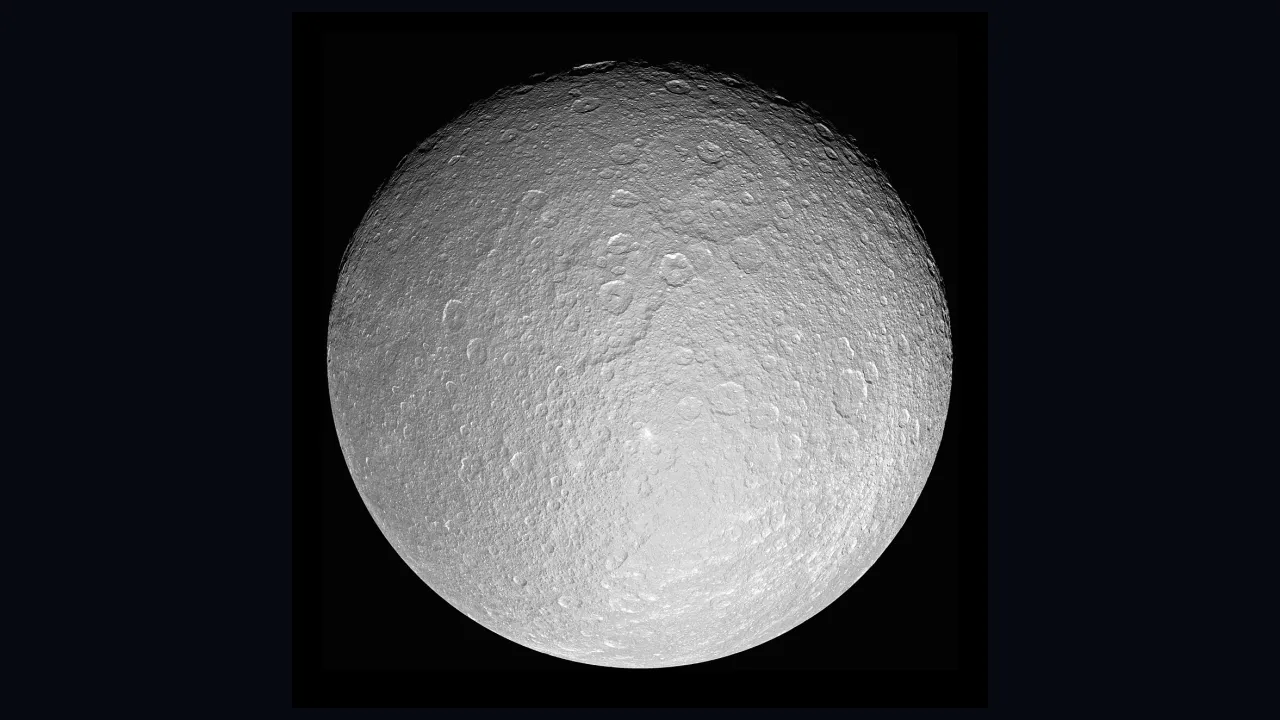
1. Where does Rhea rank in size among Saturn's moons?
2. What did spacecraft cameras discover Rhea's bright wispy lines really are?
🤯 Mind-Blowing Fact • Grade 2
Even though Rhea has real oxygen floating around it, Earth's air is five trillion times thicker than Rhea's tiny gas halo!
✨ Word Sparks (Grade 2 Glossary)
Tap 🔊 to hear
Wispy
Looking like thin, feathery streaks from far away.
Fault
A giant crack where icy ground shifts up or down.
Halo
A faint ring or thin glow surrounding a world.
🪝
How can an airless icy moon make tiny puffs of oxygen all by itself?
1
Ancient Craters Everywhere
Orbiting Saturn every four and a half days, Rhea stretches 949 miles wide. Because it has no volcanoes or liquid seas on top, ancient craters sit shoulder to shoulder across its minus-300-degree surface.
2
Solving the Wispy Puzzle
For years, blurry Voyager photos showed mysterious white 'wisps' across Rhea's back side. When Cassini zoomed close, scientists cheered: giant cracks had dropped the ground, exposing towering bright ice cliffs!
3
A Whisper of Oxygen
Fast particles trapped around Saturn zap Rhea's water ice and knock loose a super-thin of oxygen and carbon dioxide!
2. How long does Rhea take to complete one orbit around Saturn?
🤯 Mind-Blowing Fact • Grade 3
A slanted asteroid crash carved Rhea's Inktomi Crater and sprayed bright white ice rays shaped just like giant butterfly wings!
✨ Word Sparks (Grade 3 Glossary)
Tap 🔊 to hear
Ejecta
Crushed ice and rock blasted outward during an impact.
Density
How tightly matter is packed inside a given space.
Trailing side
The back half of a moon facing away from motion.
🪝
What smashed into Rhea hard enough to splash bright rays across hundreds of miles?
1
Named for the Mother of Gods
Discovered by Giovanni Cassini in December 1672, Rhea ranks ninth largest among all moons in the Solar System. With a low just slightly heavier than liquid water, Rhea resembles a colossal dirty snowball built of three-quarters water ice and one-quarter rock.
2
Inktomi, the Butterfly Crater
One of the freshest crashes on Rhea punched out a 30-mile crater named Inktomi. Because the space rock struck at a slanted angle, bright clean ice sprayed outward in a dazzling butterfly-wing pattern!
3
Canyons on the Trailing Side
On Rhea's trailing hemisphere, ancient stretching forces cracked open canyon networks hundreds of miles long. Steep cliff faces shed dark dust downward, shining bright white in sunlight.
4
Did Rhea Ever Wear Rings?
In 2008, Cassini noticed dips in electrons near Rhea that hinted at faint rings around a moon! Closer camera searches found no solid ring chunks, leaving a fun magnetic puzzle.
1. Why did the ejecta blanket around Rhea's Inktomi Crater spray out like butterfly wings?
2. What ratio of ice to rock makes up Rhea?
🤯 Mind-Blowing Fact • Grade 4
Saturn's magnetic field spins faster than Rhea orbits, so plasma slams into Rhea's back bumper like passing highway traffic!
✨ Word Sparks (Grade 4 Glossary)
Tap 🔊 to hear
Radiolysis
Splitting chemical bonds in ice using energetic space radiation.
Plasma
Electrically charged gas particles racing inside magnetic fields.
Topography
The mapped heights and depths of surface landforms.
🪝
Why does Rhea's leading face look brighter than its trailing face—the exact opposite of Iapetus?
1
Reversed Hemisphere Brightness
Orbiting 527,000 kilometers from Saturn inside the giant planet's magnetosphere, Rhea displays a brightness pattern opposite to outer Iapetus. Its leading hemisphere gleams uniformly brighter because Rhea plows straight into clean microscopic ice grains orbiting in Saturn's outer E-ring, sandblasting its front face with fresh frost! Meanwhile, Saturn's fast-spinning magnetic field overtakes Rhea from behind, bombarding its trailing hemisphere with that darkens the ice.
2
Extensional Tectonic Chasmata
Cutting right through that darkened trailing terrain are the Galzyr and Avaiki Chasmata—branching fault valleys up to four kilometers deep! Scientists suspect that when internal water froze slightly inside young Rhea, its volume expanded and cracked the brittle outer shell apart.
3
Colossal Ancient Basins
Even beneath billions of smaller craters, topographic maps trace two enormous ancient multi-ring scars: Tirawa (360 kilometers wide) and Mamaldi (480 kilometers wide), battered relics of violent early Solar System collisions that nearly cracked Rhea's young icy crust.
4
Radiolysis and the Oxygen Exosphere
During a close 97-kilometer skim over Rhea in 2010, Cassini's mass spectrometer directly sampled molecular oxygen and carbon dioxide sputtered off the icy regolith by magnetospheric ion —marking the first time a spacecraft directly measured an oxygen atmosphere at another world, even if trillions of times thinner than Earth's sky.
1. Why is Rhea's leading (front) hemisphere brighter than its trailing (back) hemisphere?
2. What caused Rhea's crust to stretch and crack into deep chasmata canyons long ago?
🤯 Mind-Blowing Fact • Grade 5
Ultraviolet sensors spotted a mysterious necklace of bluish chemical spots lined up right along Rhea's equator—hinting that ancient ring fragments may actually have crashed there long ago!
✨ Word Sparks (Grade 5 Glossary)
Tap 🔊 to hear
Sputtering
Knocking surface atoms loose into space with fast ions.
Moment of inertia
Measure showing whether mass concentrates at a world's center.
Spectra
Rainbow light patterns revealing exact chemicals on a surface.
🪝
What do gravity-field measurements and ultraviolet ring spots reveal about Rhea's interior and surface chemistry?
1
Interior Structure and Hydrostatic Puzzles
At 1,527 kilometers in mean diameter and a bulk density of 1.236 grams per cubic centimeter, Rhea sits near the mass boundary where radiogenic heating from silicate grains may barely trigger core differentiation. Gravity-harmonic tracking during close Cassini flybys yielded a near 0.37 to 0.39—indicating Rhea lacks a large segregated rocky core and instead consists of a weakly differentiated, gradually compressed rock-ice interior.
2
Equatorial Blue Pearls: Mysterious UV Spots
In 2020, reanalysis of Cassini ultraviolet and infrared uncovered a puzzling chain of discrete bluish splotches spaced right along Rhea's equator, each tens of kilometers wide! Planetary scientists propose these equatorial 'blue pearls' represent ancient impact-exposed pockets of hydrazine monohydrate or solid carbon-dioxide ice, or perhaps localized scars from re-impacting moonlet debris.
3
Sputtering Yield of an $O_2-CO_2$ Exosphere
Cassini's Ion and Neutral Mass Spectrometer measured peak daytime densities of roughly 50 billion oxygen molecules and 20 billion carbon dioxide molecules per cubic meter just above Rhea. While energetic Saturnian ions clearly generate $O_2$ via water-ice radiolysis, the abundant $CO_2$ points to reactions with primordial carbonaceous organics or trapped dry ice excavated by micrometeoroids.
4
Re-examining the Putative Ring Depletions
Although 2008 magnetospheric electron drops symmetrically flanking Rhea initially inspired headlines of the first 'ringed moon,' exhaustive narrow-angle optical searches detected zero macroscopic rubble—attributing the plasma shadows instead to complex Alfvén-wing interactions between Rhea and Saturn's magnetic field.
5
Benchmark Comparing Titan and Mid-Sized Moons
Comparing lightly differentiated Rhea with neighboring Dione and Tethys shows how small differences in orbital resonance and initial accretion speed dictate whether a mid-sized icy world freezes quiet or erupts.