1. Why does a pulsar seem to blink off and on from Earth?
2. How fast can the fastest pulsars spin around?
🤯 Mind-Blowing Fact • Grade 2
NASA engraved a map of Earth's location using 14 pulsar tick rates onto the Golden Records aboard the Voyager spacecraft!
✨ Word Sparks (Grade 2 Glossary)
Tap 🔊 to hear
radio telescope
Giant dish antenna catching invisible space radio waves
tilt
To lean at a slanted angle
Crab Nebula
Colorful cloud left by a 1054 supernova
🪝
Why did scientists briefly joke that the first pulsar signal might be 'Little Green Men'?
1
A Mystery Radio Beep
In 1967, a young student in England named Jocelyn Bell Burnell checked miles of paper charts from a brand-new . She spotted a tiny, steady 'scruff' ticking every 1.33 seconds from the exact same spot among the stars! Because it ticked more evenly than a watch, her team jokingly labeled it 'LGM-1' for Little Green Men.
2
Tilted Magnetic Beams
Soon she found three more ticking stars in different directions—proving they were natural wonders, now called pulsars! A pulsar is a spinning neutron star whose magnetic poles away from its spin poles, sweeping twin radio beams across the sky.
3
Heart of the Crab Nebula
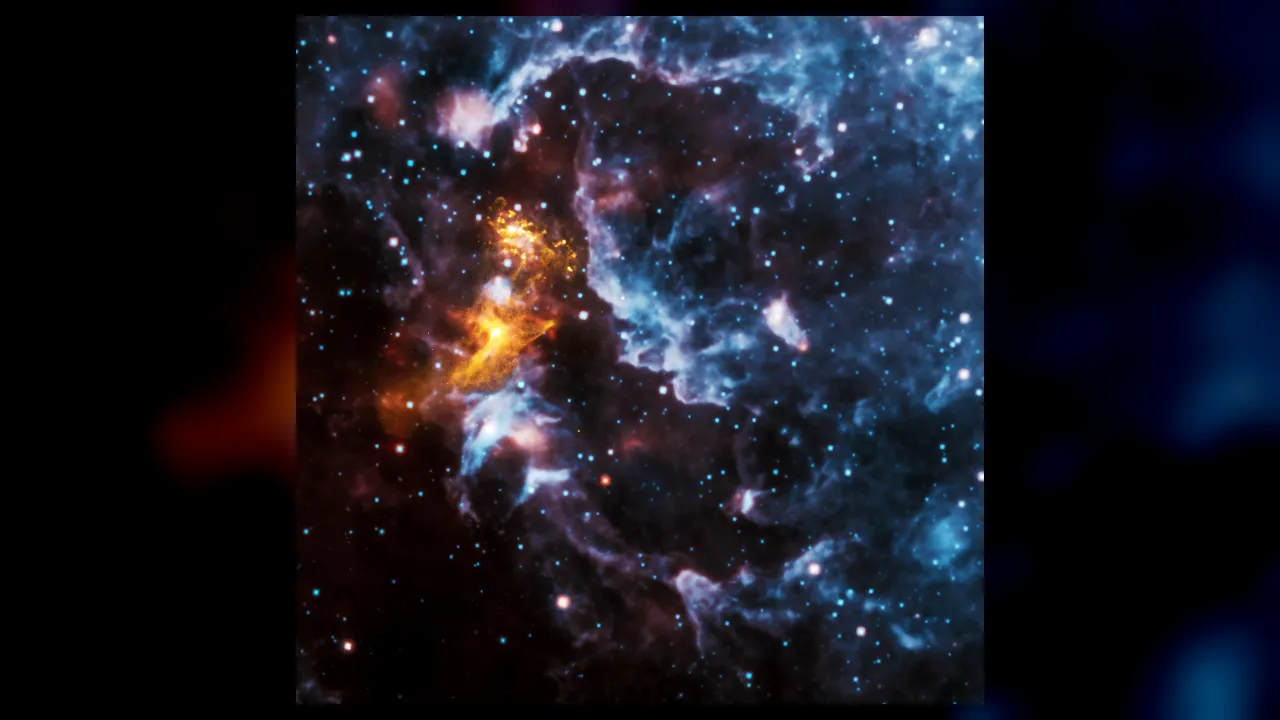
Inside the famous , a young pulsar flashes thirty times every second in radio waves, visible light, and X-rays!
1. Who discovered the very first pulsar signal on radio telescope charts in 1967?
2. Why did NASA engrave 14 pulsar patterns onto the Voyager Golden Records?
🤯 Mind-Blowing Fact • Grade 3
The fastest spinning pulsar ever clocked—PSR J1748-2446ad—whirls around 716 times per second, moving its equator at nearly a quarter the speed of light!
✨ Word Sparks (Grade 3 Glossary)
Tap 🔊 to hear
millisecond
One-thousandth of a single second
atomic clock
Ultra-exact clock timed by vibrating atoms
line of sight
Straight viewing path between observer and object
🪝
How did a ticking dead star reveal the very first planets ever found outside our Solar System?
1
Why Tilted Poles Matter
Even on Earth, our magnetic North Pole sits slightly tilted away from the geographic North Pole we spin around. On a neutron star, trillion-strength magnetic fields funnel charged particles out of both magnetic poles in tight beams of radio, optical, X-ray, or gamma-ray light. Whenever that tilted beam sweeps across Earth's , we detect a pulsar!
2
Nature's Best Timekeepers
Because a 12-mile neutron star packs more mass than our Sun, practically nothing slows its spin randomly. Some ' pulsars' keep time so accurately—down to billionths of a second—that they rival the best built in physics labs!
3
Finding the First Exoplanets!
In 1992, astronomers Aleksander Wolszczan and Dale Frail noticed tiny, repeating early-and-late shifts in pulsar PSR B1257+12's ticks. Three rocky planets—nicknamed Draugr, Poltergeist, and Phobetor—were tugging the pulsar back and forth, becoming humanity's first confirmed exoplanets!
4
Spinning Down Slowly
Over tens of millions of years, beaming out energy gradually slows a pulsar until its lighthouse beams fade away.
1. What happens if a spinning neutron star's beams NEVER point toward Earth?
2. What surprising discovery was made around pulsar PSR B1257+12 in 1992?
🤯 Mind-Blowing Fact • Grade 4
Some cannibalistic 'Black Widow' pulsars spin back up by stealing gas from a partner star—and then blast that same partner away with fierce radiation!
✨ Word Sparks (Grade 4 Glossary)
Tap 🔊 to hear
accretion disk
Swirling pancake of gas spiraling onto stars
kinetic energy
Energy an object possesses from its motion
gravitational waves
Ripples in spacetime made by accelerating masses
🪝
How can an old, tired pulsar suddenly speed back up to spin 700 times a second?
1
Electromagnetic Braking
Young pulsars like the Crab Pulsar—born in a supernova watched by skygazers in the year 1054 CE—spin dozens of times per second. Yet radiating fierce magnetic winds and particle beams steals rotational ! Every day, the Crab Pulsar slows by about 38 billionths of a second, powering the glowing X-ray nebula around it.
2
Recycled Millisecond Pulsars
After 10 to 100 million years, an isolated pulsar slows past the 'death line' where its beams shut off. Unless it has a binary partner! When an aging companion star swells up, the dead neutron star siphons off a swirling of gas. Like water hitting a waterwheel, infalling matter spins the neutron star back up into a 'recycled' millisecond pulsar!
3
Testing General Relativity in Binaries
In 1974, Russell Hulse and Joseph Taylor discovered PSR B1913+16, a pulsar orbiting another neutron star. Tracking its pulses over years showed their orbit shrinking by 3.5 meters per year—the exact energy carried away by predicted by Albert Einstein!
4
X-Ray GPS for Deep Space
NASA's SEXTANT experiment aboard the Space Station proved spacecraft can read X-ray pulsar ticks like cosmic GPS satellites to navigate far past Pluto!
1. How does an old, slow neutron star get 'recycled' into an ultra-fast millisecond pulsar?
2. What Nobel Prize discovery did the Hulse-Taylor binary pulsar prove in the 1970s?
🤯 Mind-Blowing Fact • Grade 5
By watching subtle timing ripples across 68 millisecond pulsars for 15 years, NANOGrav turned the Milky Way itself into a detector catching spacetime waves billions of miles long!
✨ Word Sparks (Grade 5 Glossary)
Tap 🔊 to hear
sidereal time
Time measured relative to distant background stars
positron
Positively charged antimatter twin of an electron
pulsar timing array
Network of pulsars timed to catch spacetime ripples
🪝
How did astronomers turn dozens of pulsars scattered across the Milky Way into a galaxy-sized gravitational-wave detector?
1
Jocelyn Bell Burnell and the Mullard Array
Constructing a four-acre dipole array in Cambridge to study interplanetary scintillation of quasars, graduate researcher Jocelyn Bell Burnell noticed a quarter-inch anomaly on chart-recorder paper in November 1967. Repeating precisely every $1.3373011$ seconds in , source PSR B1919+21—soon explained by Thomas Gold as a rotating, magnetized neutron star—confirmed Baade and Zwicky's 33-year-old theoretical remnant.
Spinning a $10^{12}$-gauss magnetic dipole creates colossal electric potentials exceeding $10^{12}$ volts near the polar caps, ripping electrons and from the iron surface into a co-rotating magnetosphere. Racing along curved open magnetic field lines near the 'light cylinder'—where co-rotation speed hits $c$—relativistic particle cascades emit coherent radio beams alongside gamma-ray pulses mapped by NASA's Fermi telescope.
3
Strong-Field Relativity Laboratories
Discovered in 2003, the Double Pulsar system (PSR J0737-3039A/B)—the only known binary where BOTH neutron stars beamed radio pulses toward Earth across a tight 2.4-hour relativistic orbit—allowed physicists to test five independent predictions of Einstein's general relativity simultaneously, verifying orbital gravitational-wave decay, Shapiro light-bending delay, and geodetic spin precession to better than 99.99% precision.
4
Galaxy-Scale Pulsar Timing Arrays
In June 2023, international consortia led by NANOGrav in North America alongside European, Australian, Indian, and Chinese radio arrays unveiled landmark evidence for a stochastic low-frequency gravitational-wave background! Timing 68 ultra-stable millisecond pulsars across 15 years to sub-microsecond accuracy revealed spatial 'Hellings-Downs' correlations—catching light-years-long spacetime swells generated by pairs of supermassive black holes inspiraling across distant galaxy mergers.
5
Autonomous Deep-Space Navigation
Demonstrated in orbit by NASA's SEXTANT experiment using NICER X-ray detectors, X-ray pulsar navigation (XNAV) triangulates spacecraft position from invariant millisecond pulse arrival times—offering GPS-like kilometer accuracy anywhere in the outer Solar System and beyond without relying on Earth-based Deep Space Network antennas.