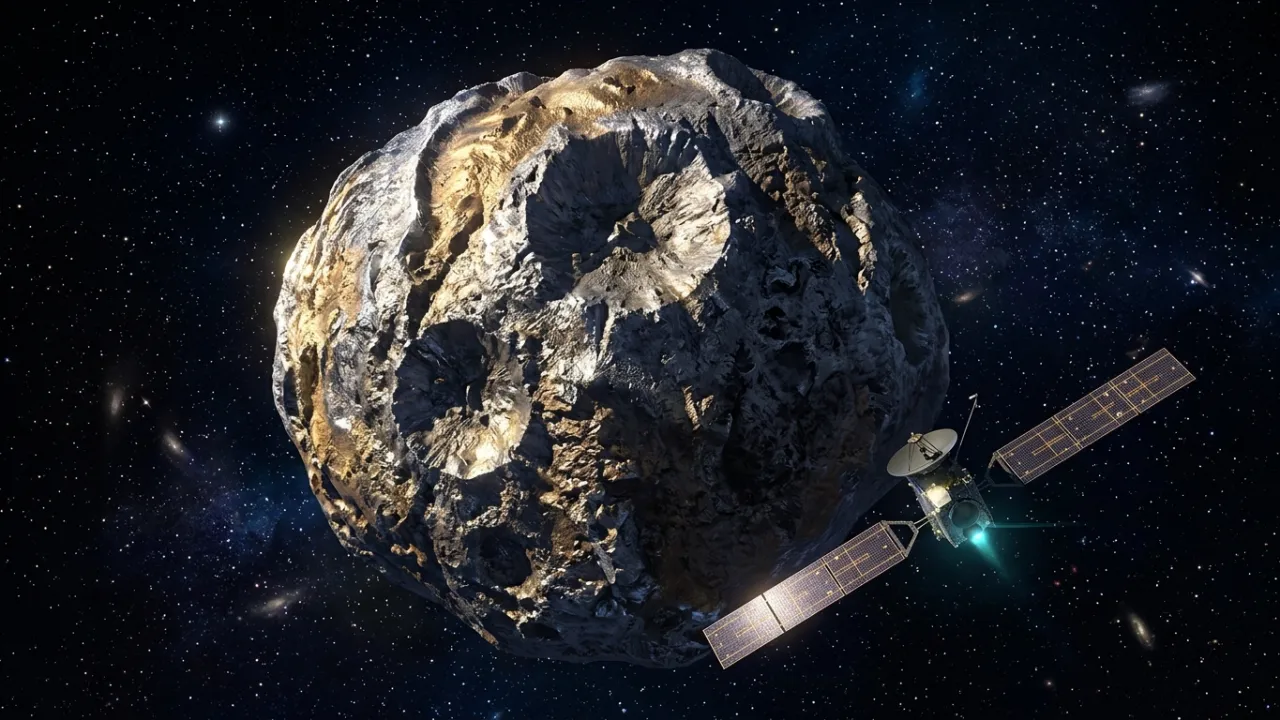
1. What unusual material makes up a huge share of 16 Psyche?
2. When is NASA's Psyche spacecraft scheduled to arrive at Psyche Asteroid?
🤯 Mind-Blowing Fact • Grade 2
On a metal crater rim on Psyche, giant frozen splashes of solid iron might poke up into the sky like spiky metal towers!
✨ Word Sparks (Grade 2 Glossary)
Tap 🔊 to hear
catalog
Numbered official list of discovered space objects
hit-and-run
Glancing space crash stripping off outer layers
geologist
Scientist who studies rocks, metals, and planets
🪝
Since humans can never drill down to Earth's metal core, how can we inspect one up close?
1
Sixteenth Asteroid Found
Italian astronomer Annibale de Gasparis discovered Psyche in 1852 and named it after the Greek goddess of the soul. Because fifteen asteroids had already been found before it, astronomers gave it the official name 16 Psyche.
2
Stripped in Cosmic Crashes
Why can't drill to Earth's iron core? Roughly 1,800 miles of scorching rock block the way, where temperatures top 9,000 degrees! Billions of years ago, giant crashes may have knocked the outer rock shell off a baby planet, leaving 16 Psyche behind as a bare metal core.
3
Blue Thrusters to 2029
Riding glowing blue solar-electric thrusters, NASA's Psyche spacecraft is cruising 2.2 billion miles to map its metallic craters in 2029!
1. Why does studying 16 Psyche help scientists understand our own planet Earth?
2. Why does 16 Psyche have the number '16' in front of its name?
🤯 Mind-Blowing Fact • Grade 3
While cruising toward its target in late 2023, NASA's Psyche spacecraft beamed a 15-second video of an orange cat named Taters chasing a laser pointer from 19 million miles away!
✨ Word Sparks (Grade 3 Glossary)
Tap 🔊 to hear
radar
Bouncing radio waves to map distant surfaces
magnetometer
Instrument measuring invisible magnetic fields in space
density
How much mass packs into a given space
🪝
How did bouncing Earth radar waves off 16 Psyche reveal a world unlike anything humans have ever visited?
1
Radar Echoes Like a Bell
Every world humans have explored up close so far—planets, moons, comets, and rocky asteroids—wears a surface of rock, ice, or gas. When astronomers bounced giant radio beams off potato-shaped 16 Psyche, the signal echoed back extra strong, proving its crust holds huge amounts of iron and nickel metal!
2
Thirty to Sixty Percent Metal
Spanning 173 miles at its widest and holding a full 1 percent of the entire Asteroid Belt's mass, Psyche isn't a solid steel ball. Careful measurements show it combines 30 to 60 percent dense metal with low-iron silicate rock and porous gaps.
3
Core or Unmelted Metal Rock?
Did violent early collisions strip the rocky mantle off a melted protoplanet? Or did Psyche form in an oxygen-poor zone near the young Sun where iron stayed pure metal without ever melting? NASA's Psyche orbiter carries and gamma-ray sensors to solve that mystery!
4
Laser Messages Along the Way
Launched in October 2023, the spacecraft even tested NASA's Deep Space Optical Communications—beaming high-definition cat videos back to Earth by laser from millions of miles away!
1. How did astronomers on Earth first discover that 16 Psyche contains so much metal?
2. What instrument on NASA's Psyche spacecraft will test whether 16 Psyche once had a churning liquid metal dynamo like Earth?
🤯 Mind-Blowing Fact • Grade 4
Planetary scientists coined a brand-new word—'ferrovolcanism'—for eruptions of liquid iron-nickel magma that may have flowed across 16 Psyche four billion years ago!
✨ Word Sparks (Grade 4 Glossary)
Tap 🔊 to hear
ferrovolcanism
Volcanic eruptions of melted iron-rich metal magma
gravity assist
Flying past a planet to gain speed
xenon
Heavy noble gas used in ion thrusters
🪝
Could miniature 'metal volcanoes' once have erupted molten iron across 16 Psyche's freezing surface?
1
King of the M-Type Asteroids
Orbiting in the outer Main Belt roughly 2.9 astronomical units from the Sun, 16 Psyche is the largest and heaviest of all metallic M-type asteroids. Shaped like a battered 173-by-144-by-111-mile potato with two giant bowl-like depressions, Psyche spins briskly once every 4.2 hours as it completes a five-year loop around the Sun.
2
Ferrovolcanism: Lava Made of Liquid Metal
Planetary geophysicists modeling how an exposed metallic core cools from the outside inward stumbled onto a wild possibility called ! As an outer shell of solid iron froze and shrank around a sulfur-rich liquid metal interior, intense pressure may have squeezed molten iron-sulfur magma up through cracks—erupting glowing metal lava flows across Psyche's ancient craters!
3
Hall-Effect Ion Propulsion
Launched atop a SpaceX Falcon Heavy rocket on October 13, 2023, NASA's Psyche spacecraft relies on sprawling five-panel cross-shaped solar arrays to power four Hall-effect thrusters. Ionizing gas into a glowing blue beam, those thrusters gently accelerate the probe past a May 2026 Mars to arrive at 16 Psyche in August 2029.
4
Science, Not Space Mining
Headlines sometimes joke that Psyche's iron and nickel could be worth quadrillions of dollars, yet NASA has zero plans or technology to mine it—the true treasure is unlocking how rocky planets build their cores!
1. What is 'ferrovolcanism,' a process scientists will look for on 16 Psyche in 2029?
2. How do NASA's Psyche spacecraft's Hall-effect thrusters propel it across 2.2 billion miles?
🤯 Mind-Blowing Fact • Grade 5
NASA's Psyche spacecraft was the very first interplanetary probe past the Moon to use Hall-effect electric thrusters—producing a thrust at Earth's distance as gentle as the weight of three quarters resting in your palm, yet accelerating continuously to tens of thousands of miles per hour!
✨ Word Sparks (Grade 5 Glossary)
Tap 🔊 to hear
dynamo
Churning liquid metal core generating magnetic fields
remanent
Ancient magnetism permanently locked inside cooled rock
enstatite
Magnesium silicate mineral lacking oxidized iron
🪝
Why did 16 Psyche's puzzling middleweight density force astronomers to rethink how metallic worlds form?
1
From Solid-Iron Myth to Metal-Silicate Puzzle
Discovered in Naples on March 17, 1852 by Annibale de Gasparis, 16 Psyche dominates the M-type spectral class at 2.92 astronomical units. Early Arecibo radar echoes suggested an almost pure iron-nickel sphere with density near 7,800 kilograms per cubic meter—like solid kamacite-taenite iron meteorites. Yet modern adaptive-optics volume models from VLT/SPHERE combined with gravitational perturbations on neighboring asteroids revised Psyche's bulk density to roughly 3,800 to 4,100 kg/m³! Even accounting for macroporosity, Psyche must blend 30 to 60 percent metal by volume with low-iron silicates ( or orthopyroxene).
2
Three Competing Origin Scenarios
That intermediate density sets up a thrilling three-way hypothesis test for NASA's Psyche mission. First, hit-and-run collisions between differentiated 500-kilometer protoplanets may have stripped away most—but not all—of Psyche's silicate mantle while shattering its iron core into a porous metallic rubble pile. Second, ferrovolcanic diking from a sulfur-enriched molten core could have intruded metal upward into a retained rocky shell. Third, Psyche might be an unmelted primordial body accreted from reduced, metal-rich chondrites or CB-like condensates!
3
Thermal Inertia and ALMA Millimeter Maps
Atacama Large Millimeter/submillimeter Array (ALMA) thermal maps and James Webb mid-infrared spectra already show heterogeneous metal concentrations inside Psyche's two massive southern craters alongside faint hydroxyl signatures—likely delivered exogenously by carbonaceous impactors.
4
Payload of the 2023–2029 Orbiter
Built by Maxar and led by Arizona State University and JPL, the Psyche spacecraft carries dual fluxgate magnetometers on a two-meter boom, a multispectral imager, and a gamma-ray and neutron spectrometer (GRNS). magnetization above background solar wind will instantly prove Psyche once sustained a convecting liquid-iron !
5
Mapping from Four Decreasing Orbits
Entering orbit in August 2029 after a May 2026 Mars flyby, Psyche will spiral down across twenty-six months from 709 kilometers to just 75 kilometers altitude—atomically fingerprinting nickel, iron, silicon, and potassium across humanity's first explored metal world.