⚡ Cosmic SparkStands nearly motionless above Earth's North Pole all night while every other northern star wheels around it
🤯 Mind-Blowing Fact • Grade 1
Contrary to a common myth, the North Star is NOT the brightest star in the night sky—it ranks around 48th brightest!
✨ Word Sparks (Grade 1 Glossary)
Tap 🔊 to hear
compass
Tool that shows north, south, east, and west
North Pole
Top spinning point of Planet Earth
Little Dipper
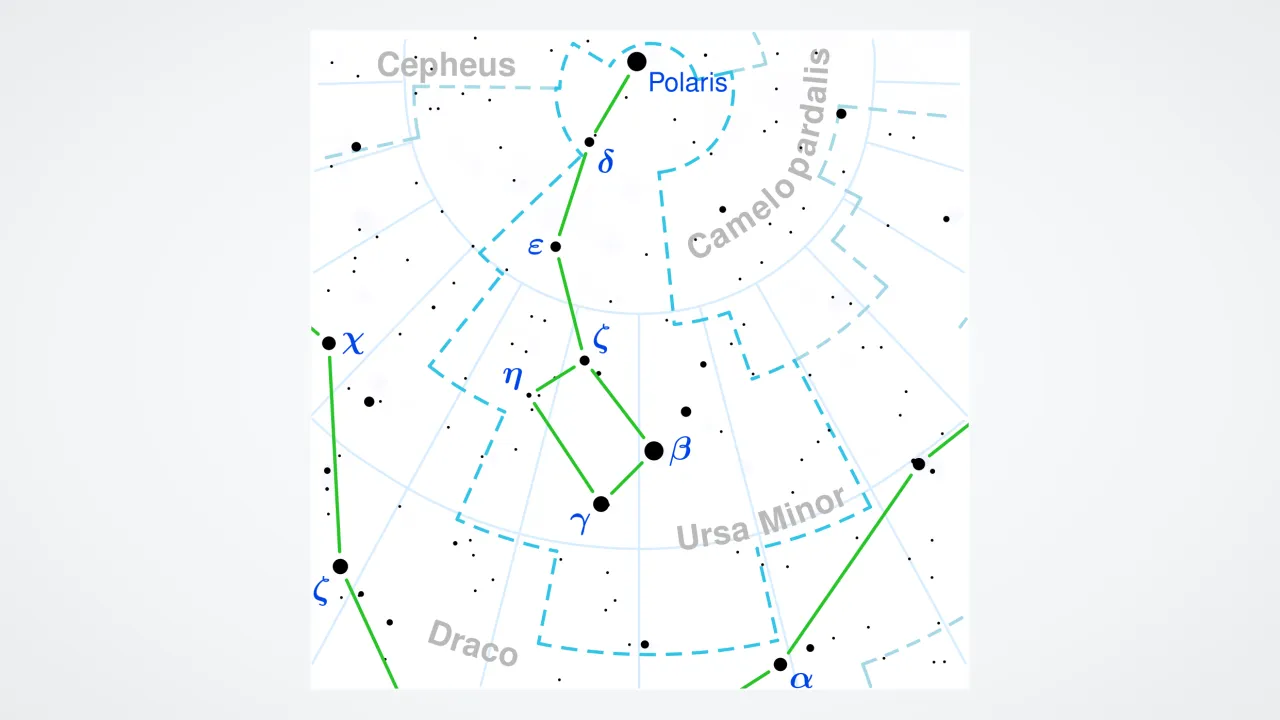
Spoon-shaped star group holding the North Star
🪝
Why does one special star hold still all night while every other star spins across the sky?
1
Standing Still Above the Pole
Spin an umbrella right over your head and watch the tip in the middle stay still! Earth's points almost straight at one golden star called Polaris, the North Star. All night long, other stars circle around it while it stays put!
2
Finding Your Way Home
Face the North Star and you are always facing true north! Sailors and hikers have used this sky for hundreds of years.
3
Tip of the Little Dipper
Two front stars on the Big Dipper's bowl point straight to it!
1. Why does the North Star stay in almost the exact same spot in the sky all night?
2. Is the North Star the very brightest star in the whole night sky?
🤯 Mind-Blowing Fact • Grade 2
Freedom seekers traveling north at night along the Underground Railroad followed the 'Drinking Gourd' (the Big Dipper) to find the steady North Star!
✨ Word Sparks (Grade 2 Glossary)
Tap 🔊 to hear
Pointer Stars
Two Big Dipper stars aiming at North Star
latitude
Distance north or south of Earth's equator
axis
Imaginary rod Earth spins around every day
🪝
How can two stars in the Big Dipper help you find north in five seconds flat?
1
Follow the Pointer Stars
Want to find north on a starry camping trip without a phone or compass? First spot the seven bright stars of the Big Dipper! Trace an imaginary line through the two outer stars of its cup—Dubhe and Merak—and hop five times their spacing across the sky to land right on the North Star at the handle tip of the Little Dipper.
2
Measuring How Far North You Live
Even cooler, the North Star's height above your northern horizon equals your on Earth! At the North Pole it shines straight overhead, while at the equator it rests right on the horizon.
3
Forty-Six Suns Wide
Up close, 448 light-years away, this golden supergiant spans 46 times wider than our Sun and hides two smaller sibling stars!
1. Where would you see the North Star if you stood right at Earth's North Pole?
2. Where does the North Star sit inside the constellation of the Little Dipper (Ursa Minor)?
🤯 Mind-Blowing Fact • Grade 3
Long-exposure night photographs centered on Polaris turn every surrounding star into colorful concentric rings called 'star trails' around one tiny pinprick center!
✨ Word Sparks (Grade 3 Glossary)
Tap 🔊 to hear
precession
Slow circular wobble of a spinning planet's axis
star trail
Curved light arc made in long night photos
Thuban
Draco star that served as Egypt's North Star
🪝
Did you know Earth's North Star hasn't always been the North Star—and won't keep the job forever?
1
Earth's 26,000-Year Top Wobble
Spin a toy top on a table and watch its handle trace a slow circle as it leans! Gravity from the Sun and Moon makes Planet Earth wobble the exact same way—a slow 25,770-year circle called axial . Because of that wobble, Earth's North Pole points at different stars across thousands of years!
2
Past and Future Pole Stars
When ancient Egyptians built the Great Pyramids 4,600 years ago, a star named in Draco the Dragon held the North Star job! Today Alpha Ursae Minoris sits less than half a degree from the pole, reaching its closest alignment in the year 2102 before bright Vega takes a turn in 12,000 years.
3
Closest Cepheid Variable Star
Located 448 light-years away, our North Star is also the closest Cepheid variable star to Earth—a yellow supergiant 1,260 times brighter than our Sun that pulses gently every four days!
4
A Three-Star Team
Hubble photos show two Sun-sized yellow-white companions—Polaris Ab and Polaris B—orbiting the supergiant!
1. Why did ancient pyramid builders use Thuban instead of Polaris as their North Star?
2. What special class of pulsing star is the supergiant in Polaris?
🤯 Mind-Blowing Fact • Grade 4
In 2024, Mount Wilson's CHARA telescope array resolved giant magnetic starspots right across the face of Polaris—something never clearly imaged on a Cepheid variable before!
✨ Word Sparks (Grade 4 Glossary)
Tap 🔊 to hear
starspot
Magnetic patch making part of star brighter or darker
North Celestial Pole
Exact sky point directly above Earth's North Pole
instability strip
Temperature-brightness zone where aging stars naturally pulse
🪝
Why did the North Star's four-day heartbeat nearly stop in the 1990s—and how did spiderweb-sharp mirrors map spots on its surface?
1
The Case of the Shrinking Heartbeat
Throughout the 1800s, astronomers clocked Alpha Ursae Minoris brightening and dimming by about ten percent every 3.97 days—classic Cepheid behavior. Then, across the 20th century, something weird happened: its pulse shrank until by the mid-1990s it varied by barely two percent! Astronomers wondered if the North Star was evolving completely out of its Cepheid instability zone, until its pulse unexpectedly bounced back and steadied around four percent.
2
First Sharp Map of a Cepheid's Face
In 2024, astronomers using Georgia State University's CHARA Array—six separated telescopes on Mount Wilson linked across 1,000 feet—captured the sharpest-ever images of Polaris Aa as its close companion Polaris Ab completed its 30-year orbit! Surprise: just like sunspots on our Sun, giant bright and dark magnetic spots freckled the supergiant's 40-million-mile-wide face.
3
Weighing a Supergiant With Kepler's Laws
Tracking close companion Polaris Ab along its tight 30-year loop let astronomers weigh the Cepheid directly using Isaac Newton's and Johannes Kepler's laws of gravity. Their measurements pegged Polaris Aa at 5.13 solar masses—intriguingly lighter than its dazzling brightness normally predicts, hinting that two smaller stars may have merged inside Ursa Minor millions of years ago!
4
Peak Alignment Coming in March 2102
Right now Earth's precessing creeps subtly closer to Polaris every single year. On March 24, 2102, the pole will pass within just 0.45 degrees of the supergiant—narrower than the apparent width of a full Moon—before slowly drifting onward toward future pole stars in Cepheus and Cygnus!
1. What unexpected feature did the CHARA Array discover on the surface of Polaris Aa in 2024?
2. How close to the exact North Celestial Pole will Polaris get at its closest alignment in 2102?
🤯 Mind-Blowing Fact • Grade 5
Measuring Polaris Aa's exact mass via its orbiting buddy Polaris Ab revealed a 'Cepheid mass puzzle'—leading some astrophysicists to suspect our North Star formed when two smaller stars merged millions of years ago!
✨ Word Sparks (Grade 5 Glossary)
Tap 🔊 to hear
first overtone
Higher-harmony stellar pulse faster than base beat
arcminute
Sky angle equal to one-sixtieth of degree
dynamical mass
True weight measured directly from orbital gravity
🪝
How did Gaia astrometry of a wide companion, six-telescope optical interferometry, and a Cepheid mass discrepancy turn Earth's pole star into an astrophysical detective story?
1
Celestial Pole Geometry and Precessional Epochs
Positioned at declination +89° 22′ in Ursa Minor, Alpha Ursae Minoris currently sits roughly 38 from the North Celestial Pole. Lunisolar gravitational torques acting on Earth's equatorial bulge drive a 25,772-year precessional sweep of our spin axis across a 23.4-degree circle on the sky: shifting the pole star mantle from Thuban (Alpha Draconis) around 2600 BCE to Kochab and Pherkad in classical antiquity, peaking just 27.15 arcminutes from Polaris in 2102 CE, and passing near Errai, Alderamin, and eventually dazzling Vega around 14,000 CE.
2
Settling a Century-Long Distance Debate via Polaris B
Because second-magnitude Polaris Aa saturates Gaia's main focal plane, its distance sparked decades of heated debate ranging from 320 to 450 light-years. Astronomers solved the riddle cleanly by measuring Gaia's sub-percent trigonometric parallax for 8th-magnitude F3V companion Polaris B—discovered by William Herschel in 1779 orbiting ~2,400 AU away—anchoring the triple system firmly at 447.6 ± 1.6 light-years (137.2 parsecs).
3
First-Overtone Pulsation and Historical Secular Brightening
Polaris Aa (spectral class F7Ib, ~46 solar radii, ~1,260 solar luminosities) pulsates not in its fundamental mode, but in its 3.97-day first radial overtone. Intriguingly, historical star catalogs from Ptolemy and al-Sufi alongside modern photometry indicate Polaris has brightened over the centuries while its pulsation period lengthens by ~4.5 seconds per year, probing stellar interior adjustments inside the Hertzsprung-Russell instability strip.
4
CHARA Interferometry, Starspots, and the Cepheid Mass Puzzle
Combining Hubble astrometry with 2024 CHARA/MIRC-X six-beam optical interferometry across inner F6V companion Polaris Ab's eccentric 29.4-year orbit (~18.5 AU semimajor axis) yielded a direct of 5.13 ± 0.28 solar masses for Polaris Aa—noticeably lower than evolutionary luminosity tracks predict unless Polaris resulted from an ancient binary merger! Simultaneously, CHARA's milliarcsecond reconstructions exposed dynamic photospheric starspots modulating radial velocities on a ~120-day rotational period.
5
Calibration Benchmark for Cosmology
As the nearest and brightest classical Cepheid in the sky, resolving Polaris's mass-luminosity tension sharpens stellar pulsation physics underlying the entire extragalactic distance scale.