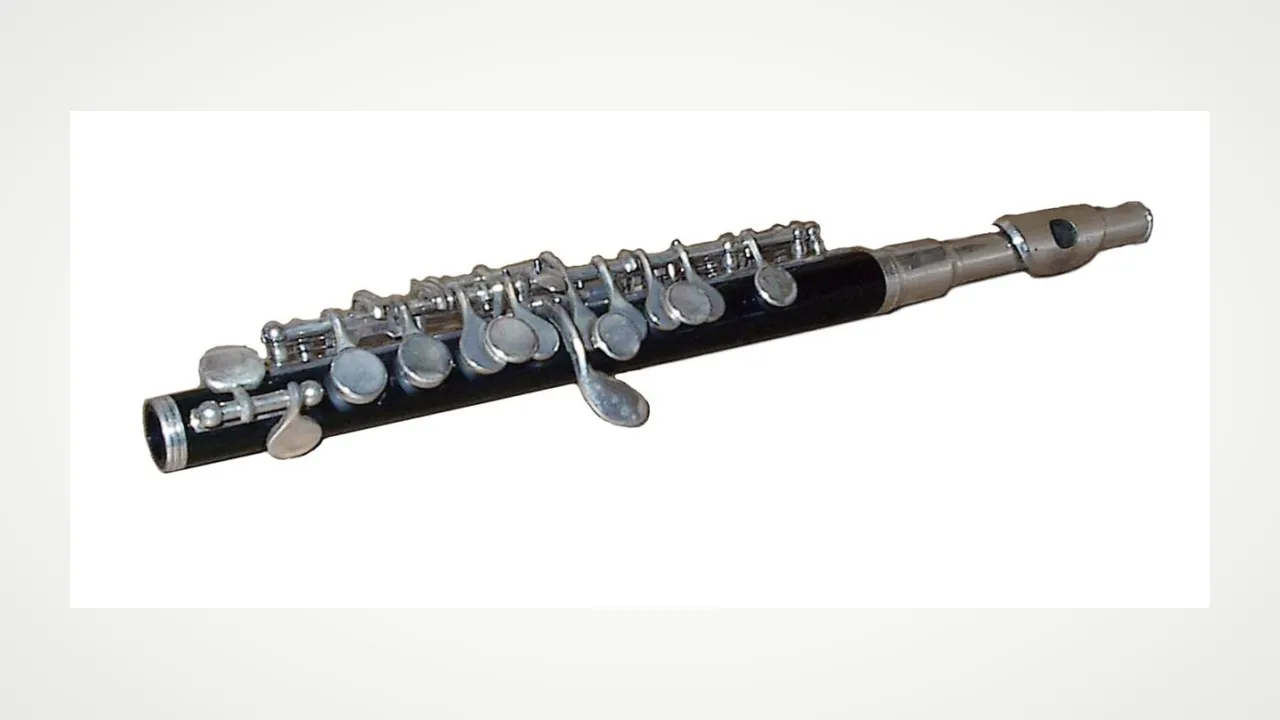
2. Compared to a regular flute, how big is a piccolo?
🤯 Mind-Blowing Fact • Grade 2
Every note on a piccolo sounds eight scale steps higher than the exact same finger pattern on a regular flute!
✨ Word Sparks (Grade 2 Glossary)
Tap 🔊 to hear
octave
Eight musical steps from low to high
vibrate
To wiggle back and forth very quickly
woodwind
A wind instrument played with finger keys
🪝
Why does shrinking a flute make every single note jump higher?
1
Brighter Than Lightning
Close your eyes and listen as thunderous drums rumble across the concert stage. Suddenly, a silver streak of sound flashes right over the whole band! That sparkling voice comes from the piccolo, whose Italian name means little flute.
2
Built Small to Sing High
A piccolo is only half as long as a regular concert flute, measuring about twelve inches from end to end. Makers carve concert piccolos from dark wood for warm tones, while marching players often carry shiny metal ones outdoors.
3
Blowing Across the Edge
Instead of using a reed, a player blows a thin stream of air across an open lip hole. Because the tube inside is so short, the air fast and leaps one whole higher than a flute.
1. What does the Italian word piccolo mean in English?
2. Why do marching bands often choose metal piccolos instead of wooden ones?
🤯 Mind-Blowing Fact • Grade 3
The piccolo's highest note vibrates more than four thousand times every single second—matching the very top key on a grand piano!
✨ Word Sparks (Grade 3 Glossary)
Tap 🔊 to hear
embouchure
How a player shapes lips to blow
air column
Tube of air vibrating inside an instrument
resonance
Rich ringing sound boosted inside a space
🪝
What happens to air vibrations when you shrink a flute tube in half?
1
Shrinking the Air Column
What would happen if you shrank a concert flute to half its length? Blow across its open hole, and every single pitch jumps one full octave higher! In Italian, flauto piccolo means little flute, yet this compact woodwind commands the brightest voice in the orchestra.
2
Edge-Tone Vibrations
Unlike clarinets or oboes, the piccolo needs no wooden reed at all. A musician shapes a precise lip opening called an and aims a fast jet of breath across the embouchure hole. Splitting against the sharp rim sets the short internal into rapid vibration.
3
Hardwood Versus Silver
You might spot gleaming silver piccolos at outdoor parades, where metal projects crisply across stadiums. Inside symphony halls, however, most players prefer dark African grenadilla wood. Dense hardwood softens shrillness and gives high notes a sweet, singing .
4
Storms, Birds, and Marches
Composers call on the piccolo whenever music needs dazzling sparkle or wild weather. Beethoven unleashed it to whistle like a fierce thunderstorm, and John Philip Sousa crowned his famous march The Stars and Stripes Forever with a leaping piccolo solo.
1. Why do symphony musicians usually prefer grenadilla wood piccolos indoors?
2. Which famous march features a legendary high piccolo solo near the end?
🤯 Mind-Blowing Fact • Grade 4
Unlike a standard concert flute, the piccolo skips the lowest footjoint keys, making written D—sounding D5—its deepest note!
✨ Word Sparks (Grade 4 Glossary)
Tap 🔊 to hear
bore
Hollow interior passage inside a wind tube
conical
Shaped like a cone that gradually narrows
frequency
Number of sound wave vibrations each second
🪝
How can a twelve-inch wooden tube cut cleanly through a hundred booming orchestral instruments?
1
Piercing a Wall of Sound
Picture one hundred musicians playing at full volume—timpani booming, brasses blazing, and strings surging together. Above that massive wall of sound, a twelve-inch wooden tube slices effortlessly into every corner of the concert hall with one gleaming phrase. How can the smallest member of the flute family outshine instruments twenty times its size without straining?
2
Short Bore, Double Frequency
Acoustic physics holds the secret inside the piccolo's thirty-two-centimeter . Pitch depends on how rapidly an enclosed air column vibrates, and halving an open pipe's length doubles its fundamental . When a flutist directs a focused air jet across the sharp embouchure edge, rapid air-stream oscillations excite pitches that sound one full octave higher than written, climbing all the way to C8 on a grand piano.
3
Reverse-Conical Engineering
Peek inside a concert grenadilla piccolo and you will discover a clever design surprise. While a modern flute combines a tapered headjoint with a cylindrical body, most orchestral piccolos reverse that geometry: a cylindrical headjoint joins a gently body that narrows toward the open end. This reverse taper tames harsh upper partials and keeps extreme notes centered in tune.
4
From Battlefield Fifes to Symphonies
Long before entering gilded concert halls, small transverse flutes marched across European battlefields as shrill military fifes whose signals carried clearly over drums. Eighteenth-century makers added keys for chromatic notes, and in 1808 Ludwig van Beethoven welcomed the piccolo into symphonic music in his Fifth and Sixth Symphonies. Today its agile voice paints flashing lightning, darting songbirds, and jubilant parade fanfares.
1. How does the internal bore of most wooden orchestral piccolos differ from a modern concert flute?
2. Which composer helped introduce the piccolo to the symphony orchestra in 1808?
🤯 Mind-Blowing Fact • Grade 5
Because the human ear canal naturally resonates around 3,000 Hz, a piccolo requires only a fraction of a tuba's breath power to sound equally loud to listeners!
✨ Word Sparks (Grade 5 Glossary)
Tap 🔊 to hear
aerophone
Instrument producing sound primarily through vibrating air
transposing
Sounding higher or lower than written notes
obbligato
Essential solo melody woven above an ensemble
🪝
Why does human hearing make the tiny piccolo sound effortlessly colossal above a full symphony orchestra?
1
A Laser Beam of Acoustic Energy
When ninety orchestral musicians unleash a fortissimo chord, low instruments must pump enormous physical energy into the room just to be heard. Yet a single piccolo player, calmly shaping a microscopic ribbon of breath at the back of the woodwind riser, sends luminous notes shimmering over brasses and percussion alike. Its secret lies equally in fluid dynamics and the biology of the human ear.
2
Psychoacoustics and Edge-Tone Physics
Classified organologically as an edge-blown , the piccolo converts steady breath into rapid vortices as an air jet oscillates across the sharp bevel of the embouchure hole. Measuring roughly 32 centimeters—half the acoustic length of the C concert flute—it functions as an octave- instrument sounding from D5 (about 587 Hz) to C8 (4,186 Hz). Most of that three-octave compass sits squarely between 1,000 and 4,000 Hz, the exact frequency band where the human ear canal naturally amplifies incoming sound waves.
3
Boehm Keywork Meets Conical Bore
After Theobald Boehm revolutionized the concert flute in 1847 with large tone holes and linked ring keys, makers adapted his ergonomic mechanism to the piccolo while deliberately preserving an older bore profile. Whereas modern flutes feature a cylindrical body paired with a parabolic headjoint, top orchestral piccolos pair a cylindrical headjoint with a reverse-conical body crafted from dense African blackwood (Dalbergia melanoxylon). That narrowing taper dampens piercing upper harmonics, yielding rounded sweetness without sacrificing projection.
4
Intonation at Millimeter Scale
Because high-frequency wavelengths measure only centimeters long, tiny temperature shifts or lip-angle adjustments noticeably alter pitch on the piccolo. Moving the headjoint tuning cork by a single millimeter or rolling the embouchure inward by degrees can bend upper-register notes substantially, demanding extraordinary breath support and microscopic muscular control from orchestral specialists.
5
From Baroque Flautino to Symphonic Fire
Descending from Renaissance military fifes and echoing Vivaldi's dazzling flautino concertos, the piccolo entered symphonic scores during the late eighteenth century before Beethoven immortalized its triumph in Symphony No. 5 and tempestuous fury in Symphony No. 6. From Tchaikovsky's filigree ballet dances and Ravel's shimmering orchestral tapestries to Sousa's iconic march , this miniature powerhouse crowns wind literature with unmatched brilliance.