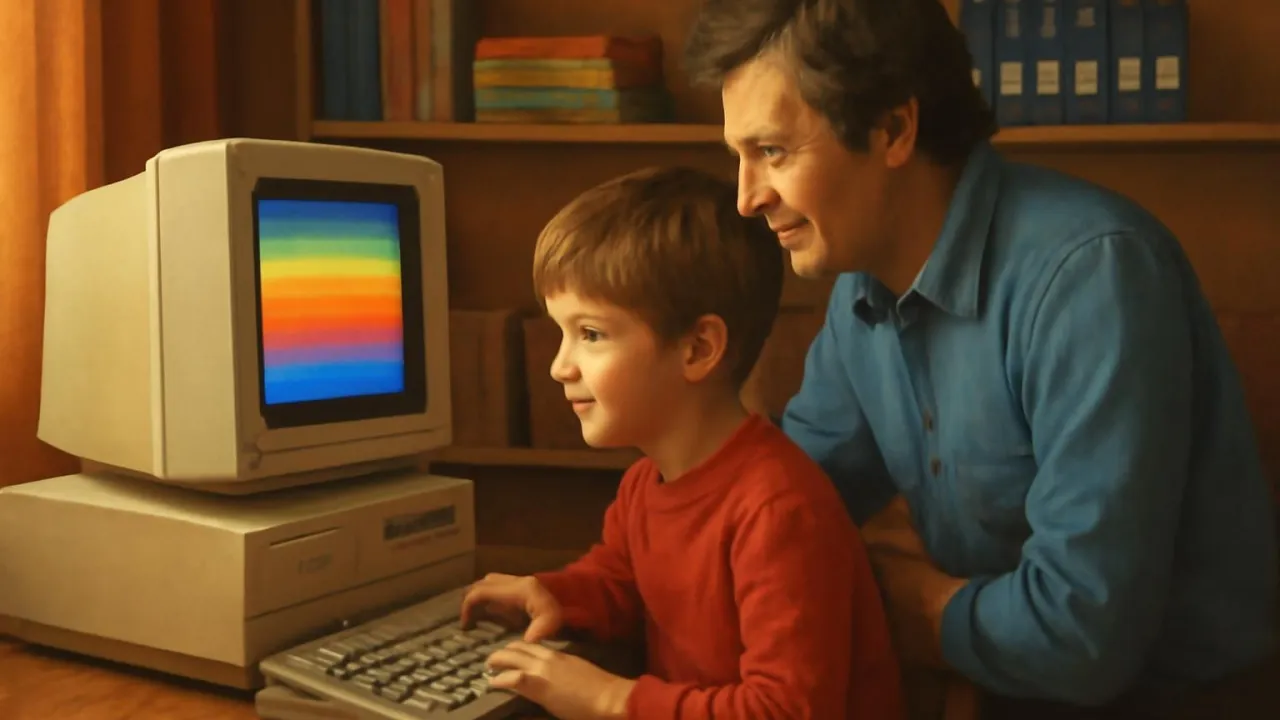
1. What sound might you hear when a computer starts?
2. Where do people use computers?
🤯 Mind-Blowing Fact • Grade 2
The first personal computers had less memory than a toy robot today!
✨ Word Sparks (Grade 2 Glossary)
Tap 🔊 to hear
chip
Tiny part that helps computer think
program
Set of steps the computer follows
memory
Where the computer keeps information
🪝
What if you could talk to a machine and see it answer you?
1
Meet the Computer
When you press the power button, the computer wakes up and makes a beep. The screen lights up, and you can see words and pictures appear. You use a keyboard to type and a mouse to click, making things happen on the screen.
2
Fun and Learning
People use computers to play games, draw colorful pictures, and write stories. At school, computers help us learn new things and find answers to questions. You can even talk to friends using computers.
3
How It Works
Inside the computer, tiny parts called help it think very fast. The computer follows instructions, called , to do what you want. Computers changed the world by making information easy to use and share.
The first Apple computer was sold as a kit you had to build yourself!
✨ Word Sparks (Grade 3 Glossary)
Tap 🔊 to hear
circuit
A path for electricity to flow
processor
The brain of the computer
binary
A code with only 0 and 1
🪝
Can you imagine a tiny box thinking faster than a whole library?
1
Turning Ideas into Actions
When you power on a computer, it makes a cheerful beep and the screen glows. You use the keyboard to type letters, and the mouse helps you move the pointer. The computer follows your commands, turning your ideas into pictures, stories, and games.
2
What’s Inside the Box?
A computer is filled with electronic parts called and chips. These chips process information using a system called code, which is made of zeros and ones. The main chip, called the , acts like the computer’s brain and controls everything.
3
How Computers Changed Our World
Personal computers made it possible for people to write, draw, and solve problems at home. Before computers, only big businesses and scientists had machines for data. Now, almost every classroom and home uses computers for learning and fun.
4
From Prototype to Popular
The first personal computers were invented in the 1970s by creative engineers. Steve Jobs and Steve Wozniak built the Apple I, a famous early model. Their prototype used a wooden case and simple , but it started a revolution in how we live and learn.
The first IBM PC cost as much as a small car in 1981!
✨ Word Sparks (Grade 4 Glossary)
Tap 🔊 to hear
hardware
The physical parts of a computer
software
The instructions a computer follows
innovation
A new idea or invention
🪝
What if you could fit a whole library and a drawing studio into one small box?
1
The Birth of Personal Computing
In the late 1970s, engineers like Steve Wozniak and Steve Jobs imagined a computer small enough for every home. They built the Apple I, a prototype with a wooden case and basic circuits, which inspired others to create new models. Before this, computers were huge and filled entire rooms, making them hard for most people to use. The personal computer changed everything by making powerful technology easy to own and operate.
2
How Does a Computer Work?
A personal computer uses electronic circuits and a central processor to perform calculations at incredible speeds. Data is stored in memory chips and is processed using binary code, which is a language of zeros and ones. When you type or click, the computer’s and work together to follow your instructions. This combination lets you write stories, play games, and even connect with people around the world.
3
Changing the Way We Live and Learn
Personal computers brought new opportunities for learning, creativity, and communication to millions of people. Students can research topics, create digital art, and solve math problems with just a few clicks. Businesses use computers to organize information, design products, and connect with customers everywhere. The world became more connected and efficient thanks to this invention.
4
From Prototype to Everyday Tool
Early personal computers like the Apple I and IBM PC inspired rapid in technology. Over the years, computers became smaller, faster, and easier to use, making them part of daily life. Today, almost every classroom, office, and home has at least one computer. The personal computer’s journey from a wooden box to a powerful tool shows how imagination and engineering can change the world.
A modern smartphone is millions of times more powerful than the first personal computers from the 1970s!
✨ Word Sparks (Grade 5 Glossary)
Tap 🔊 to hear
microprocessor
A tiny chip that runs the computer
operating system
The main software that controls the computer
cloud computing
Using the internet to store and process data
🪝
What if you could hold the power of thousands of books, calculators, and art studios in a single machine on your desk?
1
The Dawn of Personal Computing
In the 1970s, computers were massive, expensive machines used mostly by scientists and large organizations. Visionaries like Steve Wozniak and Steve Jobs believed that computers should be small, affordable, and accessible to everyone. Their invention, the Apple I, was released in 1976 as a kit with a wooden case and simple circuit boards. This prototype sparked a revolution, inspiring companies like IBM to create their own personal computers for homes and offices. The era of personal computing had begun, forever changing the way people work, learn, and communicate.
2
Inside the Machine: How It Works
A personal computer is a complex system made up of hardware components such as the central processing unit (CPU), memory chips, storage drives, input devices, and output displays. The CPU, often called the processor, executes millions of instructions per second using binary code, which is a language of only zeros and ones. When you type on the keyboard or move the mouse, the computer’s translates your actions into electronic signals. These signals travel through circuits, allowing the computer to process data, display graphics, and run software applications.
3
Engineering Breakthroughs and Innovations
The development of in the early 1970s was a key breakthrough, enabling computers to become smaller and more powerful. Early personal computers like the Apple II and IBM PC used 8-bit and 16-bit processors, which could handle basic graphics and simple programs. As technology advanced, computers gained more memory, faster processors, and improved storage, allowing for complex tasks such as video editing, 3D modeling, and global communication. The invention of graphical user interfaces made computers easier for everyone to use, not just experts.
4
Global Impact and Cultural Change
Personal computers transformed education, business, and everyday life by making information and creative tools widely available. Classrooms now use computers for research, simulations, and interactive learning, while businesses rely on them for data analysis, design, and communication. The rise of the internet and networking connected millions of computers worldwide, creating a digital society where people can share ideas instantly. Today, personal computers are essential for innovation, problem-solving, and connecting communities across the globe.
5
The Future of Personal Computing
Since the first personal computers, technology has continued to evolve rapidly, with laptops, tablets, and smartphones now offering even greater mobility and power. Modern computers use multi-core processors, solid-state drives, and to handle vast amounts of data and complex tasks. As artificial intelligence and quantum computing develop, the personal computer will keep changing how we learn, work, and create. The story of the personal computer shows how curiosity, engineering, and imagination can shape the world for generations to come.