1. What does Perseverance seal inside shiny metal tubes?
2. What special gas did a golden box inside the rover make on Mars?
🤯 Mind-Blowing Fact • Grade 2
Perseverance carried a tiny Mars helicopter tucked under its belly and two real pieces of spacesuit fabric to test how Martian radiation wears them down!
✨ Word Sparks (Grade 2 Glossary)
Tap 🔊 to hear
fossil
Preserved trace of ancient life inside rock
carbon dioxide
The main gas making up Mars's thin air
radiation
Invisible energy waves traveling through outer space
🪝
Why did scientists steer their newest rover straight into a rocky, cliff-filled crater?
1
Steering Around Danger
Splashdown happened billions of years ago in Jezero Crater, leaving behind steep cliffs and sand traps. In February 2021, onboard cameras compared live ground photos to orbital maps, steering the rover safely to a flat parking spot!
2
Searching an Ancient Delta
Why visit a tricky spot? Ancient rivers once poured into this crater lake, piling mud into a fan-shaped delta where tiny of microscopic life might hide.
3
Microphones and Oxygen
For the first time, microphones recorded real Martian breezes! Meanwhile, a toaster-sized experiment named MOXIE baked gas to create pure oxygen.
1. Why was Jezero Crater chosen as the landing site?
2. What sound did Perseverance's microphones capture for the very first time?
🤯 Mind-Blowing Fact • Grade 3
In 2024, Perseverance inspected an arrowhead-shaped rock nicknamed 'Cheyava Falls' covered in tiny 'leopard spots' formed by ancient water and organic chemistry!
How does a robot recognize signs of three-billion-year-old microbes on another planet?
1
Pinpoint Landing at Jezero
Rushing through fiery orange plasma at twelve thousand miles per hour, NASA's Mars 2020 capsule popped its parachute above hazardous Jezero Crater. Using Terrain-Relative Navigation, computer brains scanned boulders and cliffs below in seconds, dodging obstacles to touch down safely on February 18, 2021.
2
Detective Pair: SHERLOC and WATSON
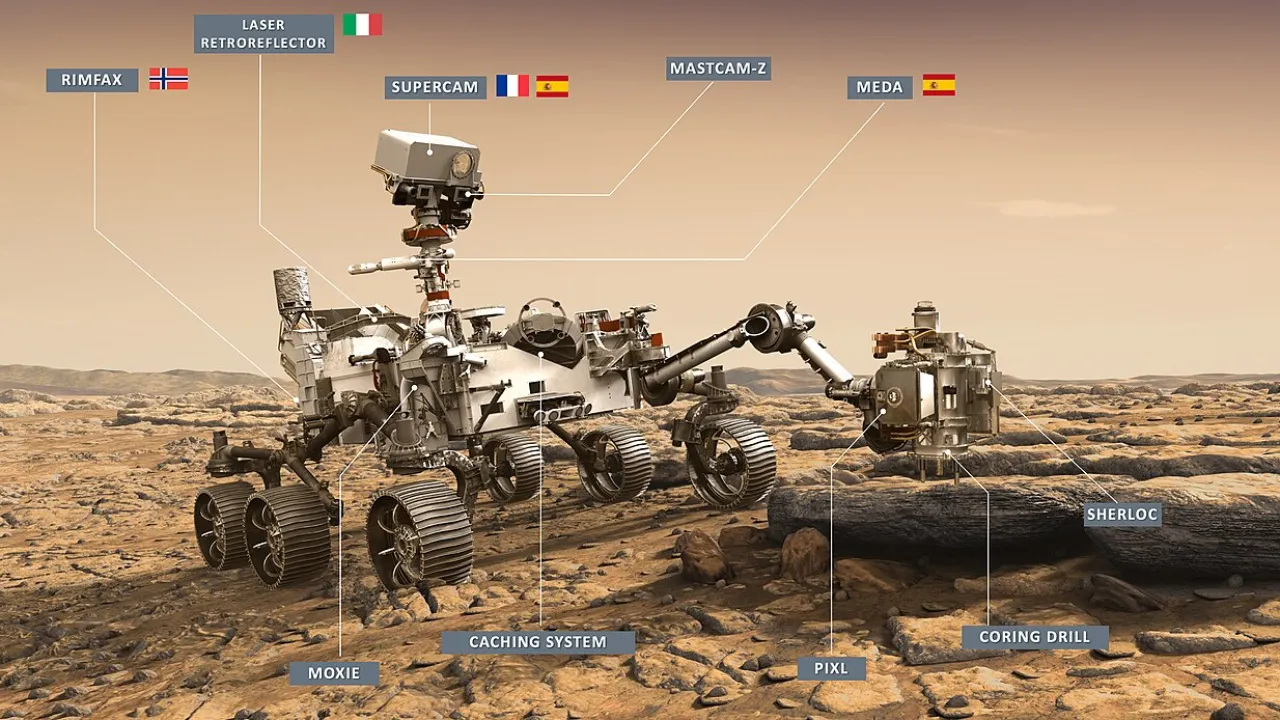
Mounted on the end of a seven-foot turret arm, an scanner named SHERLOC teams up with a close-up camera called WATSON. Together they map microscopic mineral grains and organic carbon compounds without crushing the rock's delicate textures.
3
The Ultra-Clean Sample Cache
Inside the rover's belly spins a miniature robot arm and forty-three tubes scrubbed cleaner than an operating room, sealing chalk-sized rock cores for future laboratories on Earth.
4
Breathing and Propellant From Air
At the same time, the gold-plated MOXIE box zapped Martian carbon dioxide at 1,470 degrees Fahrenheit, splitting off enough oxygen over sixteen runs for a small dog to breathe for ten hours!
1. Why are the rover's titanium sample tubes kept ultra-clean?
2. Besides helping astronauts breathe, why will making oxygen on Mars be super useful?
🤯 Mind-Blowing Fact • Grade 4
An anodized aluminum plate on Perseverance displays Earth, the Sun, and a serpent-wrapped medical staff honoring healthcare workers around the world!
✨ Word Sparks (Grade 4 Glossary)
Tap 🔊 to hear
igneous
Rock formed when molten lava or magma cools
carbonate
Water-formed mineral great at trapping ancient biosignatures
electrolysis
Using electricity to split molecules apart chemically
🪝
Why did Jezero Crater's floor turn out to be hardened volcanic magma instead of soft lake mud?
1
Built Bigger, Smarter, and Tougher
Although Perseverance shares the six-wheeled body style of its predecessor Curiosity, engineers upgraded almost everything inside its 2,260-pound frame. Thicker aluminum wheels with gentler curved treads resist sharp rocks, while self-driving AutoNav software calculates safe paths while the wheels are still turning—allowing Perseverance to cover ground several times faster than any previous Mars rover.
2
Radar Under the Wheels and Volcanic Surprises
As the rover rolled across Jezero's floor, its RIMFAX ground-penetrating radar beamed radio waves thirty feet below the dust to sketch buried strata. When SuperCam and the X-ray instrument PIXL examined the crater floor, geologists got a shock: instead of lake mud, the bottom rocks were crystalline stones cooled from ancient lava, later altered by groundwater! That lucky surprise gave scientists exact volcanic crystals that labs on Earth can radiometrically date like atomic clocks.
3
Exploring the Sedimentary Delta
Driving onward to the towering river delta front, Perseverance cored fine-grained sandstones, shoreline minerals, and organic-bearing mudstones—even leaving a backup depot of ten sealed sample tubes at Three Forks.
4
Paving Humanity's Next Giant Leap
By deploying the Ingenuity helicopter and proving in-situ resource utilization through MOXIE's solid-oxide of atmospheric carbon dioxide, Perseverance transformed from a lone robotic scout into a trailblazer for human exploration.
1. Why were geologists actually thrilled to find igneous volcanic rock on Jezero Crater's floor?
2. What tool lets Perseverance peer thirty feet beneath the Martian surface as it drives?
🤯 Mind-Blowing Fact • Grade 5
Nearly 11 million space fans sent their names to Mars aboard Perseverance, etched by electron beams in microscopic letters onto three fingernail-sized silicon chips!
✨ Word Sparks (Grade 5 Glossary)
Tap 🔊 to hear
biosignature
Chemical or physical clue indicating past or present life
stromatolite
Layered rock mound built by ancient microbial mats
in-situ
Using natural resources found right at the destination
🪝
How do you search a 28-mile-wide Martian crater for microscopic biosignatures without accidentally contaminating the evidence?
1
Precision Guidance Into Ancient Waters
Billions of years ago, a rushing river breached the western rim of Jezero Crater, fanning sediments into a standing body of water 28 miles across. Landing amid boulder fields and steep delta scarps would have doomed earlier missions, so NASA's Mars 2020 engineers equipped the descent stage with Lander Vision System cameras and Terrain-Relative Navigation. During parachute descent, onboard algorithms matched surface landmarks in milliseconds and diverted the Sky Crane to a safe touchdown zone on February 18, 2021.
2
Microscale Chemical Mapping
Unlike Curiosity, which pulverizes rocks for internal ovens, Perseverance preserves intact rock architecture where fossilized microbial mats—similar to Earth's ancient —might leave chemical halos. On its turret, PIXL focuses a hair-thin X-ray beam across abraded rock patches to map elemental distributions, while SHERLOC uses deep-ultraviolet Raman and fluorescence spectroscopy to pinpoint aromatic organic rings alongside water-deposited minerals.
3
Engineering Marvel of Adaptive Caching
Collecting pristine cores required inventing a three-thousand-part Adaptive Caching Assembly with nine drill bits and forty-three hermetically sealed titanium tubes baked to extreme planetary-protection cleanliness. In 2024, coring at Bright Angel exposed 'Cheyava Falls,' a mudstone veined with calcium sulfate and millimeter-scale iron-phosphate 'leopard spots'—a tantalizing potential formed by redox reactions.
4
In-Situ Resource Utilization With MOXIE
To prepare for crewed expeditions, the Mars Oxygen Resource Utilization Experiment compressed thin Martian air—96 percent carbon dioxide—and passed it across catalyzed nickel electrodes at 800 degrees Celsius, liberating breathable molecular oxygen at up to twelve grams per hour.
5
Climbing Out of the Crater
Having scaled the delta and climbed up Jezero's towering western rim to inspect four-billion-year-old crustal rocks, Perseverance continues building humanity's priceless geological archive on another world.