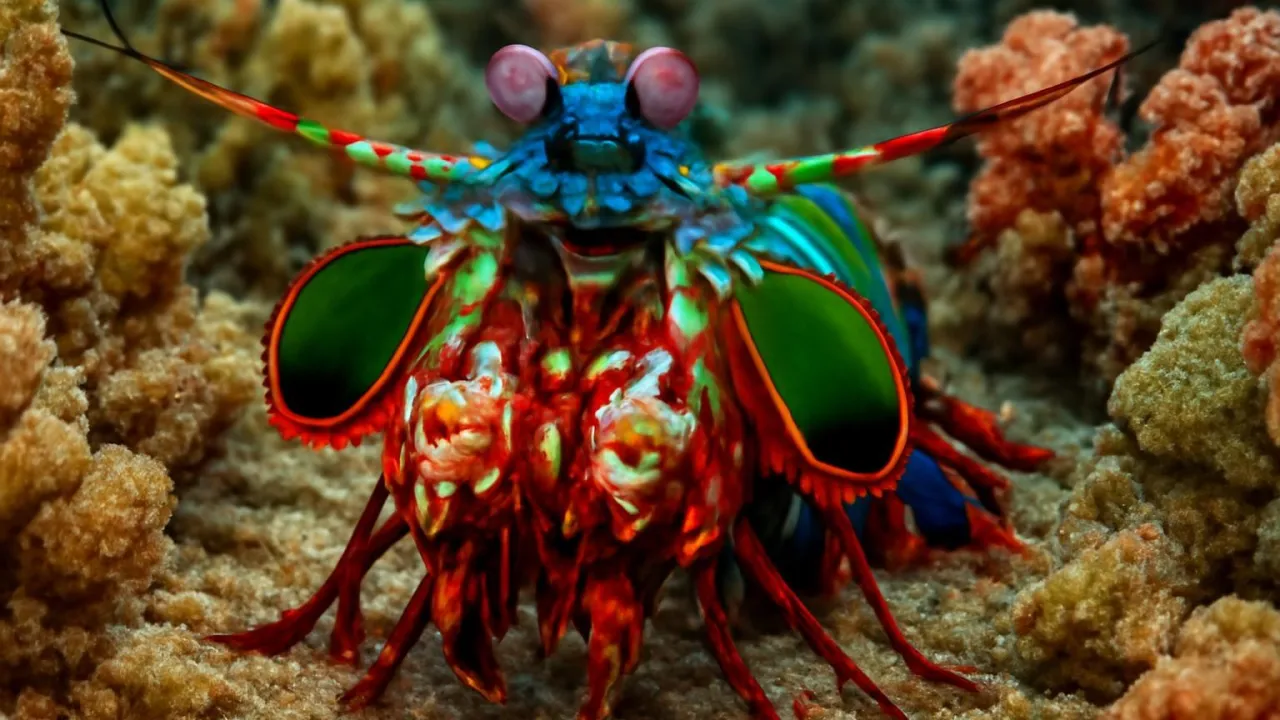
1. What colors does the peacock mantis shrimp have?
2. Where does the shrimp live?
🤯 Mind-Blowing Fact • Grade 2
Its punch can move as fast as a speeding bullet underwater!
✨ Word Sparks (Grade 2 Glossary)
Tap 🔊 to hear
coral reef
A colorful underwater home for many sea animals
claws
Sharp pincers used to catch and break food
punch
A quick, strong hit with a claw or hand
🪝
Have you ever seen a shrimp that can punch faster than your eye blinks?
1
Bright and Beautiful
The peacock mantis shrimp has bright colors all over its body, including red, green, and blue. It looks like a tiny rainbow swimming in the ocean. These colors help it blend in with the where it lives.
2
Powerful Punching Claws
This shrimp has special that can very fast and very hard. It uses these claws to break open shells of small animals and catch its food. Its punch is so fast it can even crack aquarium glass.
3
Home in the Ocean
Peacock mantis shrimp live in warm in the Indo-Pacific ocean. They hide in small holes and cracks during the day. At night, they come out to hunt for food like fish and crabs.
Its punch accelerates faster than a .22 caliber bullet, making it one of the fastest strikes on Earth!
✨ Word Sparks (Grade 3 Glossary)
Tap 🔊 to hear
camouflage
Colors that help animals hide in their home
raptorial
Special claws used for grabbing and striking prey
ecosystem
All living things and their homes working together
🪝
Did you know the peacock mantis shrimp has one of the fastest punches in the ocean?
1
Amazing Colors and Camouflage
The peacock mantis shrimp displays vivid red, green, and blue colors that help it blend into coral reefs. This protects it from predators and surprises prey. Its bright colors also signal strength to other shrimp nearby. This adaptation helps it survive in its ocean home.
2
Lightning-Fast Punching Claws
This shrimp’s claws strike with incredible speed and force, faster than a bullet. The punch can shatter shells and even aquarium glass. This powerful strike helps it catch prey like crabs and small fish quickly. The claws store energy like a spring before releasing the punch.
3
Habitat and Behavior
Peacock mantis shrimp live in warm coral reef of the Indo-Pacific region. They build burrows or hide in crevices during the day to avoid predators. At night, they actively hunt by using their claws to stun or kill prey. Their behavior helps maintain balance in the reef food web.
4
Role in the Ecosystem
As predators, mantis shrimp control populations of small fish and shellfish, keeping the reef healthy. Their burrowing also aerates the ocean floor, helping nutrients cycle. They have symbiotic relationships with other reef animals by sharing shelter. This shrimp is an important part of coral reef biodiversity.
2. What role does the mantis shrimp play in the ecosystem?
🤯 Mind-Blowing Fact • Grade 4
Its punch creates tiny bubbles that explode, stunning prey even without contact!
✨ Word Sparks (Grade 4 Glossary)
Tap 🔊 to hear
cavitation
Bubbles formed by fast movement underwater
symbiosis
Two animals helping each other live
raptorial
Claws that grab and hit prey quickly
🪝
How can a shrimp punch so fast it breaks glass and changes its coral reef home?
1
Colorful Adaptations and Camouflage
The peacock mantis shrimp’s brilliant red, green, and blue colors serve as camouflage within coral reefs, allowing it to avoid predators and ambush prey effectively. Its coloration also signals dominance to other mantis shrimp, reducing fights. This adaptation is vital for survival in the competitive reef environment.
2
Mechanics of the Superfast Punch
Its claws function like a spring-loaded hammer, storing energy before releasing a punch that accelerates faster than a bullet underwater. This punch can break shells of crabs and mollusks and even shatter aquarium glass, demonstrating immense power. The shrimp’s punch speed creates bubbles that also stun prey.
3
Ecological Role and Symbiosis
As a predator, the mantis shrimp regulates populations of small fish and shellfish, maintaining balance in coral reef food webs. Its burrowing aerates the ocean floor, promoting nutrient cycling, which benefits other reef organisms. Sometimes, it shares its burrow with gobies, showing a symbiotic relationship that offers mutual protection.
4
Geographic Range and Human Impact
Peacock mantis shrimp inhabit coral reefs throughout the Indo-Pacific, from East Africa to Australia. Coral reef degradation caused by climate change and pollution threatens their habitat. Overfishing in some regions also reduces their prey availability. Conservation efforts to protect coral reefs help preserve these remarkable shrimp and their ecosystems.
1. What special effect does the shrimp’s punch create underwater?
2. How does the mantis shrimp help coral reefs?
🤯 Mind-Blowing Fact • Grade 5
Its punch accelerates at over 10,000 times the force of gravity, making it one of nature’s fastest strikes.
✨ Word Sparks (Grade 5 Glossary)
Tap 🔊 to hear
raptorial
Claws designed for fast, powerful strikes
cavitation
Bubbles formed by rapid underwater movement
acceleration
How quickly something speeds up
🪝
What makes the peacock mantis shrimp’s punch one of the fastest and most powerful strikes in the animal kingdom?
1
Taxonomy and Scientific Classification
The peacock mantis shrimp, Odontodactylus scyllarus, belongs to the order Stomatopoda within the class Malacostraca. Unlike true shrimp, stomatopods have specialized appendages used for hunting. Their evolutionary adaptations distinguish them from other crustaceans, showcasing a unique predatory niche in marine ecosystems.
2
Physiological Mechanics of the Punch
This shrimp’s claws operate through a saddle-shaped spring mechanism that stores elastic energy before release. The punch accelerates at approximately 10,400 g, reaching speeds near 50 miles per hour underwater. The resulting strike generates bubbles that collapse violently, producing shockwaves to stun or kill prey beyond physical contact.
3
Conservation Status and Ecological Importance
While not currently endangered, peacock mantis shrimp populations face threats from coral reef habitat loss due to climate change and pollution. Their role as apex invertebrate predators helps maintain balance in reef food webs by controlling populations of crustaceans and small fish. Protecting coral reefs indirectly supports their survival.
4
Comparative Physical and Behavioral Traits
At up to 7 inches (18 centimeters), the peacock mantis shrimp is larger than many other stomatopods. Its vibrant coloration aids in intraspecific communication and camouflage. Behaviorally, it exhibits complex mating rituals and territoriality, often engaging in ritualized combat to defend burrows within coral reef structures.
5
Quantitative Measurements and Environmental Adaptations
The mantis shrimp’s punch speed exceeds 50 miles per hour, with an surpassing that of a bullet fired from a handgun. Its exoskeleton can withstand repeated high-impact strikes without damage. It thrives in Indo-Pacific coral reefs with temperatures ranging from 75 to 85 degrees Fahrenheit, adapting to diverse reef microhabitats. This remarkable physiology allows it to survive and dominate in a complex environment.