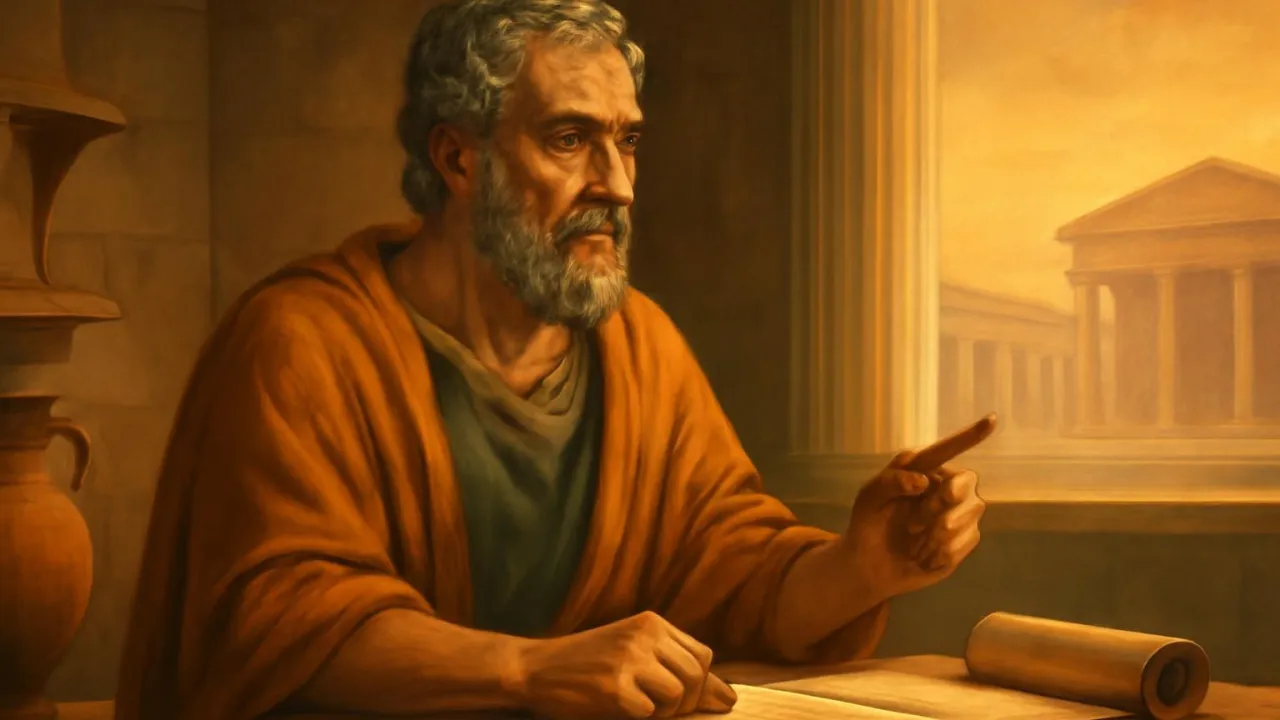
Parmenides’ poem is one of the earliest works about philosophy and reality.
✨ Word Sparks (Grade 2 Glossary)
Tap 🔊 to hear
illusion
Something that looks real but is not
poem
A special kind of writing with rhythm
philosophy
Thinking about big questions in life
🪝
Have you ever wondered if things really change or stay the same?
1
Curious Questions
Parmenides wondered if change was real or just an . He asked big questions about being and truth. He wanted to understand what is real and what is not.
2
Hard Work Thinking
He wrote to explain his ideas. He practiced thinking deeply every day. His words helped others learn about and reality.
3
A Famous Idea
Parmenides said that change is not real but only seems to happen. This idea was new and important. It helped shape how people think about the world.
Parmenides’ poem is one of the first texts to use reason over senses to explain reality.
✨ Word Sparks (Grade 3 Glossary)
Tap 🔊 to hear
being
What really exists and never changes
perseverance
Keep trying even when it is hard
metaphysics
Philosophy about what is real and beyond
🪝
What if everything you see changing is only a trick of your mind?
1
Parmenides’ Big Idea
Parmenides believed that true reality never changes and is one whole . He used the word 'being' to mean what really exists and does not change. His philosophy asked people to think about what is permanent and what is only appearance.
2
Thinking with Perseverance
He wrote a poem called 'On Nature' that explained his ideas about reality and truth. Parmenides showed by carefully explaining why change is impossible. His work introduced important words like 'hypothesis' and 'truth' in philosophy.
3
Changing Philosophy Forever
Parmenides’ ideas challenged other thinkers who believed in change and motion. His philosophy started a new way to think about existence and reality. This influenced many later philosophers and the study of .
4
The Power of Thought
Parmenides taught that using reason and logic is the best way to find truth. He believed senses can be misleading. His work reminds us to question what we see and think deeply about life.
Parmenides’ poem is one of the earliest surviving works to focus on logic over senses.
✨ Word Sparks (Grade 4 Glossary)
Tap 🔊 to hear
ontology
Study of what exists and being
argumentation
Using reasons to explain ideas clearly
existence
The state of being real or alive
🪝
How did Parmenides’ ideas change the way people think about reality forever?
1
Historical Context
Parmenides lived in ancient Greece around 500 BCE during a time when many philosophers explored the nature of reality and . His hometown Elea was a center for early philosophical thought and lively debates. He questioned the common belief that the world constantly changes and moves.
2
A Turning Point in Philosophy
Parmenides argued that change and motion are illusions and that only 'being' truly exists and is unchanging. This was a turning point because it challenged the ideas of Heraclitus, who believed everything changes and flows. His poem 'On Nature' carefully explained this revolutionary way of thinking.
3
Signature Innovation
Parmenides introduced the idea that reason and logic should guide understanding rather than relying on the senses, which can deceive people. He used careful to show why change is impossible in true reality. This method became a foundation for metaphysics and , shaping future philosophy.
4
Global Impact
Parmenides’ philosophy influenced many later thinkers, including Plato and Aristotle, who built on his ideas about being and change to develop Western philosophy. His work helped shape ideas about , truth, and knowledge that are still studied today around the world.
2. What did Parmenides believe guides understanding best?
🤯 Mind-Blowing Fact • Grade 5
Parmenides’ phrase 'what is, is' became a foundational statement in philosophy and logic.
✨ Word Sparks (Grade 5 Glossary)
Tap 🔊 to hear
ontology
Study of what exists and being
epistemology
Study of knowledge and how we know
rational
Using clear thinking and reason
🪝
How did Parmenides’ radical ideas about being and change shape the foundation of Western philosophy?
1
Early Life and Background
Parmenides was born around 515 BCE in Elea, a Greek city in southern Italy known for its intellectual community. He lived during a time when many thinkers sought to understand the universe through reason rather than myth. His environment encouraged deep questioning about existence and reality.
2
Philosophical Mechanics and Method
Parmenides developed a method of philosophical inquiry that emphasized reason and logic over sensory experience. He argued that the senses can deceive us, and only through thought can we grasp the unchanging nature of true being. His poem 'On Nature' presents a systematic argument about the impossibility of change.
3
Quantitative and Qualitative Legacy
Though none of Parmenides’ original works survive fully, fragments of his poem reveal a detailed that influenced metaphysics. His assertion that 'what is, is' and 'what is not, is not' laid groundwork for logical principles. Later philosophers, including Plato and Aristotle, expanded on his ideas to develop Western metaphysical thought.
4
Historical and Cultural Impact
Parmenides’ challenge to the belief in change marked a significant turning point in ancient philosophy. His ideas prompted debates that shaped the development of logic, , and metaphysics. His influence extended beyond Greece, impacting philosophical traditions worldwide and continuing to inspire modern thinkers.
5
Inspiring Takeaways
Parmenides teaches us the power of questioning what seems obvious and the importance of using reason to seek truth. His work reminds us that deep thinking and perseverance can change how we understand the world. His legacy encourages curiosity and careful reasoning in all areas of life, inspiring thinkers everywhere to explore big questions.