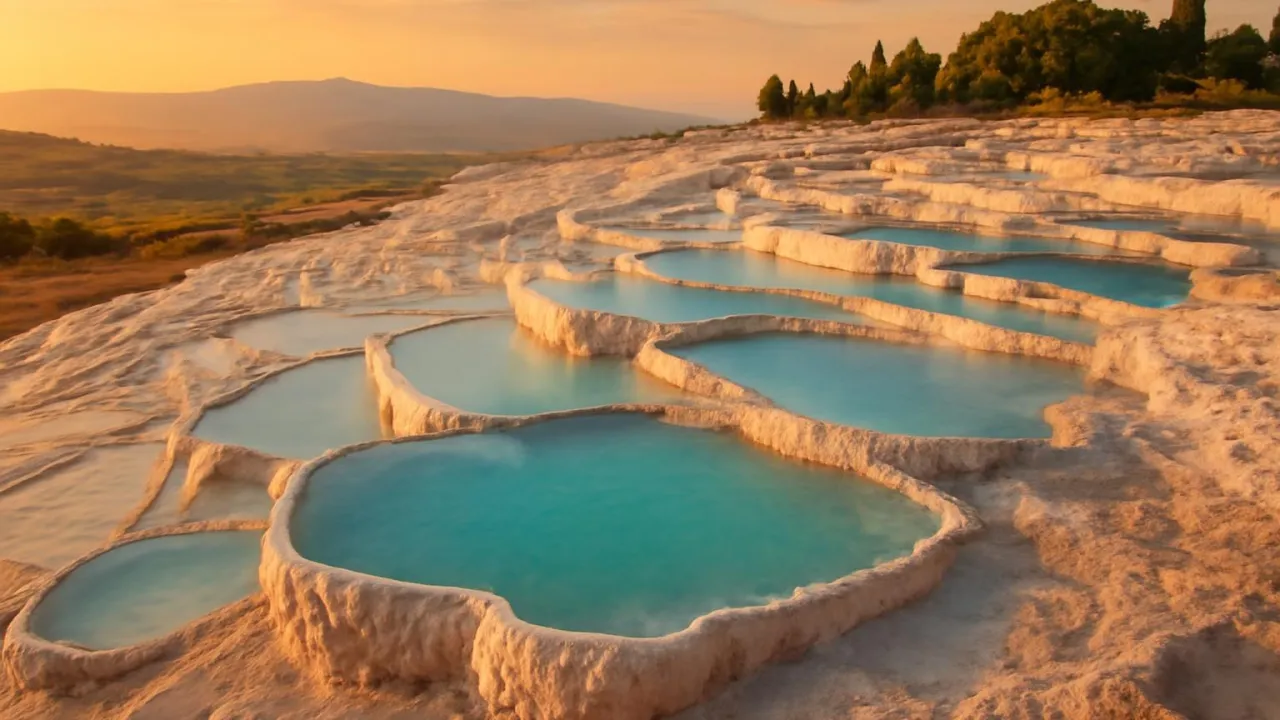
People have visited Pamukkale’s pools for thousands of years—even ancient Romans loved them!
✨ Word Sparks (Grade 2 Glossary)
Tap 🔊 to hear
spring
Water that comes up from the ground
surface
The top part of something
protected
Kept safe from harm
🪝
Can you imagine dipping your toes in warm, bright blue pools on a white hill?
1
A Hill of White Steps
Pamukkale looks like a giant staircase made of snow, but it’s not cold. Warm water flows down the hill, making the steps smooth and shiny. People come from all over to see the white terraces.
2
How the Pools Form
Hot under the ground send water up to the . The water has minerals that build up and make the white steps. Over many years, the pools grow bigger and brighter.
3
A Special Place in Turkey
Families visit Pamukkale to take pictures and splash in the pools. The pools are famous in Turkey and are for everyone to enjoy. The name Pamukkale means “Cotton Castle” in Turkish.
Pamukkale’s pools are still growing and changing every year, thanks to the flowing hot springs!
✨ Word Sparks (Grade 3 Glossary)
Tap 🔊 to hear
travertine
A white stone made from minerals
deposition
When minerals build up over time
erosion
When water or wind wears things away
🪝
What if the ground beneath your feet felt warm, smooth, and as white as clouds?
1
Nature’s White Staircase
Pamukkale’s terraces look like giant white steps, but they’re made of stone, not snow. The bright blue water comes from hot springs deep underground. As the water flows down, it cools and leaves behind white minerals called . This process creates the unique, shimmering pools that visitors see today.
2
How the Pools Form
The hot water is filled with calcium carbonate, a mineral that forms when water evaporates. Over many years, the mineral builds up, creating new terraces and pools. This natural process is called , and it’s what makes Pamukkale so bright and white. The pools are always changing shape as new layers form.
3
A Place for Relaxation
People have visited Pamukkale for thousands of years to relax in its warm waters. Even ancient Romans built baths near the pools, believing the water had healing powers. Today, visitors must be careful to protect the terraces from . Special walkways help keep the white stone safe.
4
A World Wonder in Turkey
Pamukkale is a UNESCO World Heritage site because of its rare beauty and history. The name means 'Cotton Castle' in Turkish, describing its fluffy appearance. The terraces stretch over a mile, and the highest point rises 525 feet above the land. People from around the world come to see this natural wonder.
2. Why do people use special walkways at Pamukkale?
🤯 Mind-Blowing Fact • Grade 4
The terraces of Pamukkale can hold over 17,000 gallons (65,000 liters) of water at once!
✨ Word Sparks (Grade 4 Glossary)
Tap 🔊 to hear
crystallize
To turn into a solid crystal shape
geology
The study of rocks and Earth
archaeologist
A scientist who studies ancient places
🪝
Imagine standing on a gleaming white hill, where warm water flows under your toes—how did this magical place form?
1
The Making of a Cotton Castle
Pamukkale’s dazzling terraces are formed by the constant flow of mineral-rich hot springs that bubble up from deep within the Earth. As the hot water travels over the hillside, it cools and releases calcium carbonate, which into travertine, creating the famous white steps. This process, known as deposition, has been shaping Pamukkale for over 400,000 years. The result is a landscape that looks like a frozen waterfall or a staircase made of clouds.
2
A History of Healing and Wonder
People have been drawn to Pamukkale for thousands of years, especially during the time of the ancient Romans. They built the city of Hierapolis next to the pools, believing the warm, mineral waters could heal sickness and soothe tired muscles. have found ancient baths and temples near the terraces, showing how important this site was in history. Today, Pamukkale is protected as a UNESCO World Heritage site to keep its beauty safe for the future.
3
Natural Science at Work
The unique white color of Pamukkale comes from a chemical reaction between the hot spring water and the air. As the water cools, it can no longer hold all its dissolved calcium carbonate, so the mineral settles out and forms solid layers. This ongoing process means the terraces are always changing, with new pools forming and old ones fading away. Scientists study Pamukkale to learn about , mineral deposition, and how water shapes the land.
4
Protecting a Fragile Treasure
Because Pamukkale is delicate, visitors must walk barefoot on special paths to avoid damaging the travertine. Too many people or pollution can harm the white terraces, so rules are in place to protect them. The site is not just important for Turkey, but for the whole world, as it shows how natural forces can create breathtaking beauty. Pamukkale’s pools continue to inspire awe and curiosity in everyone who visits.
1. How does calcium carbonate form the white terraces?
2. Why is Pamukkale protected today?
🤯 Mind-Blowing Fact • Grade 5
Pamukkale’s hot springs deposit nearly 2.2 pounds (1 kg) of calcium carbonate every single day!
✨ Word Sparks (Grade 5 Glossary)
Tap 🔊 to hear
precipitate
When a solid forms from a liquid
hydrothermal
Related to hot water from underground
conservation
Protecting nature and important places
🪝
What scientific secrets are hidden in the steaming white terraces where ancient Romans once bathed and nature’s chemistry never sleeps?
1
A Geothermal Marvel Born of Chemistry
Pamukkale’s breathtaking terraces are the product of geothermal activity and complex chemical reactions that have unfolded over hundreds of thousands of years. Deep underground, water is heated by geothermal energy and becomes saturated with dissolved calcium carbonate. As this mineral-rich water emerges at the surface, it rapidly cools and releases carbon dioxide, causing the calcium carbonate to out and crystallize into travertine. This ongoing process has built up the iconic white terraces, which cover an area of about 6,600 feet (2,000 meters) in length and rise up to 525 feet (160 meters) above the valley.
2
Ancient Civilizations and the Healing Springs
The allure of Pamukkale’s thermal pools has attracted people since prehistoric times, but it was the ancient Greeks and Romans who truly transformed the area. The city of Hierapolis, founded in the 2nd century BCE, became a major center for health and worship, with grand bath complexes and temples built alongside the terraces. Archaeological discoveries reveal that people believed the mineral-rich waters could cure illnesses, and the site became a destination for travelers seeking wellness and spiritual renewal.
3
Dynamic Landscape: Deposition, Erosion, and Conservation
The formation of Pamukkale’s terraces is a delicate balance between mineral deposition and natural erosion. As calcium carbonate continues to accumulate, new pools form while older ones may erode or dry up. Human activity, such as tourism and water diversion, has threatened the site’s integrity, prompting strict measures. Today, visitors must walk barefoot on designated paths, and water flow is carefully managed to preserve both the travertine and the site’s ecological health.
4
Global Significance and Scientific Study
Pamukkale is recognized as a UNESCO World Heritage site for its geological, historical, and cultural value. Scientists study the site to understand systems, mineral crystallization, and environmental impacts on fragile landscapes. The terraces’ unique structure provides insight into Earth’s natural processes, while the ancient ruins of Hierapolis offer a glimpse into how early civilizations interacted with their environment.
5
A Living Laboratory for the Future
As climate change and increased tourism place new pressures on Pamukkale, ongoing research and sustainable management are essential to protect this natural wonder. By monitoring water chemistry, controlling visitor access, and restoring damaged areas, scientists and conservationists aim to ensure that Pamukkale’s white cascades continue to inspire and educate future generations. The site stands as a powerful example of how geology, history, and human stewardship can come together to preserve a world treasure.