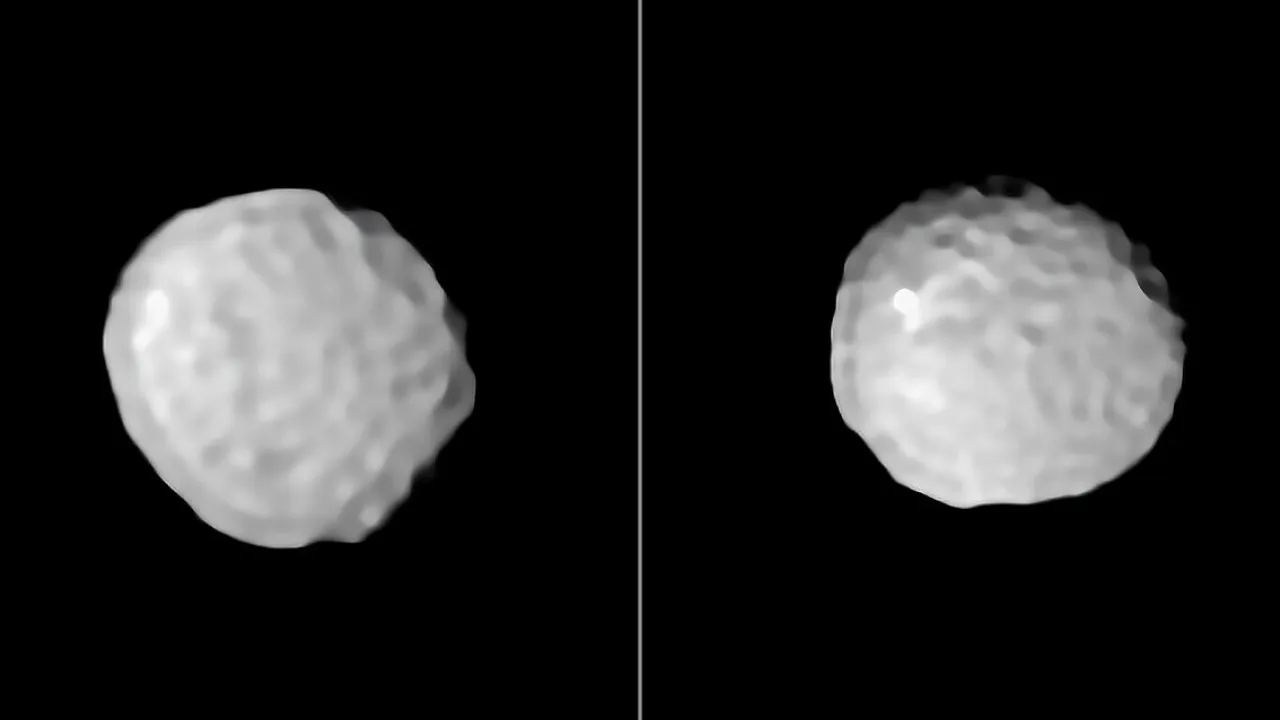
1. What sports ball does crater-covered Pallas look like in sharp telescope photos?
2. How is Pallas's path around the Sun different from most asteroids?
🤯 Mind-Blowing Fact • Grade 2
When Heinrich Olbers discovered Pallas in the same region as Ceres, he was the very first scientist to guess that a whole belt of small worlds circled between Mars and Jupiter!
✨ Word Sparks (Grade 2 Glossary)
Tap 🔊 to hear
wisdom
Deep knowledge and smart, careful thinking
angle
Amount one path slants away from another
fuel
Material burned or used to push rockets
🪝
Why has no robotic spacecraft ever stopped to orbit giant Pallas yet?
1
Named for Wisdom
On March 28, 1802, German doctor and astronomer Heinrich Olbers spotted a moving star while hunting for newly found Ceres! Named after Pallas Athena, Greek goddess of , 2 Pallas was only the second asteroid ever discovered.
2
Hard for Rockets to Reach
Measuring 318 miles wide, Pallas is nearly tied with Vesta as the second-biggest asteroid! Why did NASA's Dawn visit Vesta and Ceres instead of Pallas? Pallas's orbit tilts at a steep 35-degree , requiring huge amounts of extra rocket to match!
3
Super-Fast Fender Benders
Plunging steeply across the main belt means Pallas slams into smaller rocks twice as fast as normal, stamping craters across its entire crust!
1. Why is Pallas much harder for spacecraft to orbit than Ceres or Vesta?
2. Who was 2 Pallas named after?
🤯 Mind-Blowing Fact • Grade 3
In 1803, English chemist William Hyde Wollaston discovered a brand-new silvery metal on Earth and named it 'palladium' right after newly discovered asteroid Pallas!
✨ Word Sparks (Grade 3 Glossary)
Tap 🔊 to hear
adaptive optics
Fast-bending telescope mirrors fixing blurry air twinkle
Geminids
Bright yearly December meteor shower from Phaethon
palladium
Precious silvery metal named after asteroid Pallas
🪝
How did giant ground telescopes in Chile finally reveal Pallas's golf-ball face without a spacecraft?
1
Sharper Than Space Cameras
Because no space probe has visited 2 Pallas yet, its 318-mile surface stayed blurry for two centuries. In 2020, astronomers used special bendable mirrors—called —on the Very Large Telescope in Chile to cancel out Earth's twinkling air and snap razor-sharp portraits!
2
Hyper-Speed Impacts
Those portraits stunned planetary scientists: Pallas looks just like a heavily dimpled golf ball! While typical belt asteroids bump into each other at three miles per second, Pallas's 34.8-degree tilted orbit causes smashups averaging seven miles per second—punching at least thirty-six craters wider than twenty miles!
3
A Bright Salty Mystery Spot
Inside one crater gleams a bright white spot, likely ancient underground salt brought up from Pallas's water-rich rocky interior.
4
Link to December's Geminid Meteors
Fragments blasted off Pallas formed the Pallas asteroid family—likely including weird blue rock 3200 Phaethon, parent of December's dazzling Geminid meteor shower!
1. Why are impact speeds on Pallas more than twice as fast as average Asteroid Belt collisions?
2. How did astronomers capture crisp, golf-ball-clear images of Pallas from Earth in 2020?
🤯 Mind-Blowing Fact • Grade 4
Impact collisions on Pallas pack roughly four times the kinetic energy per pound of typical Asteroid Belt crashes—making Pallas the most violently battered large world in the belt!
✨ Word Sparks (Grade 4 Glossary)
Tap 🔊 to hear
B-type asteroid
Primitive bluish carbon- and clay-rich asteroid group
kinetic energy
Energy an object carries from its motion
rock comet
Asteroid shedding dust from extreme solar heat
🪝
Why is Pallas sandwiched halfway between dry volcanic Vesta and icy dwarf planet Ceres in its evolution?
1
Third Largest by Mass, Nearly Tied in Width
Containing roughly 7 percent of all mass in the Main Asteroid Belt, 2 Pallas ranks third behind Ceres and Vesta—though its 318-mile (512-kilometer) average width nearly ties Vesta's 326 miles! Unlike volcanic Vesta, infrared spectra classify Pallas as a —the exact same bluish, carbon- and clay-rich spectral class as sample-return target Bennu.
2
A Salty, Muddy Interior
Adaptive-optics measurements from the European Southern Observatory's SPHERE instrument pinned Pallas's density near 2,900 kilograms per cubic meter—denser than icy Ceres yet lighter than iron-cored Vesta. Models suggest Pallas accreted slightly slower than Vesta, holding enough mild radioactive heat to melt interior ice into salty brines that drained rock downward and left bright evaporite salt pockets near craters!
3
Equator-Spanning Mega-Basin
Along Pallas's equator yawns a colossal 250-mile-wide impact basin carved roughly 1.7 billion years ago when a twenty-five-mile projectile struck nearly head-on. That tremendous crash excavated miles of dark hydrated crust and launched thousands of fragments—known today as the Pallas collisional family—across steeply inclined orbits.
4
3200 Phaethon and Rock-Comet Meteors
Orbital dynamics trace 3.6-mile near-Earth asteroid 3200 Phaethon straight back to that Pallas family! Sweeping closer to the blazing Sun than Mercury every 1.4 years, Phaethon bakes glowing sodium vapor out of its fractured rocks to shed the gritty December Geminid meteor stream.
1. How does Pallas's interior compare to Vesta's and Ceres's?
2. How is Pallas likely connected to every December's bright Geminid meteor shower?
🤯 Mind-Blowing Fact • Grade 5
William Herschel actually invented the word 'asteroid' in 1802 right after Pallas was discovered, because both Ceres and Pallas looked like tiny pinpricks of starlight even in his biggest telescopes!
✨ Word Sparks (Grade 5 Glossary)
Tap 🔊 to hear
delta-v
Change in velocity needed for spacecraft maneuvers
ellipsoid
Three-dimensional oval ball with unequal axis lengths
metamorphism
Mineral transformation driven by intense heat or pressure
🪝
What cosmic upheaval hurled a 512-kilometer protoplanet onto an orbital inclination steeper than Pluto's?
1
Shattering the Single-Planet Paradigm in 1802
When Heinrich Wilhelm Olbers recovered Giuseppe Piazzi's newly found Ceres in early 1802 and unexpectedly spotted 2 Pallas nearby on March 28, astronomy faced a revolution: two miniature worlds shared virtually identical 2.77-AU semi-major axes! Yet Gauss's orbit calculations quickly revealed Pallas was an outlier, swinging with an eccentricity of 0.231 and a staggering 34.8-degree inclination—more than double Pluto's 17-degree tilt! Even William Herschel coined the word 'asteroid' ('star-like') in 1802 specifically to describe tiny Pallas and Ceres.
2
Extreme Collisional Physics Revealed by VLT/SPHERE
Because plane-change penalties have kept orbital missions away, astronomers turned the 8.2-meter Very Large Telescope's SPHERE extreme adaptive-optics imager onto Pallas in 2020. Resolving features down to four kilometers, SPHERE unveiled an irregular 568 × 530 × 450-kilometer triaxial saturated with craters exceeding thirty kilometers—covering twice the surface fraction of Ceres or Vesta! Driven by its steep inclination, Pallas endures mean impact velocities of 11.5 kilometers per second (versus 5.3 km/s belt-wide), quadrupling specific impact kinetic energy.
3
Hydrated B-Type Composition and Partial Differentiation
Near-infrared 3-micron absorption bands demonstrate Pallas's crust brims with phyllosilicate clays low in iron and water ice, matching carbonaceous CM/CI meteorites that underwent intense thermal dehydration or shock . With a bulk density of 2,920 kg/m³ and a bright high-albedo crater deposit closely resembling Ceres's Occator sodium-carbonate salts, Pallas represents a volatile-rich protoplanet that experienced brine percolation without melting into a global silicate magma ocean.
4
Secular Excitation During Giant-Planet Instability
Pallas sits near Jupiter's 18:7 mean-motion resonance, which keeps its eccentric orbit surprisingly stable today. Dynamical models indicate only sweeping secular resonances during early giant-planet migration—or gravitational scattering off Mars-sized planetary embryos—could have pumped a 512-kilometer protoplanet to 34.8 degrees.
5
Phaethon and JAXA's DESTINY+ Flyby
Although Pallas awaits its own orbiter, JAXA's upcoming DESTINY+ mission will fly past 3200 Phaethon—giving scientists a close-up inspection of a likely Palladian fragment baked near the Sun!