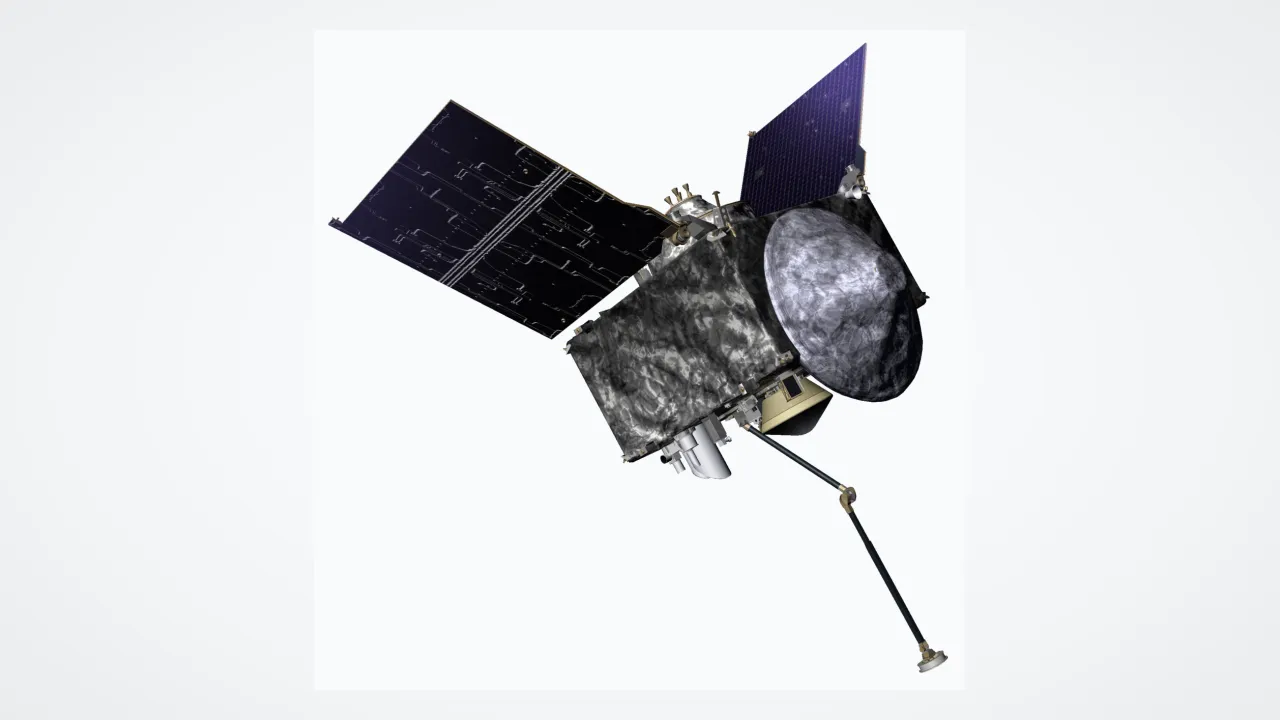
1. What surprising thing happened when OSIRIS-REx's arm tapped asteroid Bennu?
2. How did the sample get down safely onto the Utah desert?
🤯 Mind-Blowing Fact • Grade 2
OSIRIS-REx brought home 121.6 grams of asteroid Bennu—more than twice its sixty-gram goal and the biggest asteroid sample NASA ever collected!
✨ Word Sparks (Grade 2 Glossary)
Tap 🔊 to hear
nitrogen
Clean, non-reactive gas used to puff pebbles inward
crater
Bowl-shaped dent formed by a space impact
flap
Thin flexible gate keeping pebbles trapped inside
🪝
How did collecting TOO MUCH asteroid treasure almost let it spill back into space?
1
Boulders Everywhere!
Scientists expected asteroid Bennu to have smooth sandy beaches, yet cameras arriving in 2018 revealed rugged boulders everywhere! Carefully mapping every inch, the team picked a small nicknamed Nightingale just fifty feet wide.
2
Overflowing With Pebbles
In October 2020, the round TAGSAM head tapped Nightingale and puffed harmless gas to swirl gravel inside. It grabbed so much rock that a chunky pebble wedged the slightly open!
3
Stashing the Capsule Fast
Quickly skipping the weighing spin so zero precious grains floated away, engineers sealed the overflowing head inside its return capsule—bringing four ounces home in 2023!
1. Why were pebbles leaking slowly out of the sampler head right after touchdown?
2. What clean gas did the sampler puff to blow rocks into its chamber?
🤯 Mind-Blowing Fact • Grade 3
Right after dropping its sample capsule at Earth, the main spacecraft fired its thrusters and got a brand-new job and name—OSIRIS-APEX—to visit asteroid Apophis in 2029!
✨ Word Sparks (Grade 3 Glossary)
Tap 🔊 to hear
cleanroom
Ultra-filtered lab keeping dust and germs out
phosphate
Mineral compound essential for DNA and cell energy
clay
Fine mineral formed when rock reacts with water
🪝
Why did cameras catch asteroid Bennu mysteriously spitting pebbles out into outer space?
1
An Active, Popping Asteroid
Days after entering orbit around 1,600-foot-wide Bennu—the smallest object ever orbited by a spacecraft—navigation cameras caught tiny bright dots shooting off its surface like popcorn! Heating and cooling every 4.3 hours cracks dark boulders until pebbles pop right into space.
2
Steering Into Nightingale Crater
Surrounding Nightingale Crater towered a sharp boulder nicknamed 'Mount Doom' as tall as a two-story building. Using Natural Feature Tracking, onboard computers compared live camera views to onboard 3D maps, guiding the van-sized probe onto a parking-space-sized target!
3
Stuck Fastener Surprise in Texas
When the capsule landed in Utah in September 2023 and reached NASA's in Houston, two of its thirty-five lid screws wouldn't budge! Engineers crafted custom surgical-steel tools to unlock the treasure safely.
4
Clues to Ancient Oceans
Inside gleamed jet-black carbon dust, water-bearing , and bright white crusts of sodium left by ancient salty water!
1. What record did Bennu set when OSIRIS-REx entered orbit around it?
2. Why were bright white crusts of phosphate on Bennu's dark rocks so exciting?
🤯 Mind-Blowing Fact • Grade 4
Laboratory tests on Bennu's pristine dust revealed all five chemical letter bases needed to build both DNA and RNA, plus fourteen of the twenty amino acids used by life on Earth!
✨ Word Sparks (Grade 4 Glossary)
Tap 🔊 to hear
Yarkovsky effect
Tiny gentle push caused when sunlit rocks radiate heat
lidar
Mapping surfaces in 3D using pulsed laser beams
nucleobase
Chemical code letter forming the rungs of DNA
🪝
How can gentle afternoon sunlight slowly push a million-ton asteroid onto a new path through space?
1
Measuring the Yarkovsky Push
Beyond hunting for life's chemical origins, NASA's OSIRIS-REx tackled a vital planetary-defense question. Bennu's orbit crosses Earth's path every six years, giving it a tiny 1-in-2,700 chance of striking Earth in the late twenty-second century. By tracking the spacecraft's radio signals to millimeter precision, navigators measured the : as Bennu spins, its sun-warmed afternoon side radiates infrared heat into space like a whisper-soft thruster, nudging the asteroid nearly a thousand feet off a purely gravitational path each year!
2
Lidar Mapping and TAGSAM Physics
Canadian laser altimeter OLA scanned Bennu with billions of laser pulses, building a 3D topographic globe accurate to two centimeters. Because microgravity offers almost zero friction to push against a drill, Lockheed Martin engineer Jim Harris invented TAGSAM—inspired by blowing dust into a plastic cup in his driveway with an air compressor! On October 20, 2020, nitrogen gas fluidized Bennu's near-cohesionless regolith while twenty-four tiny steel velcro-like pads trapped fine surface dust.
3
Evaporite Brines From a Lost Ocean World
In 2024–2025 laboratory analyses, Bennu's 121.6-gram treasure yielded fourteen of the twenty protein-building amino acids, all five of DNA and RNA, and eleven evaporite salt minerals—including sodium carbonate—that crystallized as ancient briny water evaporated inside Bennu's long-shattered parent planetesimal!
4
Second Act at Apophis
Still healthy in space, the renamed OSIRIS-APEX probe will rendezvous with asteroid Apophis right after its thrilling 20,000-mile flyby of Earth in April 2029.
1. How does the Yarkovsky effect slowly alter asteroid Bennu's orbit over decades?
2. What everyday backyard experiment inspired the invention of the nitrogen-puffing TAGSAM collector?
🤯 Mind-Blowing Fact • Grade 5
More than seventy percent of OSIRIS-REx's precious asteroid sample has been locked inside nitrogen vaults in Texas and New Mexico so today's young students can study it decades from now with future instruments!
✨ Word Sparks (Grade 5 Glossary)
Tap 🔊 to hear
cohesion
Tendency of neighboring particles to stick together
phyllosilicate
Sheet-structured clay mineral formed by liquid water
evaporite
Salt mineral crystallized as briny water dries up
🪝
Why did touching asteroid Bennu feel less like landing on rock and more like plunging an arm into weightless foam?
1
Decoding an Acronym of Exploration
Every letter in OSIRIS-REx states a scientific pillar: Origins, Spectral Interpretation, Resource Identification, Security, Regolith Explorer. Launched September 8, 2016 under leadership from the University of Arizona and NASA Goddard, the 2,110-kilogram spacecraft spent two years chasing carbonaceous B-type asteroid 101955 Bennu—entering the tightest orbital loop ever flown, barely one kilometer from the center of a 490-meter rubble pile whose surface gravity is a hundred-thousandth of Earth's.
2
Thermal Fracturing and Near-Zero Cohesion
Spectrometers OVIRS and OTES mapped hydrated and unexpectedly thick carbonate veins up to a meter long across dark boulders, proving liquid water once circulated across kilometers of Bennu's parent asteroid. Even more surprising came during the October 20, 2020 Touch-And-Go maneuver at Nightingale Crater: instead of resisting impact, Bennu's surface grains had virtually zero inter-particle , allowing the TAGSAM head to plunge 48 centimeters deep until backup thrusters fired!
3
Planetary Protection in Reverse: Curation Purity
When the Sample Return Capsule streaked into Earth's atmosphere at 27,650 miles per hour on September 24, 2023 and settled onto the Utah Test and Training Range, recovery teams raced it into nitrogen-purged gloveboxes at Johnson Space Center. Fashioning bespoke non-magnetic surgical-steel drivers to bypass two seized fasteners kept pure nitrogen flowing over 121.6 grams of untouched regolith.
4
Brine Chemistry and Racemic Amino Acids
Subsequent international micro-analyses revealed ammonia-rich organic matter, magnesium-sodium phosphates resembling from Saturn's icy moon Enceladus, all five canonical nucleobases, and equal 'left-handed' and 'right-handed' mixtures of fourteen proteinogenic amino acids—suggesting life's preference for left-handed amino acids evolved later on Earth.
5
Seventy-Five Percent Saved for Tomorrow
Just as NASA preserved Apollo lunar rocks for technologies not yet invented in 1969, curators sealed over seventy percent of Bennu's sample untouched for future generations of scientists—including today's elementary students!