🎵 INSTRUMENTS
🎶 Pair of Concussion Metal Plaque Idiophones (Hornbostel-Sachs 111.142)
VA Music, Fine Arts & Sound Physics SOL 5.5
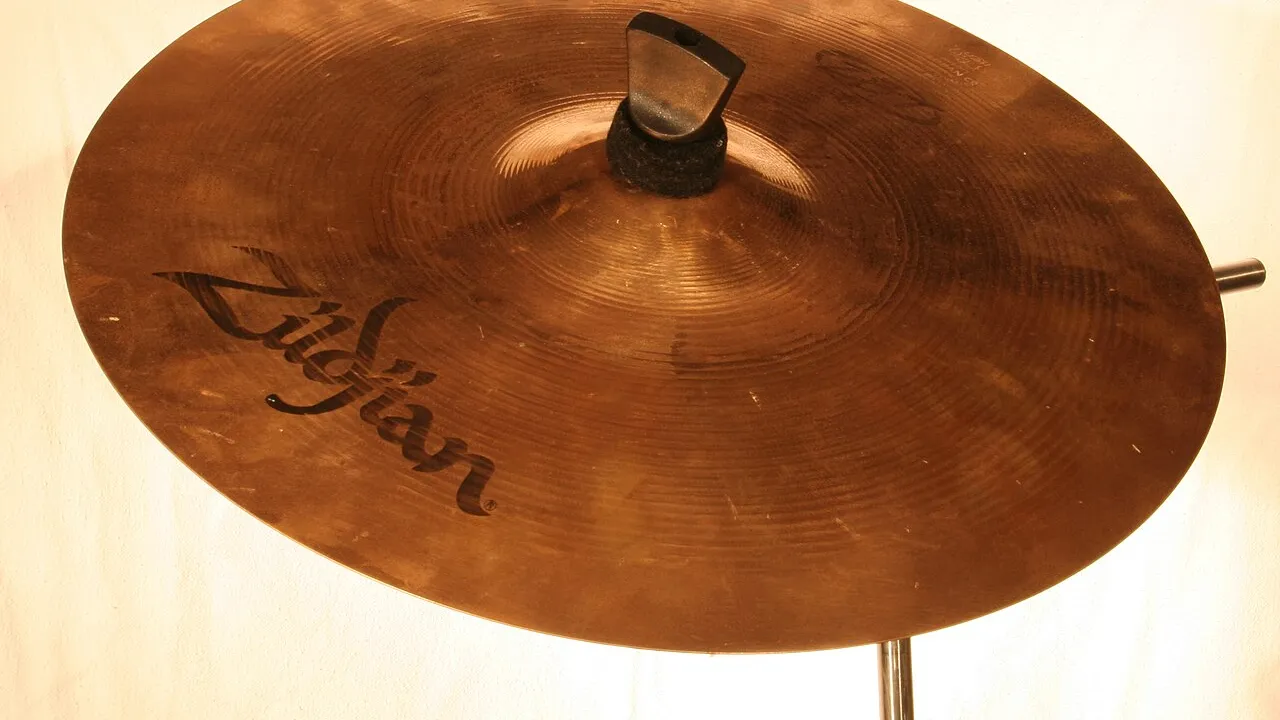
Orchestral Crash Cymbals
Twin Bronze Suns Exploding Into Shimmer
Grade 3 • Fluent • 144 words
🎶 Instrument Family & OriginPercussion family; Bronze Age Near East and Anatolia, perfected in 1623 Constantinople bell-bronze workshops
🪵 Materials & RangeMatched pair of cast B20 bronze discs (16–22 in / 41–56 cm wide) with leather straps; unpitched shimmer (~200 to 16,000+ Hz)
🔊 How Sound Is MadeTwo hand-held bronze plates sweep past each other in a glancing arc, launching cascading waves across hammered metal
⚡ Signature Sound SparkCrowns an entire hundred-piece symphony climax with a blinding flash of golden, sunlit sound
🤯 Mind-Blowing Fact • Grade 1
If you slam two cymbals flat together like clapping hands, trapped air sucks them shut with a funny dull 'pop' instead of a crash!
✨ Word Sparks (Grade 1 Glossary)
Tap 🔊 to hear
bronze
Golden metal mixed from copper and tin
shimmer
Sparkling ring dancing high in the air
strap
Strong leather loop held by each hand
🪝
What twin golden plates flash and splash like musical lightning?
1
KAA-SHHHHHH!
KAA-SHHHHHH! Two shiny golden plates meet high in the air! Out bursts a giant splash of bright, sparkling sound! The whole room tingles from wall to wall!
2
Hold the Leather Straps
Each round disc has a soft leather handle. Never poke fingers inside the metal dome! Loose let the shiny plates ring free.
3
Brush, Never Slam!
Players sweep one plate past the other smoothly. Pulling both rims to your shirt stops the ring right away!
1. What happens if you clap two crash cymbals completely flat together?
2. How does a cymbal player suddenly hush a loud ringing crash?
🤯 Mind-Blowing Fact • Grade 2
In Anton Bruckner's Seventh Symphony, the cymbal player waits nearly an entire hour to play just one glorious, unforgettable crash!
✨ Word Sparks (Grade 2 Glossary)
Tap 🔊 to hear
climax
Most exciting, powerful peak of a song
dome
Raised round cup in a cymbal's center
grooves
Tiny circular rings carved across metal
🪝
Why does an orchestral cymbal player wait patiently for twenty minutes just to play one single crash?
1
Worth the Wait!
Watch the percussionist stand tall at the back of the symphony, counting hundreds of quiet measures while holding two gleaming bronze discs! Right when the brass and strings reach their grandest peak—KAAA-SHHHH!—one perfectly timed crash crowns the whole song in golden light!
2
Secret of the Glancing Sweep
Good cymbal technique looks more like a graceful figure-eight dance than a collision. One hand holds a disc steady at an angle while the other brushes upward past it, letting the top edge kiss first before glancing off into open air.
3
Whispers and Sizzles Too
Crash cymbals are not only for loud fireworks! Brushing their grooved rims lightly together creates a silky metallic whisper softer than falling rain.
1. Why does a cymbal player hold leather straps right near the knuckles instead of gripping the metal?
2. How do cymbal players make a gentle, whispering metallic swish for quiet passages?
🤯 Mind-Blowing Fact • Grade 3
The Sultan of the Ottoman Empire gave metalworker Avedis the family name *Zildjian*—meaning 'son of the cymbal maker'—starting a family business over four hundred years old!
✨ Word Sparks (Grade 3 Glossary)
Tap 🔊 to hear
idiophone
Instrument whose solid body vibrates to sound
alloy
Metal blend melted together from two elements
lathe
Spinning machine carving fine grooves into bronze
🪝
What four-hundred-year-old metal-melting secret keeps orchestral cymbals from shattering when they crash?
1
Ancient Bronze Meets a 1623 Secret
Three thousand years ago, musicians in ancient Egypt, Israel, and China clashed small bronze plates during parades and temple dances. Then in 1623, an Armenian metalworker named Avedis in Constantinople discovered a special way to heat and hammer bell bronze—mixing eighty percent copper with twenty percent tin—so thin plates could ring brilliantly without cracking!
2
Idiophones: Metal That Sings by Itself
Unlike drums that stretch a skin or horns that vibrate air inside pipes, cymbals are —the solid bronze body itself bends and ripples to make sound! Thousands of tiny hammer dimples and spiral grooves scatter waves in every direction.
3
Matched Pairs With Slightly Different Voices
Test each half of an orchestral pair separately and you will notice one disc sounds a tiny bit lower than its partner! That slight pitch difference blends into a wider, richer splash.
4
Light Viennese to Heavy Germanic Pairs
Players pick quick sixteen-inch pairs for lively marches or heavy twenty-inch pairs for giant Romantic symphonies.
1. What metal recipe forms classic B20 orchestral cymbal bronze?
2. Why are the two cymbals in a concert pair intentionally chosen with slightly different natural pitches?
🤯 Mind-Blowing Fact • Grade 4
Hector Berlioz loved shimmering delicacy so much that in *Roméo et Juliette* he shrank crash cymbals down to tiny thick bronze discs called *crotales* that ring like fairy bells!
✨ Word Sparks (Grade 4 Glossary)
Tap 🔊 to hear
quench
Cool red-hot metal fast in cold water
brittle
Hard yet easy to crack or shatter
cascade
Energy flowing step-by-step from low to high
🪝
Why does a cymbal crash actually grow *higher* and brighter a split second *after* the two plates separate?
1
Blooming Shimmer Through Wave Cascade
Listen closely in slow motion right after two nineteen-inch crash cymbals strike: first comes a warm, dark metallic 'whoomp,' and half a second later a dazzling cloud of high silvery frequencies blooms overhead! High-speed physics shows that large bending waves race across the curved bronze dome and collide with one another, transferring energy upward from low vibrations into thousands of shimmering high overtones.
2
Metallurgy of Quenched Bell Bronze
At room temperature, ordinary 80/20 tin-bronze is as as a ceramic dinner plate and would shatter on impact! Artisans heat cast bronze blanks glowing cherry-red, roll them flat, and plunge () them instantly into cold water—locking flexible crystal grains into place before hand-hammering alters internal tension and spiral lathing trims thickness toward the rim.
3
Anatomy of the Flamenco Crash
To avoid an air-pocket vacuum lock, orchestral percussionists offset the two rims by an inch so a tiny 'flam' edge contact vents trapped air milliseconds before the full bow surfaces brush past in a fluid upward arc, holding both faces toward the balcony afterward to radiate high harmonics.
4
Tchaikovsky's Rapid-Fire Fireworks
In Tchaikovsky's Symphony No. 4 finale, the cymbalist executes blazing sixteenth-note crashes alongside marching brass without ever missing a beat!
1. Why must red-hot B20 bronze be plunged rapidly into cold water during cymbal making?
2. Why does an orchestral cymbal crash seem to 'bloom' brighter right after impact?
🤯 Mind-Blowing Fact • Grade 5
Physicists studying crash cymbals discovered that shimmering bronze plates obey the exact same mathematical 'wave turbulence' equations that describe ocean swells breaking into sea spray!
✨ Word Sparks (Grade 5 Glossary)
Tap 🔊 to hear
piatti
Italian orchestral score term for crash cymbals
camber
Gentle arch curving across a cymbal bow
wave turbulence
Chaotic energy cascade from big waves upward
🪝
How does nonlinear wave turbulence inside a curved two-millimeter bronze shell turn one impact into a 16-kilohertz sonic supernova?
1
Organology of Concussion Plaque Idiophones
Designated 111.142 in the Hornbostel-Sachs taxonomy—concussion plaques or vessel clappers struck together in complementary pairs—orchestral crash cymbals ( in Italian, Becken in German) typically measure 46 to 56 centimeters (18 to 22 inches) in diameter and weigh 1.8 to 2.8 kilograms per plate. Suspended exclusively via supple elk-hide or braided leather straps threaded through the central bell hole via a traditional cymbalist's knot, the discs maintain unconstrained free-edge boundary conditions.
2
Nonlinear Shell Mechanics and Wave Turbulence
Why doesn't a flat sheet of steel sound like a cymbal? Because an orchestral cymbal possesses shallow spherical curvature () plus a raised central dome, large transverse deflections stretch the bronze mid-plane geometrically. Governed by the Föppl–von Kármán equations of thin elastic shells, this geometric nonlinearity couples bending modes together into weak : within 30 to 80 milliseconds of impact, kinetic energy injected into low modes (200–600 Hz) cascades chaotically upward across thousands of densely packed modes extending past 16,000 Hz!
3
Beta-Phase B20 Bronze Metallurgy
Standard cast symphonic cymbals employ B20 alloy (80% copper, 20% tin). Slow cooling forms brittle delta-phase intermetallics; quenching from ~780 °C preserves tough, elastic beta-phase crystals capable of enduring repeated high-G impacts. Subsequent hand-hammering introduces localized residual stress islands that scatter symmetric nodal lines, eliminating obnoxious single-pitch 'gong' hums.
4
Doppler Swirls and Radiative Directivity
Because wavelengths at 10 kHz measure just 3.4 centimeters, high-frequency shimmer beams strongly perpendicular to the bronze face; rotating the plates outward after impact sweeps shimmering Doppler interference patterns across the hall.
5
Symphonic Peaks
From Wagner's Lohengrin Prelude and Rachmaninoff's Piano Concerto No. 2 to Mussorgsky's Night on Bald Mountain, crown orchestral architecture with broadband brilliance.