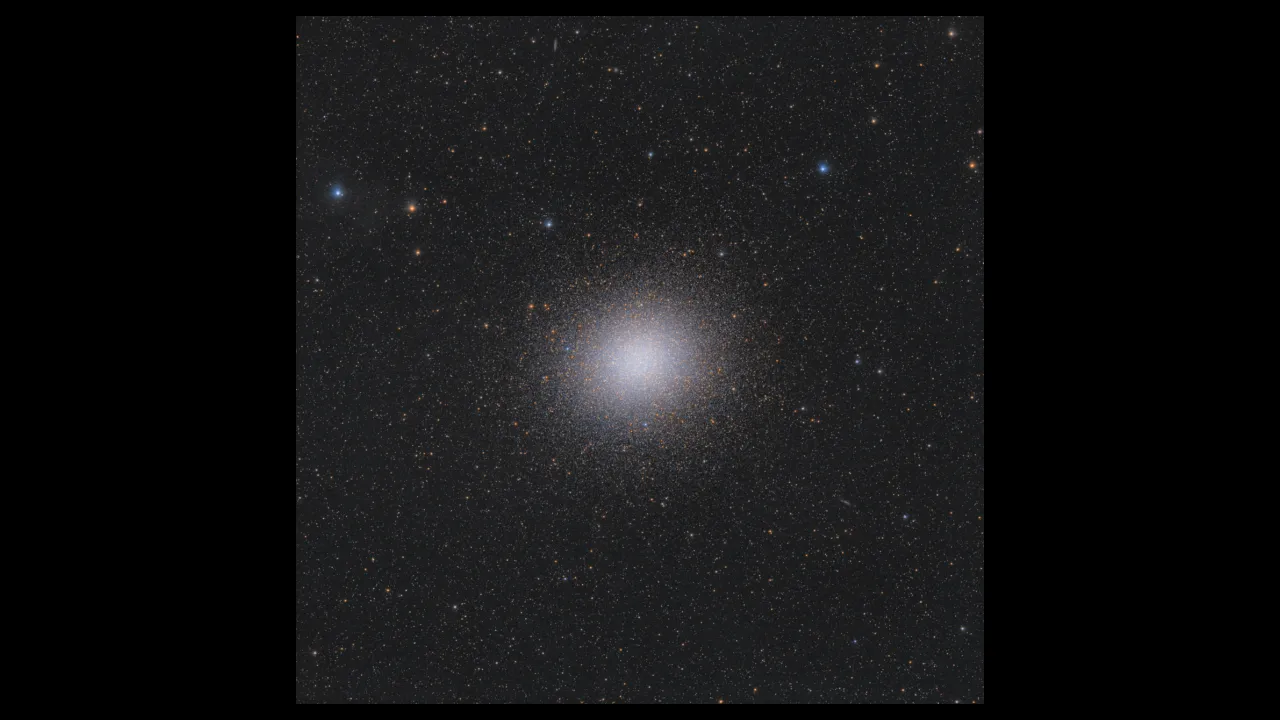
🪐 Scale / Diameter~150 light-years across • ~10 million stars
☄️ Composition & OrbitAncient Population II stars (~12 billion years old) • Stripped dwarf galaxy core
⚡ Cosmic SparkPacks 10 million stars so tightly its night sky would blaze brighter than 100 full moons
🤯 Mind-Blowing Fact • Grade 1
Stars in the center of Omega Centauri sit dozens of times closer together than our Sun sits to its nearest neighbor!
✨ Word Sparks (Grade 1 Glossary)
Tap 🔊 to hear
sphere
A round 3D shape like a ball
Milky Way
The giant spiral galaxy where we live
core
The very center of a round object
🪝
What if ten million stars squeezed together into one giant sparkling ball?
1
A Giant Star Ball
Picture a snow globe filled with ten million tiny suns! Far out in space, stars pack together in a huge round ball. It is the biggest star cluster in our .
2
Mistake in the Sky
From Earth, it looks like one fuzzy star to bare eyes. Long ago, sky watchers thought it was a single star! Big telescopes showed millions of stars inside.
3
Super Crowded Core
Near the middle, stars float super close together. A planet there would never have a dark night!
1. About how many stars pack inside Omega Centauri?
2. What did people long ago think Omega Centauri was before telescopes?
🤯 Mind-Blowing Fact • Grade 2
From the southern half of Earth, Omega Centauri looks almost as wide across the sky as the full Moon!
✨ Word Sparks (Grade 2 Glossary)
Tap 🔊 to hear
globular cluster
A tight, ball-shaped crowd of ancient stars
dwarf galaxy
A small galaxy with fewer stars than ours
orbit
To travel in a curved path around something
🪝
Could a sparkling ball of stars actually be the leftover heart of a swallowed galaxy?
1
King of Star Clusters
Look south toward the constellation Centaurus and you can spot a glowing smudge without any binoculars. That bright patch is Omega Centauri, the largest globular star cluster orbiting our Milky Way galaxy. About ten million stars swarm inside a round ball spanning 150 light-years across.
2
Ancient Cosmic Grandparents
Most stars inside this cluster are around twelve billion years old! They formed when the universe was still very young, shining in warm shades of gold, orange, and red alongside rare hot blue stars.
3
A Stolen Galaxy Heart
Scientists noticed its stars have different ages. That clue suggests our Milky Way gobbled up a smaller billions of years ago, leaving its tight starry center behind!
1. Roughly how old are most of the stars in Omega Centauri?
2. What do astronomers think Omega Centauri used to be long ago?
🤯 Mind-Blowing Fact • Grade 3
Omega Centauri weighs as much as four million Suns combined—ten times heavier than most big globular clusters!
✨ Word Sparks (Grade 3 Glossary)
Tap 🔊 to hear
nucleus
The dense, packed central part of a galaxy
heavy elements
Atoms heavier than hydrogen and helium made in stars
black hole
A space region with gravity nothing escapes
🪝
What would the sky look like if you stood on a planet deep inside ten million crowded suns?
1
Hidden Behind a Star's Name
In 1603, mapmaker Johann Bayer gave a glowing point in the southern sky a Greek letter name—Omega Centauri—assuming it was a lone star. Later in 1677, astronomer Edmond Halley aimed a telescope there and realized it was a hazy cloud. Today we know NGC 5139 holds ten million stars about 17,000 light-years away!
2
Blazing Starry Skies
Out near our Sun, the nearest star sits over four light-years away. Deep inside Omega Centauri's core, stars pack just a tenth of a light-year apart! If you stood on a rocky planet there, your night sky would dazzle with stars shining 100 times brighter than Earth's full Moon.
3
Survivor of a Galactic Crash
Typical globular clusters form all their stars at once. Omega Centauri broke the rules—its stars formed in several waves with different . Astronomers realized it is the stripped of an ancient dwarf galaxy captured by the Milky Way.
4
A Rare Black Hole Clue
Hubble Space Telescope measurements tracked seven fast-moving stars zipping around its center, pointing to a hidden mid-sized !
1. Why does Omega Centauri have a Greek star name even though it is a cluster?
2. What did fast-moving stars in Omega Centauri's center help Hubble discover?
🤯 Mind-Blowing Fact • Grade 4
Weird 'blue straggler' stars inside Omega Centauri look impossibly young because two old stars crashed together or shared fresh hydrogen fuel!
✨ Word Sparks (Grade 4 Glossary)
Tap 🔊 to hear
galactic halo
A huge spherical region surrounding a spiral galaxy
blue straggler
An old star made hot again by merging
spectroscopy
Splitting starlight into colors to find elements
🪝
How did seven speeding stars unlock a missing link between small black holes and giant galactic monsters?
1
A Giant in the Galactic Halo
Orbiting high through the Milky Way's halo some 17,000 light-years away in Centaurus, NGC 5139—famous as Omega Centauri—dwarfs every other globular cluster in our galaxy. Spanning roughly 150 light-years across and packing four million solar masses, this gravitational powerhouse binds around ten million stars into a glittering sphere visible to the naked eye across southern latitudes.
2
Extreme Stellar Crowding
Mutual gravity keeps those millions of stars weaving through tight, looping orbits without flying apart. Inside the central core, stellar density skyrockets until neighboring suns pass within 0.1 light-years—barely twenty-five times closer than Proxima Centauri is to Earth. Close gravitational brushes sometimes force two aging stars to collide and merge into rejuvenated, hot '' stars.
3
Fossil of a Devoured Galaxy
Spectroscopic studies revealed multiple stellar generations enriched with varying amounts of iron and helium spanning billions of years. True globular clusters lack the gravity to hold onto supernova gas for second-generation starbirth. That chemical fingerprint proves Omega Centauri was once the core of a much larger dwarf galaxy whose outer stars were tidally shredded by the Milky Way.
4
The Missing-Link Black Hole
Comparing twenty years of Hubble images, astronomers clocked seven central stars racing too fast to stay bound unless an intermediate-mass black hole of at least 8,200 solar masses anchors the core.
1. How do 'blue straggler' stars form inside crowded clusters like Omega Centauri?
2. Why could a normal star cluster NOT create Omega Centauri's multiple generations of stars?
🤯 Mind-Blowing Fact • Grade 5
Data from the Gaia space telescope revealed a long ribbon of stars called the Fimbulthul stream torn directly off Omega Centauri and draped across the sky!
✨ Word Sparks (Grade 5 Glossary)
Tap 🔊 to hear
retrograde orbit
Moving backward compared to a galaxy's main spin
intermediate-mass
Mid-sized between small stellar and supermassive black holes
accreted
Pulled in and merged by gravitational attraction
🪝
Why does the Milky Way's grandest globular cluster break almost every textbook rule about star clusters?
1
From Ptolemy's Catalog to Modern Astrophysics
Nearly two millennia ago, the Alexandrian astronomer Claudius Ptolemy recorded a luminous point on the back of Centaurus as a single star, and Johann Bayer later assigned it the designation Omega in 1603. When Edmond Halley observed NGC 5139 from Saint Helena in 1677 and John Herschel resolved thousands of pinpoint suns in the 1830s, humanity glimpsed an extraordinary colossus: 10 million stars totaling roughly 4 million solar masses across a 150-light-year diameter.
2
Relics of Galactic Cannibalism
Classical globular clusters are single-age populations forged in one rapid burst. High-resolution spectroscopy of Omega Centauri shattered that expectation by uncovering distinct stellar populations formed across a two-billion-year span, including metal-rich stars and subpopulations astonishingly rich in helium. Combined with its retrograde galactic orbit and trailing stellar streams like Fimbulthul, the evidence confirms NGC 5139 is the surviving nuclear star cluster of an dwarf galaxy.
3
Collisional Dynamics in the Core
Within the cluster's central parsec, star densities exceed millions of times the solar neighborhood's average. Frequent three-body gravitational interactions eject lighter stars outward while hardening binary pairs, forging exotic millisecond pulsars, X-ray binaries, and rejuvenated blue stragglers.
4
Bridging the Black Hole Mass Gap
For decades, astrophysicists searched for black holes bridging stellar remnants (tens of solar masses) and supermassive titans (millions to billions). Analyzing over 500 Hubble exposures spanning two decades, researchers identified seven stars hurtling past the cluster's center too rapidly to escape—smoking-gun kinematics requiring a dark central mass exceeding 8,200 solar masses.
5
Window Into Early Galaxy Assembly
Located just 17,000 light-years away, Omega Centauri preserves a frozen snapshot of how massive spirals like our Milky Way grew by devouring smaller galactic neighbors.