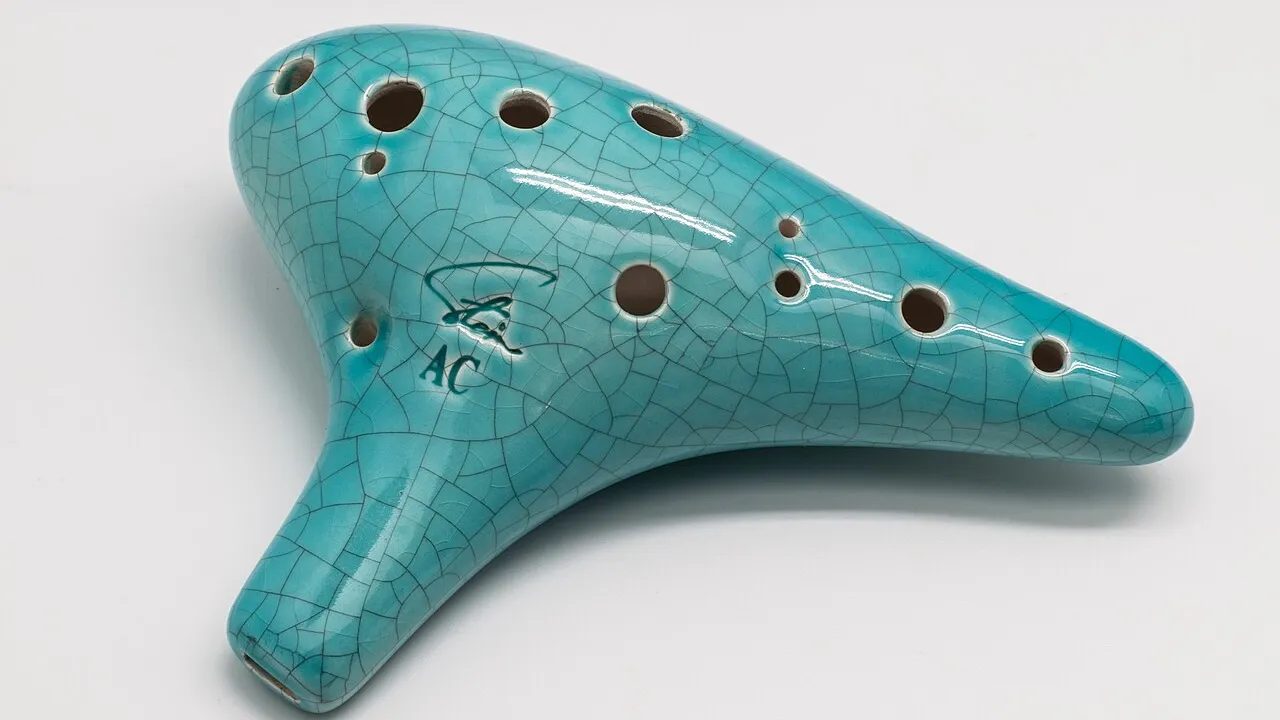
1. What does the Italian name 'ocarina' mean in English?
2. What material are classic ocarinas traditionally crafted and baked from?
🤯 Mind-Blowing Fact • Grade 2
Thousands of years before Italy's ocarina, ancient Maya potters crafted clay vessel flutes shaped like owls, frogs, and turtles!
✨ Word Sparks (Grade 2 Glossary)
Tap 🔊 to hear
terracotta
Warm brownish-red clay baked in ovens
chamber
Enclosed hollow room inside an instrument
kiln
Super-hot oven used to harden clay
🪝
Why can you drill a finger hole anywhere on an ocarina and get the exact same note?
1
A Baker's Bright Idea
Imagine being seventeen years old, working in an Italian bakery, and inventing a brand-new concert instrument! In 1853 in Budrio, Italy, young Giuseppe Donati reshaped simple clay toy whistles into the ten-hole musical ocarina.
2
Round Belly Instead of a Tube
Flutes and clarinets trap air inside long straight pipes, so holes near the bottom sound low and holes near the top sound high. An ocarina is a hollow round vessel, so all the air inside bounces together like one springy cushion!
3
Size Beats Spot
Because the whole vibrates at once, only the size of an uncovered hole changes the note—not where that hole sits!
1. Who invented the modern ten-hole Western ocarina in 1853 in Budrio, Italy?
2. On a hollow vessel flute like the ocarina, what mainly determines how much a finger hole raises the pitch?
🤯 Mind-Blowing Fact • Grade 3
Unlike flutes, clarinets, or saxophones, blowing twice as hard into a single-chamber ocarina never makes it jump an octave—multi-chamber ocarinas add extra mouthpieces instead!
✨ Word Sparks (Grade 3 Glossary)
Tap 🔊 to hear
vessel flute
Rounded hollow flute rather than long tube
xun
Ancient egg-shaped Chinese clay vessel flute
multi-chamber
Ocarina combining two or three tuned hollows
🪝
Why does an ocarina sound almost echo-pure—and why can't a single chamber jump up an octave?
1
Ancient Roots and Video-Game Fame
Close your eyes as a crystal-clear, haunting melody floats through an imaginary misty forest. Whether you recognize it from adventurous video-game scores, Italian folk ensembles, or museum treasures, the ocarina belongs to one of humanity's oldest wind designs: the .
2
Ancient Relatives Around the World
Nearly seven thousand years ago in China, musicians played an egg-shaped clay flute called the . Across Central and South America, Aztec, Maya, and Inca artisans sculpted clay long before Giuseppe Donati perfected his chromatic ten-hole Italian ocarina in 1853.
3
Springy Air Inside a Globular Shell
When you blow through the fipple stem, air splits across a sharp labium window just like on a recorder. Instead of racing down a tube, however, pressure pulses compress and expand the entire hollow air pocket like a tiny invisible spring!
4
Adding Extra Chambers
Because round vessels cannot overblow to higher octaves, builders connect two or three chambers side by side for wider ranges!
1. What was the ancient egg-shaped clay vessel flute played in China thousands of years ago?
2. How do ocarina makers build instruments capable of spanning two or three full octaves?
🤯 Mind-Blowing Fact • Grade 4
In Budrio, Italy, traditional seven-piece ocarina ensembles still perform symphonic transcriptions using giant terracotta bass ocarinas as big as watermelons!
✨ Word Sparks (Grade 4 Glossary)
Tap 🔊 to hear
Helmholtz resonator
Hollow chamber where trapped air bounces spring-like
sub-hole
Extra finger hole reaching notes below tonic
breath curve
Gradually increasing air pressure on higher notes
🪝
How does nineteen-century physicist Hermann von Helmholtz explain why an egg-shaped lump of clay breaks all the rules of tubular flutes?
1
Pure Tone Without Overtones
Strike a tuning fork and listen to its pure, floating hum; now play a sustained note on a terracotta ocarina and notice how eerily similar they feel! While oboes and saxophones blaze with dozens of upper harmonics, an ocarina radiates nearly all of its acoustic energy in one velvety fundamental wave.
2
Helmholtz Resonance in Your Hands
German physicist Hermann von Helmholtz studied hollow spheres with small openings—the exact physics governing an ocarina! Inside this globular vessel flute, the trapped air volume acts like a compressible spring, while the tiny plug of air moving in and out of the open finger holes acts like a bouncing weight. Uncovering more hole area lightens and stiffens that acoustic bounce, raising pitch smoothly regardless of where each hole sits on the clay shell!
3
From Budrio's Quintet to Twelve-Hole Concert Designs
After Giuseppe Donati unveiled his ten-hole transverse terracotta ocarina in Budrio in 1853, local musicians formed the famous Gruppo Ocarinistico Budriese—playing seven graduated sizes from tiny soprano to giant bass! In 1928, Japanese craftsman Takashi Aketagawa added two tiny '' beneath the middle fingers, creating today's standard twelve-hole concert ocarina.
4
Breath Curves and Pop-Culture Renaissance
Because breath pressure directly nudges vessel pitch upward, players sculpt rising '' across every scale—a singing skill celebrated worldwide after Ennio Morricone's 1966 film scores and Nintendo's 1998 classic The Legend of Zelda: Ocarina of Time.
1. Why does an ocarina sound so pure and smooth compared to reed instruments?
2. What innovation did Japanese maker Takashi Aketagawa add in 1928 to create the modern 12-hole ocarina?
🤯 Mind-Blowing Fact • Grade 5
On an oscilloscope screen, a sustained ocarina note forms a smooth, rounded wave with over ninety percent of its sound energy concentrated in the pure fundamental frequency!
✨ Word Sparks (Grade 5 Glossary)
Tap 🔊 to hear
sine wave
Pure, smooth sound wave without extra overtones
aperture
Open hole or window letting air pass
septet
Ensemble of seven musicians playing together
🪝
Why does non-harmonic cavity physics prevent a globular clay vessel flute from overblowing—while giving it one of the purest sine-like waves in acoustics?
1
Where Standing-Wave Rules Disappear
Hand an acoustic engineer a flute, clarinet, oboe, and bassoon, and all four obey one-dimensional wave equations along a slender tube. Now hand over a kiln-fired terracotta ocarina: tube length vanishes, hole placement becomes acoustically interchangeable, and an oscilloscope trace suddenly resembles a pure, glowing !
2
Helmholtz Equations and Inharmonic Cavity Modes
Classified organologically as an internal-duct globular vessel flute with finger holes (Hornbostel-Sachs 421.221.42), the ocarina operates as a driven Helmholtz resonator. Breath channeled down the fipple windway splits across the sharp labium , exciting uniform pressure oscillations throughout the enclosed chamber volume (V). Resonant frequency rises in proportion to the fourth root—and total area sum—of open apertures divided by chamber volume: f ≈ (v / 2π) √(A_effective / (V · L_neck)). Because a globular cavity's higher three-dimensional spatial modes sit far above integer multiples (2f, 3f) of the Helmholtz fundamental, two remarkable traits follow: upper harmonics barely couple to the air jet—creating a 90%+ fundamental-dominated timbre—and overblowing cannot lock onto a second octave!
3
Donati, Budrio Septets, and Aketagawa's 12-Hole Standard
While Mesoamerican whistling vessels and China's Neolithic xun (~5000 BCE) pioneered globular aerophones without ducts or with blowholes, seventeen-year-old Giuseppe Donati engineered the first diatonically/chromatically voiced ten-hole transverse terracotta ocarina in Budrio, near Bologna, in 1853. Budrio workshops soon standardized tuned from high sopranino C6 down to resonant contrabass G2! In 1928, Tokyo maker Takashi Aketagawa introduced twin sub-holes beneath the middle fingers, expanding the standard Alto C ocarina cleanly from A4 (440 Hz) to F6 (1,396.9 Hz).
4
Multi-Chamber Architecture and Ceramic Firing
To conquer the 1.4-octave single-chamber ceiling, artisans mold double, triple, and quadruple ocarinas housing independent internal Helmholtz chambers side by side—extending playable range across three full octaves (A4 to G7). Un-glazed porous terracotta absorbs breath condensation naturally while lending subtle earthy warmth, whereas high-fired porcelain reflects crisp upper brilliance.
5
Global Cultural Resonance
From wandering nineteenth-century Budrio that dazzled Paris, London, and New York to Ennio Morricone's iconic Western motif in The Good, the Bad and the Ugly and Koji Kondo's interactive melodies in The Legend of Zelda, this humble clay vessel continues to enchant millions.