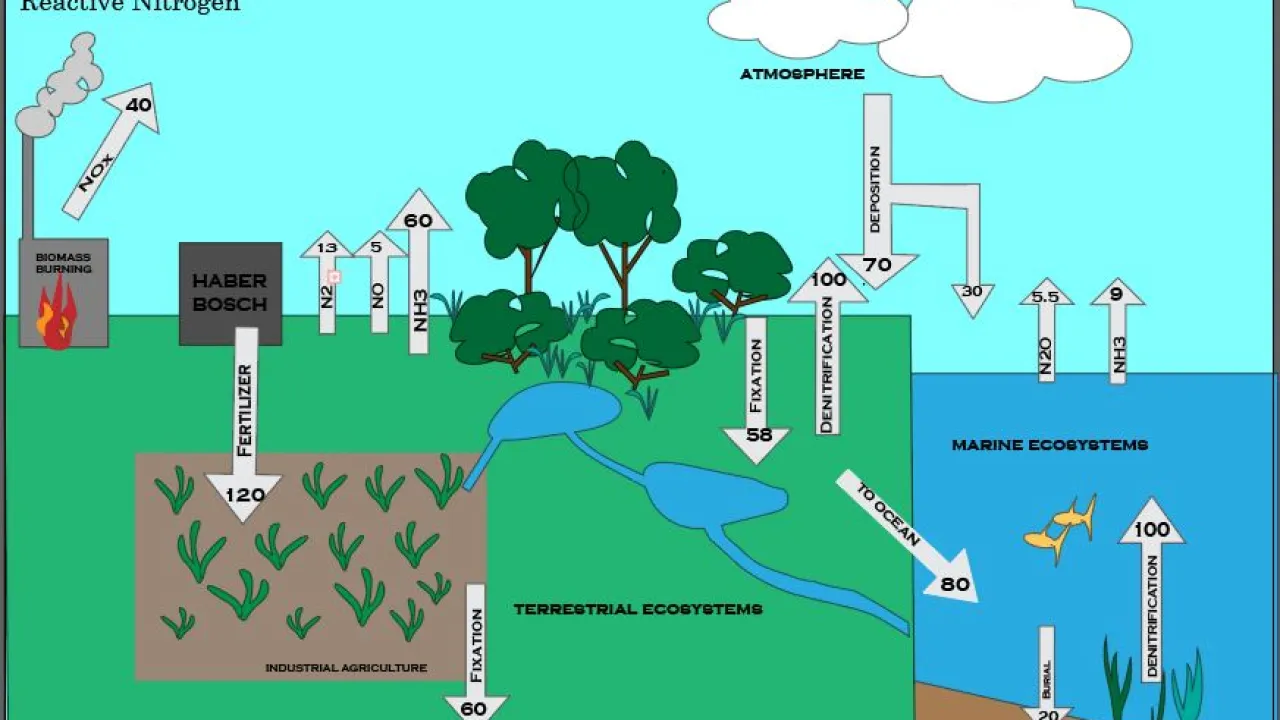
1. Where do tiny helpers change nitrogen into food that plant roots can soak up?
2. How do animals get the nitrogen they need to grow?
🤯 Mind-Blowing Fact • Grade 2
Farmers often plant clover, peas, or soybeans because friendly bacteria in their roots naturally refill the soil with fresh nitrogen!
✨ Word Sparks (Grade 2 Glossary)
Tap 🔊 to hear
Bacteria
Tiny single-celled creatures too small to see
Root
Plant part underground that drinks water
Protein
Body building block made using nitrogen
🪝
If plants are surrounded by nitrogen in the air, why can't they just drink it in?
1
Locked-Up Sky Gas
Take a deep breath in, and nearly eighty percent of that air is nitrogen gas! Every plant and animal needs nitrogen to build strong cells. Yet in the air, pairs of nitrogen atoms hold hands so tightly that plants cannot pull them apart.
2
Bacteria and Lightning Keys
Luckily, microscopic living in soil and inside clover or bean have a special superpower. They unlock nitrogen gas and mix it into nutrients that roots drink up with water. Hot lightning bolts also crack nitrogen apart during storms!
3
Returning to the Air
Rabbits, birds, and people get nitrogen by eating leafy greens, beans, and grains. When leaves fall and decay, cleanup return pure nitrogen gas back to the sky.
1. Why can't green plants use nitrogen gas straight from the air?
2. Why do farmers love planting beans, peas, and clover in their fields?
🤯 Mind-Blowing Fact • Grade 3
Every single strand of DNA in your cells—the instruction manual for how your body grows—has nitrogen rungs holding its spiral ladder together!
✨ Word Sparks (Grade 3 Glossary)
Tap 🔊 to hear
Fixation
Changing sky nitrogen into forms plants use
Legume
Bean, pea, or clover plant with root nodules
Nitrate
Dissolved soil nitrogen nutrient absorbed by roots
🪝
How do invisible bacteria beneath a peanut field run one of Earth's biggest chemical factories?
1
A Puzzle in the Atmosphere
Imagine swimming in an ocean of fresh water with a locked lid on your canteen! That is how plants experience Earth's atmosphere. Nitrogen gas makes up seventy-eight percent of the air, and living things need it to build proteins and DNA, yet two nitrogen atoms lock together with a super-strong bond.
2
Nitrogen Fixation
Special microbes called nitrogen-fixing bacteria break that tough bond in a step called . Many live inside tiny round bumps called root nodules on such as peanuts, soybeans, and clover. They transform air nitrogen into ammonia, and other soil bacteria convert it into that roots absorb easily.
3
Up the Food Web
Once plants absorb , they weave nitrogen into green chlorophyll and nutritious proteins. Grasshoppers, songbirds, and humans gain nitrogen by eating plants or other animals. Decomposers later recycle fallen leaves and animal waste back into soil nutrients.
4
Completing the Loop
Finally, denitrifying bacteria in wet soils turn leftover back into harmless nitrogen gas. Bubbles of nitrogen rise into the sky, keeping Earth's atmosphere steady year after year.
1. Where do many nitrogen-fixing bacteria live on peanut and clover plants?
2. What job do denitrifying bacteria perform at the end of the cycle?
🤯 Mind-Blowing Fact • Grade 4
George Washington Carver famously championed planting nitrogen-fixing peanuts and cowpeas to heal worn-out Southern cotton soils and boost farm harvests!
✨ Word Sparks (Grade 4 Glossary)
Tap 🔊 to hear
Symbiotic
Two different living species helping each other survive
Assimilation
Plants absorbing nutrients to build living tissues
Watershed
Land area draining rainwater into one waterway
🪝
Why did Virginia pioneer farmers rotate corn with peanuts and clover long before modern chemistry?
1
The Triple-Bond Bottleneck
Step onto a Virginia farm where rows of peanuts grow beside tall summer corn, and you can witness hidden underground teamwork. Although atmospheric nitrogen (N2) accounts for 78 percent of dry air, its two atoms share a powerful triple covalent bond. Neither oak trees nor humans can break N2 directly, even though every living cell requires nitrogen to assemble amino acids, enzymes, and chlorophyll.
2
Fixation and Nitrification
Nature unlocks N2 through two main pathways. High-voltage lightning superheats air to 30,000 degrees Celsius, fusing nitrogen with oxygen so rain washes nitrates downward. Even more important, Rhizobium bacteria inside legume root nodules—and cyanobacteria in oceans—fix N2 into ammonium. Nitrifying soil bacteria then oxidize ammonium into nitrites and plant-ready nitrates.
3
Assimilation and Ammonification
Through , plant roots draw dissolved nitrates from soil moisture to build tissues, passing organic nitrogen across food webs to herbivores and predators. When organisms shed waste or die, fungal and bacterial decomposers perform ammonification, returning mineral ammonium to topsoil so nearby plants can reuse it.
4
Denitrification and Watershed Care
In low-oxygen marshes and damp soils, anaerobic denitrifying bacteria convert excess nitrates back into atmospheric N2, closing the global loop. However, if heavy rains wash too much lawn or farm fertilizer into streams—such as tributaries of the Chesapeake Bay—excess nitrogen triggers thick algae blooms, showing why balanced nutrient stewardship matters.
1. What makes atmospheric N2 gas so difficult for plants to use on their own?
2. What can happen if heavy rain washes too much nitrogen fertilizer into a bay or river?
🤯 Mind-Blowing Fact • Grade 5
Roughly half of all the nitrogen atoms currently inside human muscle and DNA passed through the high-pressure Haber-Bosch fertilizer process before growing our food crops!
✨ Word Sparks (Grade 5 Glossary)
Tap 🔊 to hear
Nitrogenase
Bacterial enzyme that splits tough nitrogen gas bonds
Denitrification
Microbial conversion of soil nitrates into air gas
How do bacterial enzymes at room temperature accomplish a chemical feat that factories need scorching heat and crushing pressure to copy?
1
Inert Abundance Above, Essential Scarcity Below
Crack open a swollen nodule on a soybean root and you will spot a faint pink interior caused by leghemoglobin—a cousin of the protein in human blood—guarding some of Earth's hardest-working microbes. Above that field, dinitrogen gas (N2) forms 78.08 percent of Earth's atmosphere by volume. Yet because two nitrogen atoms share one of chemistry's strongest triple bonds, unreactive N2 drifts past hungry leaves untouched until specialized catalysts intervene.
2
Five Microbial Transformations
The terrestrial and marine nitrogen cycle hinges on five chemical steps driven largely by prokaryotes. First, biological nitrogen fixation uses the oxygen-sensitive enzyme inside Rhizobium, Azotobacter, and marine Trichodesmium cyanobacteria to reduce N2 into ammonia (NH3), supplemented by roughly 5 to 8 percent from atmospheric lightning. Second, chemoautotrophic nitrifying bacteria oxidize ammonium (NH4+) first into nitrite (NO2-) and then into mobile nitrate (NO3-).
3
Biospheric Synthesis and Recycling
During the third stage, assimilation, plant roots transport nitrate and ammonium across cell membranes to synthesize chlorophyll porphyrin rings, twenty essential amino acids, and the purine and pyrimidine bases of DNA and RNA. Consumers acquire organic nitrogen through trophic transfer until stage four, ammonification, in which saprotrophic fungi and bacteria mineralize detritus and urea back into soil ammonium.
4
Anaerobic Return to the Sky
Stage five, , unfolds in waterlogged wetlands, river sediments, and oceanic oxygen-minimum zones. Facultative anaerobic bacteria such as Pseudomonas use nitrate instead of oxygen for respiration, reducing NO3- step-by-step back into N2 gas that diffuses skyward and keeps atmospheric composition stable over geologic eons.
5
Industrial Fixation and Ecosystem Balance
In the early twentieth century, chemists Fritz Haber and Carl Bosch invented an industrial process using 450-degree-Celsius heat and 200 atmospheres of pressure to manufacture synthetic ammonia fertilizer. While industrial fixation now feeds billions of people, managing runoff through riparian buffer strips, cover crops, and wetland restoration remains vital to prevent aquatic .