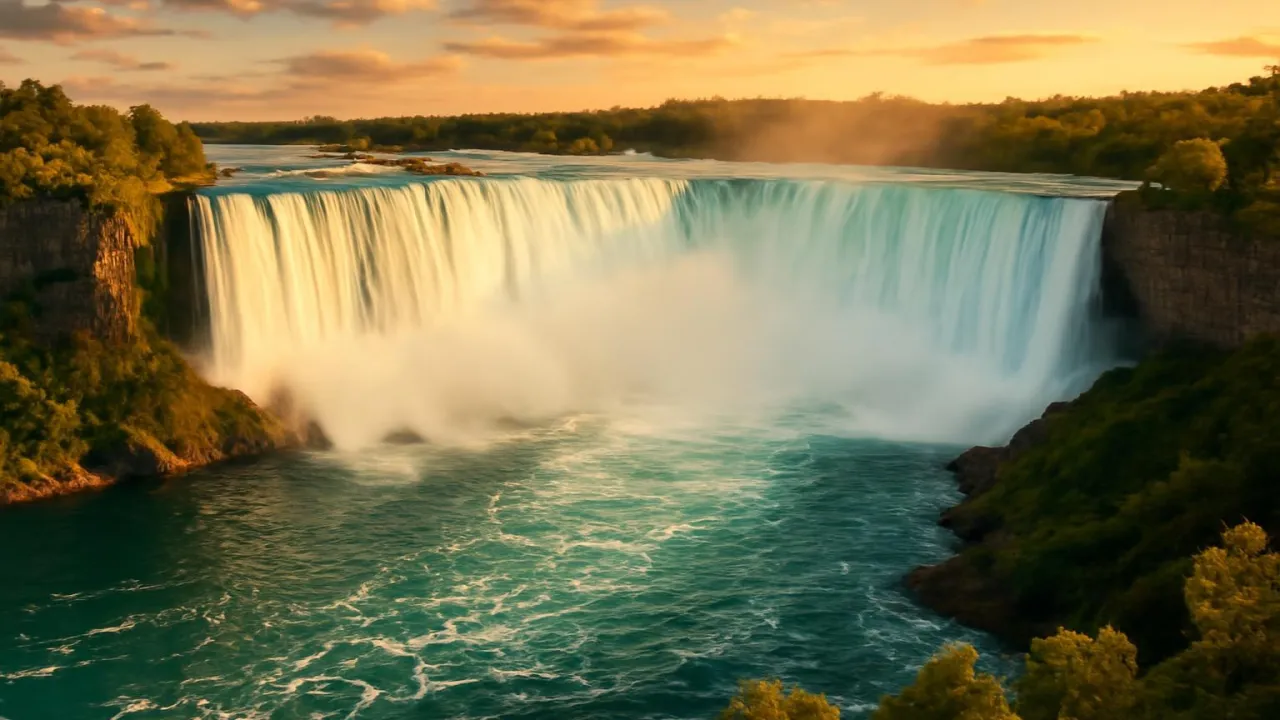
Niagara Falls moves so much water it could fill a swimming pool in seconds!
✨ Word Sparks (Grade 2 Glossary)
Tap 🔊 to hear
spray
Water drops flying in the air
rainbow
Colorful arch made by sunlight and water
edge
The place where something ends
🪝
What if you stood beside a giant waterfall?
1
A River of Power
Niagara Falls crashes with a huge roar, and mist everywhere. It is made of three big waterfalls, and water rushes over the rocks. People love to watch the white water tumble down.
2
Getting Close to the Falls
Tour boats bring visitors close to the falling water, and everyone wears raincoats. The makes in the air, and the ground shakes from the sound. People take photos to remember the amazing view.
3
Nature’s Wonder
Niagara Falls sits between the United States and Canada, and it is very famous. The falls have been here for thousands of years, and they keep shaping the land. Every second, thousands of tons of water pour over the .
The roar of Niagara Falls can reach up to 95 decibels—almost as loud as a jackhammer!
✨ Word Sparks (Grade 3 Glossary)
Tap 🔊 to hear
erosion
When water or wind wears away rocks
vibration
A shaking or moving back and forth
hydroelectric
Making electricity from moving water
🪝
What would it feel like to stand in the mist of Niagara Falls?
1
The Power of Water
Niagara Falls is one of the world’s most powerful waterfalls, with water thundering down every second. The falls are made up of three sections: Horseshoe, American, and Bridal Veil. As water pours over the edge, it creates a loud that you can feel in your chest. The mist rises so high it sometimes forms rainbows in the sunlight.
2
How the Falls Were Formed
Thousands of years ago, melting glaciers carved out the Niagara River, creating the falls. The rushing water erodes the rocks below, slowly moving the waterfall upstream. This process is called , and it changes the shape of the falls over time. Scientists study the rocks and water to learn how Niagara Falls keeps changing.
3
Visiting the Falls
People visit Niagara Falls from all over the world to see its beauty and power. Special boats called Maid of the Mist take visitors close to the roaring water for an exciting ride. There are also tunnels and observation decks where you can feel the spray and hear the thunder. Many people take photos to remember the shimmering water and bright rainbows.
4
Nature’s Energy
The force of the falling water is used to make electricity for nearby cities. Engineers built power plants that use the water’s energy to turn turbines and generate power. This is called energy, and it helps light up homes and schools. Niagara Falls is not just a beautiful landmark, but also a source of clean energy.
1. What process moves Niagara Falls upstream over time?
2. What do engineers use Niagara’s water for?
🤯 Mind-Blowing Fact • Grade 4
Niagara Falls provides enough hydroelectric power to supply about 3.8 million homes in North America!
✨ Word Sparks (Grade 4 Glossary)
Tap 🔊 to hear
conservation
Protecting nature for future people
turbine
A machine that spins to make power
limestone
A soft gray rock in the falls
🪝
Imagine standing so close to Niagara Falls that your whole body shakes from the thunderous roar—how does it work?
1
A Geological Wonder
Niagara Falls formed at the end of the last Ice Age, when melting glaciers carved deep channels in the land. Over thousands of years, the Niagara River’s powerful current has continued to erode the and shale, causing the falls to move about one foot upstream each year. This natural process of erosion shapes the landscape and creates the iconic horseshoe curve of the largest waterfall. Scientists study the rock layers to understand how the falls have changed over time.
2
Unmatched Power and Sound
Every second, more than 3,000 tons of water crash down from heights up to 167 feet. The impact creates a deep vibration that you can feel in your bones, and the sound can be heard miles away. The constant spray from the falls forms thick mist clouds, which sometimes create dazzling rainbows in the sunlight. The enormous energy of the falling water is both beautiful and powerful.
3
Visiting and Protecting the Falls
Millions of people visit Niagara Falls each year, experiencing the force of nature up close on boat rides and observation decks. Special tunnels let visitors walk behind the waterfalls, where they can feel the cool spray and hear the echoing roar. Both the United States and Canada work together to protect the falls and keep the area safe for wildlife and people. efforts help preserve this natural wonder for future generations.
4
Hydroelectric Marvel
Engineers harness the energy of Niagara Falls to generate hydroelectric power for nearby cities. Water is channeled through , which spin rapidly to create electricity without pollution. This clean energy source helps power homes, schools, and businesses on both sides of the border. Niagara Falls shows how the forces of nature can be used to help people while still being protected and respected.
2. Why do engineers build turbines at Niagara Falls?
🤯 Mind-Blowing Fact • Grade 5
The combined hydroelectric plants at Niagara Falls produce about 20% of all electricity used in Ontario and Western New York!
✨ Word Sparks (Grade 5 Glossary)
Tap 🔊 to hear
hydraulic erosion
Water wearing away rock over time
penstock
A large pipe carrying water to turbines
resonance
A deep sound made by strong vibrations
🪝
If you measured the thunder of Niagara Falls with a sound meter, what surprising science would you discover?
1
A Dynamic Natural System
Niagara Falls represents one of the most powerful and dynamic natural systems on Earth, formed approximately 12,000 years ago at the end of the last Ice Age. The Niagara River, fed by four of the Great Lakes, channels an average of 85,000 cubic feet (2,400 cubic meters) of water per second toward the falls. This immense flow carves through layers of limestone and shale, causing the falls to retreat upstream by about one foot (30 centimeters) each year through the process of . The three main waterfalls—Horseshoe, American, and Bridal Veil—together stretch over 3,950 feet (1,200 meters) across the border of Canada and the United States.
2
The Physics of Falling Water
When water plunges over the 167-foot (51-meter) drop, it accelerates due to gravity, striking the rocks below with tremendous kinetic energy. This impact produces a constant, low-frequency vibration that can be measured as ground tremors and a thunderous sound up to 95 decibels. The mist generated by the falls rises hundreds of feet, sometimes visible from miles away, and often refracts sunlight to create vivid rainbows. The erosive force of the water continues to shape the gorge, revealing new rock layers and fossils over time.
3
Hydroelectric Innovation
In the late 19th and early 20th centuries, engineers like Nikola Tesla and George Westinghouse pioneered the use of Niagara’s water power to generate alternating current electricity. Today, massive hydroelectric plants on both the American and Canadian sides divert a portion of the river through tunnels and to spin turbines. These turbines convert the mechanical energy of falling water into electrical energy, producing over 4.9 million kilowatts—enough to power millions of homes and industries in North America. Strict regulations ensure that enough water always flows over the falls to preserve its natural beauty.
4
Cultural and Environmental Impact
Niagara Falls has been a site of inspiration, tourism, and international cooperation for centuries. Indigenous peoples revered it as a sacred place long before European explorers arrived in the 1600s. Today, more than 12 million people visit annually, supporting local economies and scientific research. Conservationists and government agencies from both countries collaborate to protect the falls’ ecosystems, manage erosion, and balance tourism with environmental stewardship. Ongoing monitoring helps maintain water quality and habitats for fish, birds, and rare plants.
5
A Living Laboratory
Niagara Falls continues to serve as a living laboratory for geologists, engineers, and environmental scientists. Researchers study sediment transport, rock weathering, and the effects of climate change on water flow and erosion rates. The falls also provide data on acoustic , as the sound of the rushing water is used to monitor changes in flow and rock stability. Niagara’s blend of natural power, scientific discovery, and cross-border cooperation makes it a landmark of global importance and enduring wonder.