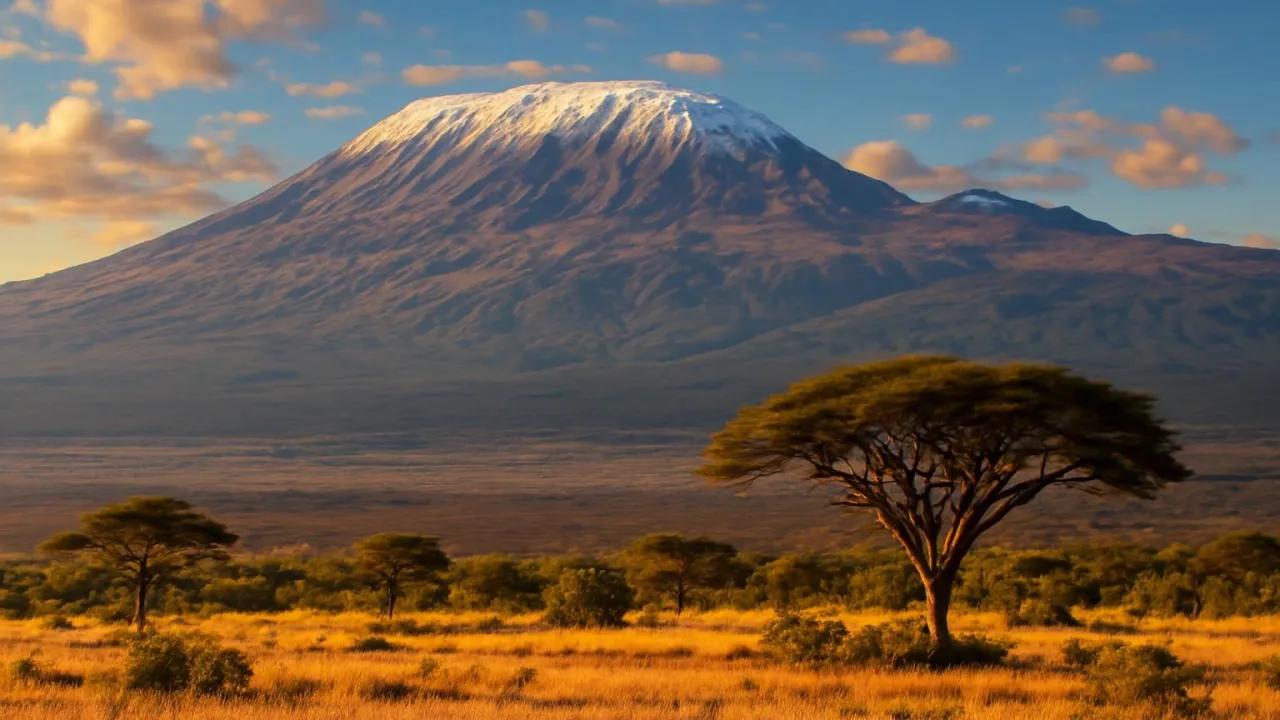
You can walk through five types of nature zones on Kilimanjaro!
✨ Word Sparks (Grade 2 Glossary)
Tap 🔊 to hear
volcano
A mountain made by melted rock
summit
The highest point of something
rainforest
A warm, wet forest with tall trees
🪝
What would you see if you climbed from warm grass to snowy ice on one mountain?
1
A Snowy Mountain in the Sun
Imagine standing in the hot sun and looking up to see a snowy peak. Mount Kilimanjaro surprises everyone because it has snow on top, even in Africa. The mountain rises high above the land, making its white shine bright.
2
Climbing Through Many Worlds
Climbers start in green filled with birds and monkeys, then walk into grassy fields. As they go higher, the air grows cold and thin, and soon they see ice and snow. Every step feels like a new adventure in a different world.
3
A Place Full of Wonder
People travel from all over to hike up Kilimanjaro and take pictures of the amazing views. They spot animals and plants that live only on this mountain. At the top, they feel like they are standing above the clouds.
Kilimanjaro’s glaciers are shrinking because of climate change.
✨ Word Sparks (Grade 3 Glossary)
Tap 🔊 to hear
stratovolcano
A tall, layered volcano made by eruptions
glacier
A large, slow-moving sheet of ice
erosion
When wind or water wears away land
🪝
What would it feel like to walk through clouds on top of Africa’s tallest mountain?
1
A Towering Volcano
Mount Kilimanjaro rises above the plains of Tanzania, reaching 19,341 feet into the sky. It is a dormant , which means it once erupted but now sleeps quietly. Its summit, called Uhuru Peak, is capped with and snow. People can see its white top from far across the land.
2
Climbing Through Climate Zones
Hikers start their journey in warm rainforests at the mountain’s base. As they climb, they pass through grassy moorlands and rocky slopes. The air grows thinner and colder with each step upward. Near the summit, the ground is icy and the wind whistles around them.
3
Nature’s Changing Wonders
Kilimanjaro’s slopes are home to many unique plants and animals. Elephants and monkeys live in the forests, while strange flowers grow higher up. The mountain’s climate changes quickly, creating many habitats. Each zone has its own special sights, sounds, and smells.
4
A Global Adventure
Every year, thousands of people travel from around the world to climb Kilimanjaro. They challenge themselves to reach the summit and look out over Africa. The journey teaches them about geology, , and the power of nature. Standing on top, climbers feel proud and amazed by Earth’s wonders.
Kilimanjaro’s summit glaciers may vanish within decades if warming continues.
✨ Word Sparks (Grade 4 Glossary)
Tap 🔊 to hear
tectonic
Related to Earth’s moving plates
glacier
A giant, slow-moving river of ice
altitude
How high something is above sea level
🪝
Imagine stepping from a warm rainforest into icy winds on one mountain—how does that happen?
1
Africa’s Majestic Stratovolcano
Mount Kilimanjaro dominates the Tanzanian landscape, soaring 19,341 feet above sea level as Africa’s tallest peak. It is a dormant stratovolcano, formed by layers of hardened lava and ash over hundreds of thousands of years. The mountain’s three volcanic cones—Kibo, Mawenzi, and Shira—tell a story of ancient eruptions. Today, only Kibo’s summit, called Uhuru Peak, is capped with permanent and snow.
2
A Journey Through Five Climate Zones
Climbers begin their trek in lush, humid rainforests teeming with monkeys and colorful birds. As they ascend, the environment shifts to heath, moorland, alpine desert, and finally to the arctic zone near the summit. Each zone features unique plants, animals, and weather patterns, creating a living laboratory for studying adaptation. The rapid change in climate and challenges both hikers and scientists alike.
3
Engineering and Natural Forces
Kilimanjaro’s height and structure result from powerful forces along the East African Rift. Over time, erosion from wind, rain, and melting shapes its slopes and valleys. The mountain’s glaciers, though shrinking due to climate change, still sparkle in the sunlight and provide important clues about Earth’s history. Scientists study these ice layers to learn about past climates and volcanic eruptions.
4
A Symbol for the World
Mount Kilimanjaro is a UNESCO World Heritage Site, attracting adventurers, researchers, and nature lovers from every continent. Local Chagga people share legends about the mountain’s spirit and protect its forests. The climb inspires global efforts to conserve unique habitats and slow loss. Kilimanjaro stands as a symbol of Africa’s beauty, resilience, and the wonders of our changing planet.
1. Why do Kilimanjaro’s climate zones change so quickly?
2. What do scientists study in Kilimanjaro’s glaciers?
🤯 Mind-Blowing Fact • Grade 5
Kilimanjaro’s glaciers have lost over 80% of their area since 1912 due to global warming.
✨ Word Sparks (Grade 5 Glossary)
Tap 🔊 to hear
stratovolcano
A tall volcano made of many eruption layers
biome
A large area with its own climate and life
conservation
Protecting nature and living things
🪝
What secrets does Africa’s tallest volcano reveal as you climb from steamy forest to icy summit?
1
A Geological Giant of the Rift
Mount Kilimanjaro rises dramatically from the East African plains, its snow-capped summit visible for over 100 miles. Formed by volcanic activity along the East African Rift, Kilimanjaro is a dormant composed of three cones: Kibo (the tallest), Mawenzi, and Shira. Geological evidence shows that Kibo last erupted about 360,000 years ago, and the mountain’s base spans nearly 25 miles (40 kilometers) across. Its immense height—19,341 feet (5,895 meters)—makes it the tallest free-standing mountain on Earth, not part of any mountain range.
2
A Vertical Journey Through Earth’s Biomes
Ascending Kilimanjaro is like traveling from the equator to the Arctic in just a few days. Climbers pass through five distinct ecological zones: rainforest, heath, moorland, alpine desert, and arctic summit. Each zone supports unique flora and fauna, from towering fig trees and blue monkeys in the rainforest to rare everlasting flowers and lichen near the summit. Temperature drops dramatically with altitude, sometimes by over 60°F (16°C) from base to peak, challenging both plants and people to adapt.
3
Engineering Forces and Erosion
Kilimanjaro’s massive structure was built by repeated eruptions that layered lava, ash, and volcanic rock. Powerful tectonic forces continue to shape the region, causing earthquakes and uplifting the land. Erosion from wind, rain, and melting glaciers carves deep gullies and valleys into the mountainside. Although the summit glaciers once covered a much larger area, they have shrunk by over 80% in the past century due to rising global temperatures.
4
Cultural Legends and Global Impact
For the Chagga people and other local communities, Kilimanjaro holds deep spiritual meaning and is central to many legends. The mountain draws over 35,000 climbers and trekkers each year, supporting local economies and efforts. As a UNESCO World Heritage Site, Kilimanjaro inspires scientific research on climate change, biodiversity, and geology. Its melting glaciers serve as a warning about the effects of global warming on fragile environments.
5
Protecting the Roof of Africa
Scientists and conservationists are working to protect Kilimanjaro’s unique ecosystems and slow the loss of its glaciers. National park rangers guard against illegal logging and poaching, while researchers monitor the health of forests and wildlife. International efforts focus on reducing carbon emissions to help preserve the mountain’s icy cap for future generations. Kilimanjaro stands as a powerful symbol of both natural wonder and the urgent need for global environmental stewardship.