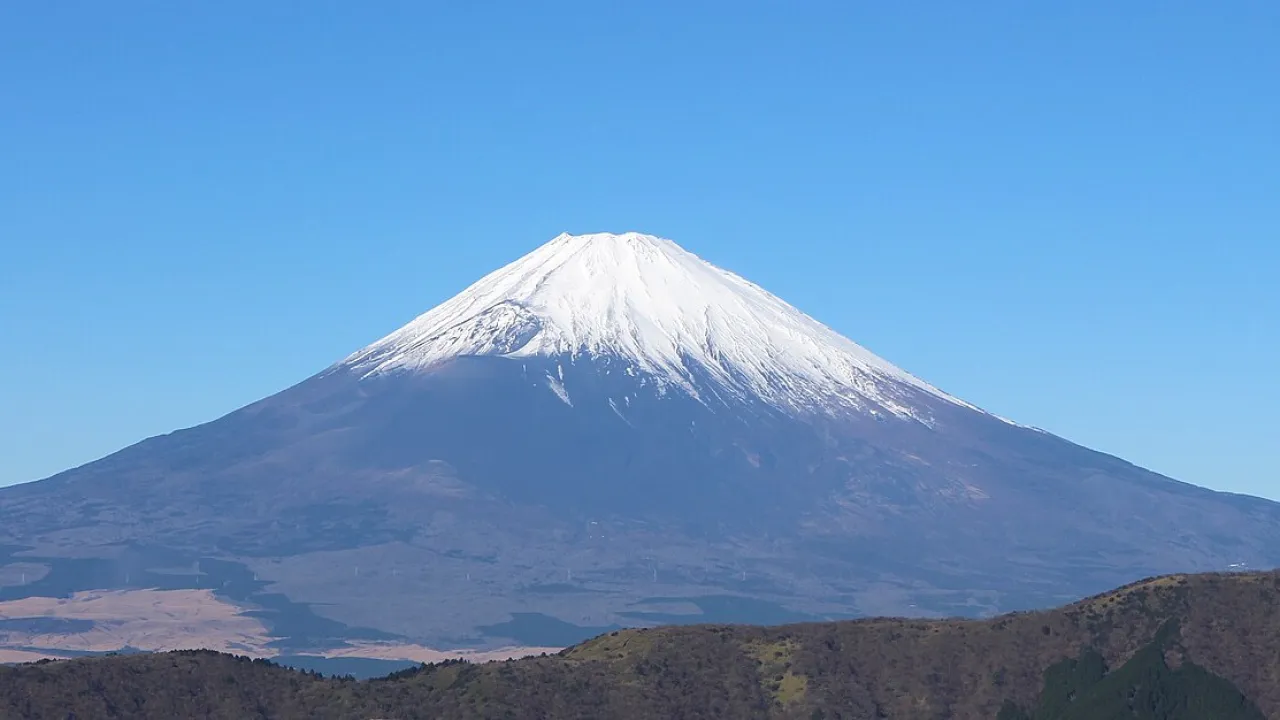
Three tiny post offices near Mount Fuji, including one right at the summit, let summer climbers mail postcards from the top of Japan!
✨ Word Sparks (Grade 2 Glossary)
Tap 🔊 to hear
lava
Hot melted rock that flows from a volcano
summit
The highest point at the top of mountains
eruption
A sudden blast of ash, gas, and lava
🪝
How can fiery melted rock build a peaceful, snow-covered mountain?
1
Rising Over Honshu
Morning mist drifts across a calm lake in Japan, and suddenly a giant snowy triangle appears in the sky! Mount Fuji stands 12,389 feet tall on Honshu Island, making it the highest mountain in the entire country.
2
Built Layer by Layer
Thousands of years ago, blasted ash and red-hot from deep underground. Each time the lava cooled into hard stone, the cone grew taller and smoother on every side.
3
Sacred Trails and Art
Mount Fuji has rested quietly since its last in 1707. Every summer, when the snow melts, thousands of hikers climb its rocky trails to watch the sunrise above the clouds.
1. When do most hikers climb to the top of Mount Fuji?
2. When did Mount Fuji last erupt?
🤯 Mind-Blowing Fact • Grade 3
When sunlight hits Mount Fuji behind the mountain, it casts a triangular shadow across the clouds below that stretches up to fifteen miles long!
✨ Word Sparks (Grade 3 Glossary)
Tap 🔊 to hear
stratovolcano
A tall cone volcano built from many layers
dormant
Quiet right now but able to erupt again
symmetrical
Matching evenly in shape on opposite sides
🪝
What secret hides underneath Mount Fuji's smooth, symmetrical slopes?
1
A Giant Above the Clouds
Picture standing beside Lake Kawaguchi at dawn while golden sunlight paints a towering snowy cone bright pink. Rising 3,776 meters above sea level on Honshu Island, Mount Fuji is Japan's tallest peak and most celebrated natural landmark.
2
Three Volcanoes in One
Geologists call Mount Fuji a because steep layers of hardened lava and volcanic ash stack inside it like giant blankets. Amazingly, today's mountain actually sits on top of two older volcanoes that formed tens of thousands of years ago.
3
Five Lakes Made by Lava
Past lava flows dammed ancient rivers around the northern base and created the famous Fuji Five Lakes. Nearby, dense forests grow right on top of porous, moss-covered lava rock.
4
Inspiring Artists and Climbers
For centuries, poets and painters like Katsushika Hokusai captured Fujisan from dozens of angles. Although since 1707, scientists still monitor subtle underground tremors beneath this sacred UNESCO World Heritage site.
1. Why do geologists classify Mount Fuji as a stratovolcano?
2. How were the Fuji Five Lakes formed near the mountain's northern base?
🤯 Mind-Blowing Fact • Grade 4
Rain and melted snow landing high on Mount Fuji's slopes filter slowly through volcanic basalt for decades before emerging as pure spring water at the mountain's foot!
✨ Word Sparks (Grade 4 Glossary)
Tap 🔊 to hear
tectonic
Relating to giant moving slabs of Earth's crust
basalt
Dark volcanic rock cooled from fluid lava
porous
Filled with tiny holes that let water pass
🪝
Why did three tectonic plates colliding beneath Japan build one of Earth's most balanced cones?
1
Where Three Plates Meet
Beneath clear autumn skies southwest of Tokyo, a snow-streaked cone rises almost straight from the Pacific coast to 12,389 feet. Mount Fuji stands directly above a rare triple junction where the Amurian, Okhotsk, and Philippine Sea plates grind together, feeding deep magma chambers that built this solitary giant mile by mile.
2
Generations of Fire and Stone
Rather than forming in a single blast, Fujisan grew across three distinct volcanic stages over hundreds of millennia. First came ancient Komitake, followed by Ko-Fuji roughly 100,000 years ago, and finally Shin-Fuji—the modern symmetrical cone built over the past 11,000 years by alternating sheets of fluid basaltic lava and explosive volcanic ash.
3
The Great Hoei Eruption
In December 1707, just forty-nine days after one of Japan's strongest recorded earthquakes shook the southern coast, a flank vent blasted dark ash high into the stratosphere without spilling liquid lava. Prevailing winter winds carried fine tephra sixty miles east, darkening midday skies and dusting streets in Edo—modern Tokyo—several inches deep before the volcano fell quiet.
4
Natural Wonder and Cultural Icon
Rain and snowmelt seeping through filter slowly for decades inside Mount Fuji before bubbling up as crystal-clear springs around its base, nourishing trout streams, wasabi farms, and the Fuji Five Lakes. Named a UNESCO World Heritage site in 2013, the sacred mountain unites plate , Shinto pilgrimage trails, classic woodblock prints, and modern seismic science.
1. What geological feature sits directly underneath Mount Fuji?
2. What happened during Mount Fuji's 1707 Hoei eruption?
🤯 Mind-Blowing Fact • Grade 5
Because fractured basalt swallows nearly every drop of rain and melting snow on its upper slopes, Mount Fuji has no permanent year-round rivers flowing down its cone!
✨ Word Sparks (Grade 5 Glossary)
Tap 🔊 to hear
subduction
One tectonic plate sliding beneath another plate
pyroclastic
Made of hot rock fragments blasted by volcanoes
aquifer
Underground rock layers that store clean groundwater
🪝
How did unusual basaltic magma create a steep stratovolcano that still shapes Japan's water, art, and science?
1
A Lone Giant on the Pacific Ring of Fire
Soaring 3,776.24 meters (12,389 feet) above Honshu's Pacific coastline, Mount Fuji dominates the skyline across Shizuoka and Yamanashi prefectures roughly 100 kilometers southwest of Tokyo. Unlike clustered alpine ranges, Fujisan rises as a solitary stratovolcano whose circular base spans nearly 30 miles across and encloses an estimated volume of 1,400 cubic kilometers, often wearing smooth lenticular cloud caps sculpted by moist high-altitude winds.
2
Subduction and Unusual Basaltic Chemistry
Mount Fuji occupies a remarkably active tectonic triple junction where the oceanic Philippine Sea Plate subducts beneath the continental Amurian and Okhotsk microplates along the Suruga and Sagami troughs. Most -zone stratovolcanoes erupt viscous, silica-rich andesitic or dacitic magma, yet Fuji predominantly produces low-viscosity basaltic magma whose alternating fluid lava flows and explosive tephra constructed unusually smooth concave slopes.
3
Stacked Cones and the 1707 Hoei Blast
Deep geological core drilling reveals three nested volcanic edifices stacked across ages: ancient Komitake on the northern flank, Pleistocene Ko-Fuji active roughly 100,000 years ago, and Holocene Shin-Fuji, which began erupting about 11,000 years ago, including the vast 864 CE Jogan lava flow. Its latest event, the 16-day Plinian Hoei eruption of December 1707, ejected 800 million cubic meters of scoria and ash from a southeastern flank crater.
4
Subterranean Aquifers and Lava Forests
Because solidified basalt contains countless gas vesicles and cooling fractures, more than two billion metric tons of annual rain and snowmelt percolate deep inside the cone rather than carving permanent surface rivers. Filtering slowly through volcanic strata for decades, mineral-rich groundwater emerges at foot springs such as Shiraito Falls and Oshino Hakkai while sustaining the dammed Fuji Five Lakes and dense Aokigahara forest.
5
Living Heritage and Seismic Vigilance
Inscribed by UNESCO in 2013 as a Cultural World Heritage site, Fujisan inspired Katsushika Hokusai's iconic Thirty-Six Views woodblock series, classical waka poetry, and centuries of summer summit climbs from mountain stations. Today, Japanese volcanologists operate continuous borehole tiltmeters, satellite interferometry, GPS arrays, and deep-low-frequency seismometers to monitor subtle magma pressure beneath the sleeping giant.