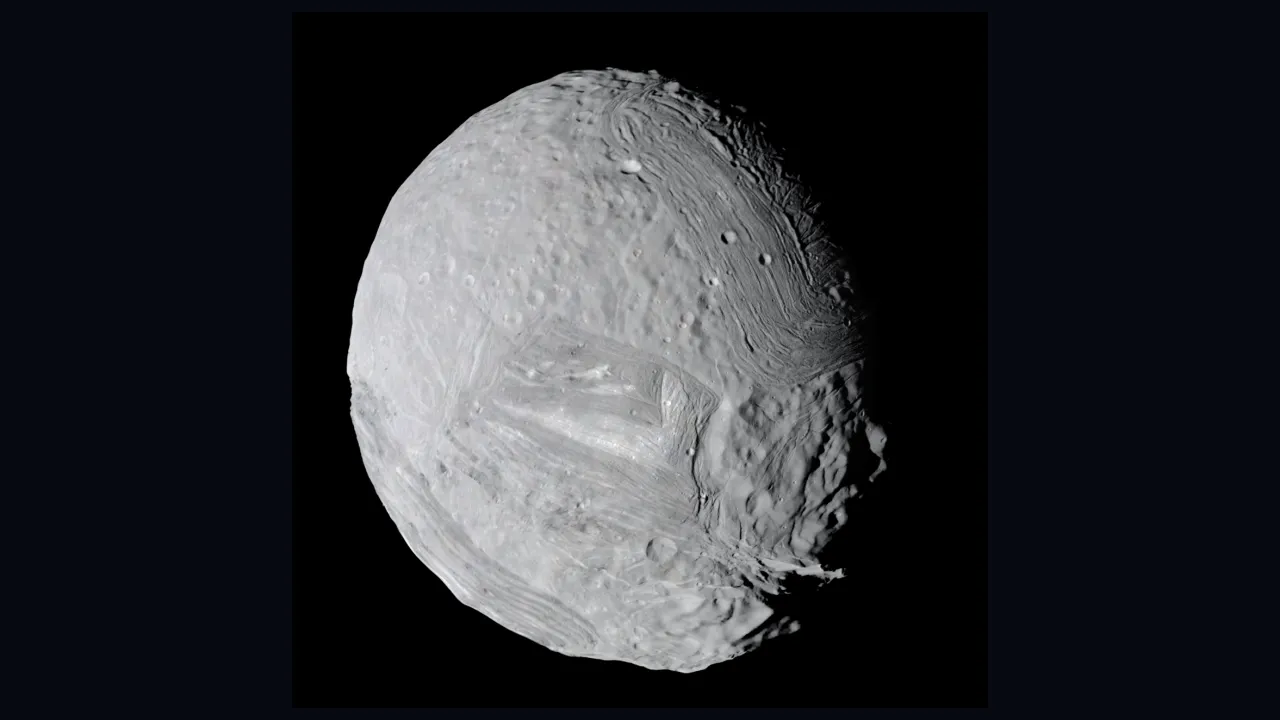
1. What Solar System record does Verona Rupes on Miranda hold?
2. Why would a dropped rock take 12 minutes to reach the bottom of Miranda's cliff?
🤯 Mind-Blowing Fact • Grade 2
One grooved pattern on Miranda forms a giant bright letter 'V' called the Chevron, wide enough to stretch across a whole state!
✨ Word Sparks (Grade 2 Glossary)
Tap 🔊 to hear
Coronae
Giant oval grooved regions on Miranda's icy crust.
Chevron
A crisp V-shaped stripe pattern on Miranda.
Scramble
To mix pieces up in a jumbled order.
🪝
Why does tiny Miranda look like five different moons glued into one ball?
1
Voyager 2's Biggest Shock
Before NASA's Voyager 2 flew past Uranus in 1986, scientists expected tiny 293-mile-wide Miranda to be a boring, cratered snowball. Instead, close-up photos revealed canyons twelve times deeper than the Grand Canyon, giant V-shapes, and grooved racetracks!
2
Giant Racetracks in Ice
Three huge oval zones called stamp Miranda's crust with neat parallel ridges, looking like giant raceways carved side by side with quiet cratered hills.
3
Shattered or Churned?
Either Miranda smashed apart long ago and pulled its scrambled chunks back together, or warm ice bubbled halfway up from inside and froze mid-swirl!
1. Which spacecraft took the only close-up photographs we have of Miranda?
2. What are the giant grooved oval 'racetrack' shapes on Miranda called?
🤯 Mind-Blowing Fact • Grade 3
Voyager 2 had to hold steady like a panning sports camera while zipping past dim Miranda at 45,000 miles per hour just to get sharp, unblurred photos!
✨ Word Sparks (Grade 3 Glossary)
Tap 🔊 to hear
Gravity boost
Using a world's gravity to sling a probe faster.
Fault scarp
A steep cliff formed where crust cracks and drops.
Buoyant
Light enough to rise upward through heavier surroundings.
🪝
Why did Voyager 2 have to fly closer to Miranda than any other moon at Uranus?
1
A Bullseye Flyby
Discovered in 1948 by astronomer Gerard Kuiper and named after the magician's daughter in Shakespeare's play The Tempest, Miranda orbits innermost of Uranus's five major moons. Because Uranus lies tipped sideways like a target, Voyager 2 had to thread right past Miranda—skimming just 1,900 miles away—to get a onward to Neptune!
2
Rising Blobs of Warm Ice
Today, most geologists favor the 'lava-lamp' model for Miranda's wild terrain. Billions of years ago, neighboring moons tugged Miranda into an oval orbit, squeezing its insides warm. Lighter, slushy ice blobs rose upward like wax in a lava lamp, wrinkling the surface into Inverness, Arden, and Elsinore Coronae!
3
Towering Verona Rupes
Where the crust stretched and snapped along a massive fault line, Verona Rupes dropped up to twelve miles—exposing gleaming blue-white ice walls.
4
Frozen Mid-Motion
Once Miranda escaped that orbital tug-of-war, its interior cooled fast, freezing its half-finished jigsaw landscape in place forever!
1. How does the 'lava-lamp' hypothesis explain Miranda's grooved coronae?
2. Which Shakespeare play gave Miranda and its giant regions (like Inverness and Elsinore) their names?
🤯 Mind-Blowing Fact • Grade 4
Because Miranda's northern half was hidden in 42-year polar winter darkness when Voyager 2 flew past in 1986, humans have still only mapped the southern half of Miranda!
✨ Word Sparks (Grade 4 Glossary)
Tap 🔊 to hear
Diapir
A rising dome of warm, lighter ice pushing upward.
Inclination
Angle a moon's orbit tilts compared to the equator.
Convection
Heat circulation as warm material rises and cool sinks.
🪝
How could a tiny moon less than 300 miles wide unleash tectonic canyons deeper than planets ten times its size?
1
Past Orbital Resonance Heating
Orbiting 129,900 kilometers from Uranus every 33.9 hours, Miranda currently shares no exact orbital resonance with its neighbors Ariel and Umbriel. However, orbital mechanics show that Miranda was once locked in a chaotic 3:1 resonance with Umbriel (and possibly a 5:3 resonance with Ariel)! That ancient gravitational dance pumped Miranda's orbital inclination to over four degrees—unusually steep for a close-in regular moon—and unleashed intense tidal flexing inside.
2
Ice Diapirism and Extensional Grabens
With a bulk density of 1.20 grams per cubic centimeter (about sixty percent ice and forty percent silicate rock), tidal warmth set off solid-state . Giant plumes of warm ice—called —pushed upward beneath Arden, Elsinore, and trapezoidal Inverness Corona, stretching the brittle crust until parallel graben faults and concentric ridges tore open!
3
The Northern Hemisphere Mystery
Because Uranus was in full southern summer during Voyager 2's 1986 flyby, Miranda's entire northern hemisphere lay plunged in pitch darkness! Half of this bizarre jigsaw moon has never been photographed.
4
Could a Remnant Ocean Linger?
In 2024, fresh computer modeling of Miranda's fault stress patterns suggested a thin liquid ocean at least 60 miles deep existed within the last 100 to 500 million years—and might not even be completely frozen today!
1. Why have humans only ever photographed the southern hemisphere of Miranda?
2. What clue in Miranda's current orbit supports an ancient gravitational resonance with Umbriel?
🤯 Mind-Blowing Fact • Grade 5
Surface gravity on Miranda is less than 1 percent of Earth's—if you weigh 100 pounds on Earth, you would weigh less than 13 ounces (lighter than a loaf of bread!) standing atop Verona Rupes!
✨ Word Sparks (Grade 5 Glossary)
Tap 🔊 to hear
Lithostatic
Downward crushing weight of overlying rock or ice.
Endogenic
Driven by heat and forces coming from inside.
Regolith
Loose blanket of powdery dust and crushed ice.
🪝
Did tectonic fractures on tiny Miranda betray a subsurface ocean comparable to Mimas and Enceladus?
1
Extreme Relief on a Low-Gravity Ellipsoid
Measuring 480 by 468 by 466 kilometers across with surface gravity merely 0.079 meters per second squared (less than one percent of Earth's!), Miranda defies classical expectations that geological vigor requires large planetary mass. Weak gravity permitted tectonic scarps like Verona Rupes to sustain up to twenty kilometers of vertical relief without collapsing under overburden—creating canyon systems twelve times deeper relative to Earth's Grand Canyon.
2
From Disruptive Reaccretion to Endogenic Upwelling
Early post-Voyager hypotheses proposed that catastrophic comet collisions shattered Miranda multiple times, letting dense silicate blocks sink through reaccreted ice to drag surface crust inward. Higher-resolution stereo photoclinometry, however, revealed crisp extensional normal faults, outward-dipping tilt blocks, and potential cryovolcanic resurfacing inside Elsinore and Inverness Coronae—favoring mantle diapirism driven by passage through a 3:1 orbital commensurability with Umbriel.
3
Thin-Shell Flexure and Recent Ocean Models
In 2024, researchers at the Johns Hopkins Applied Physics Laboratory modeled tidal stress patterns across Arden and Inverness Coronae, finding that observed asymmetrical fault belts require a brittle ice shell thinned to 30 kilometers or less atop a liquid water ocean at least 100 kilometers deep as recently as 100 to 500 million years ago!
4
Insulating Regolith Blankets
Subdued crater rims in Miranda's ancient plains appear draped in tens of meters of fluffy, insulating icy —possibly plume fallout akin to Enceladus—helping trap internal heat.
5
Mapping the Unseen Northern Hemisphere
When a future Uranus Orbiter arrives during northern illumination, mapping Miranda's uncharted northern hemisphere and testing for induced magnetic fields will reveal whether tiny Miranda still shelters a remnant briny sea.