1. What shape does our Milky Way Galaxy look like from high above?
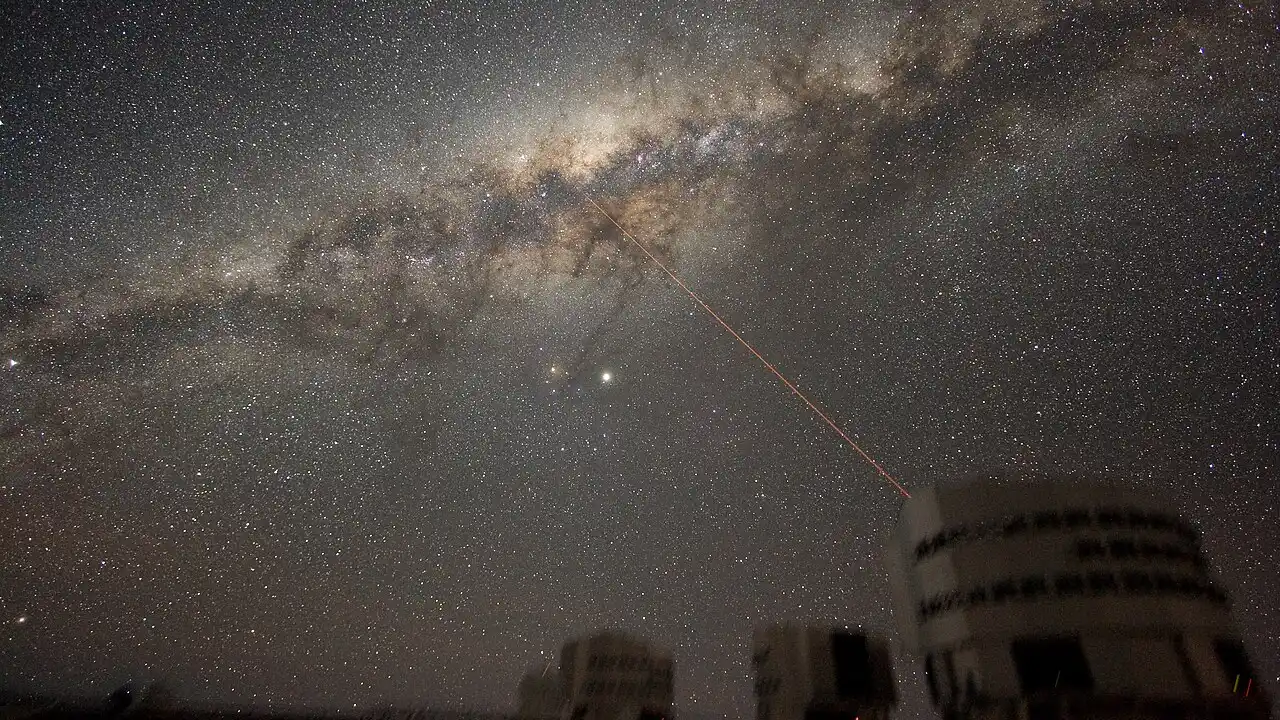
2. Why does the Milky Way look like a misty band across our night sky?
🤯 Mind-Blowing Fact • Grade 2
The last time our Solar System stood on this exact side of the Milky Way Galaxy, the very first early dinosaurs were just appearing on Earth!
✨ Word Sparks (Grade 2 Glossary)
Tap 🔊 to hear
light-year
Distance a beam of light travels yearly
spur
Smaller starry branch between main spiral arms
disk
Flat, round pancake shape of orbiting stars
🪝
How did Galileo prove the 'milky' band in the night sky wasn't a cloud of mist at all?
1
Galileo Points His Spyglass
Ancient skywatchers thought the glowing band overhead looked like spilled milk, giving our Milky Way Galaxy its name! In 1610, Italian scientist Galileo Galilei aimed his brand-new telescope at that misty band—and gasped to see countless tiny stars packed closely together!
2
Our Cozy Suburban Address
Measuring 100,000 across, our galaxy has a bright bar-shaped middle and curving spiral arms. Earth and our Sun live about halfway out in a cozy neighborhood called the Orion !
3
One Galactic Birthday
Even racing at 514,000 miles per hour, our Sun takes about 230 million Earth years to circle the galaxy's center once!
1. What did Galileo discover when he aimed a telescope at the Milky Way in 1610?
2. Where is our Solar System located inside the Milky Way Galaxy?
🤯 Mind-Blowing Fact • Grade 3
Europe's Gaia space observatory has measured the exact 3D positions and motions of nearly two billion stars across our Milky Way Galaxy!
✨ Word Sparks (Grade 3 Glossary)
Tap 🔊 to hear
barred spiral
Spiral galaxy with a straight central star bar
nebula
Giant glowing space cloud where stars form
black hole
Region of gravity so strong light stays trapped
🪝
How can astronomers draw a map of the Milky Way Galaxy if no spacecraft has ever flown outside it?
1
Mapping Our House From Inside
Imagine trying to sketch the outside shape of your house without ever stepping out the front door! Because even light takes 100,000 years to cross our Milky Way Galaxy, no camera can fly above it to snap a selfie. Instead, astronomers measure star distances and radio waves from hydrogen gas to map it from inside!
2
A Barred Spiral Giant
Those maps revealed a surprise: instead of a simple round hub, our galaxy is a ! A glowing peanut-shaped bar of older golden stars stretches across the middle, feeding bluish spiral arms rich with star-forming gas nebulae.
3
What Hides in the Very Center?
Twenty-six thousand light-years away in the direction of constellation Sagittarius sits our galaxy's anchor: Sagittarius A*, a supermassive weighing four million times as much as our Sun!
4
Billions of Worlds
With 100 to 400 billion stars—and planets orbiting nearly every star—our Milky Way holds hundreds of billions of alien worlds!
1. What sits at the exact center of the Milky Way Galaxy's starry bar?
2. Why can't NASA send a probe outside the Milky Way to photograph the whole galaxy?
🤯 Mind-Blowing Fact • Grade 4
Above and below the Milky Way's center balloon two colossal 25,000-light-year spheres of high-energy light called 'Fermi Bubbles,' likely blown by an ancient burp from our central black hole millions of years ago!
✨ Word Sparks (Grade 4 Glossary)
Tap 🔊 to hear
dark matter
Invisible mass whose gravity holds galaxies together
globular cluster
Tight round ball of hundreds of thousands of stars
interstellar dust
Tiny smoke-sized mineral grains drifting between stars
🪝
Why don't the outer stars of the Milky Way fly off into deep space when the galaxy spins so fast?
1
Peering Through Cosmic Dust
Look up at the summer Milky Way and dark rifts appear to slice right down its glowing spine. Rather than empty holes, those 'Great Rift' lanes are thick clouds of blocking visible starlight! Infrared telescopes like Spitzer and Webb plus 21-centimeter radio antennas pierce straight through that dust, mapping four major spiral lanes—including the Perseus and Scutum-Centaurus arms—plus our local Orion Spur.
2
Thin Disk, Ancient Halo
Compared to its 100,000-light-year width, the Milky Way's starry disk is remarkably wafer-thin—averaging just 1,000 light-years thick, thinner proportionally than a sheet of notebook paper! Surrounding that flat disk floats a spherical halo of 150+ ancient globular star clusters born over twelve billion years ago.
3
Invisible Dark Matter Glue
In the 1970s, astronomer Vera Rubin noticed outer spiral galaxy stars orbit just as fast as inner stars instead of slowing down like outer planets do! Only a giant, invisible halo of ''—outweighing all visible stars and gas combined by roughly five to one—provides enough gravity to hold our fast-spinning Milky Way together.
4
Growing by Cosmic Mergers
Star streams mapped by ESA's Gaia telescope prove our Milky Way grew to its current size by gently absorbing smaller dwarf galaxies billions of years ago!
1. How do astronomers see all the way to the Milky Way's center through thick clouds of interstellar dust?
2. What proves that an invisible halo of dark matter surrounds our Milky Way Galaxy?
🤯 Mind-Blowing Fact • Grade 5
Star S2 at the very center of the Milky Way whips around supermassive black hole Sagittarius A* at over 16 million miles per hour—fast enough to stretch light wavelengths precisely as Albert Einstein's general relativity predicted!
✨ Word Sparks (Grade 5 Glossary)
Tap 🔊 to hear
parallax
Tiny star position shift used to measure distance
density wave
Moving traffic jam of gravity making spiral arms
interferometry
Linking distant telescopes to act as one giant eye
🪝
How did Gaia's two-billion-star astrometry uncover the dynamic archaeology of our warped, barred Milky Way?
1
Dethroning the Heliocentric Galaxy
Until the early twentieth century, dust extinction fooled astronomers into thinking our Sun sat near the center of a modest starry lens. In 1918, Harlow Shapley measured RR Lyrae variable stars inside globular clusters hovering above the dusty plane, proving the galactic center lay tens of thousands of light-years away toward Sagittarius! Modern very-long-baseline radio pins our Solar System 26,670 light-years from the dynamical core, orbiting within the local Orion-Cygnus Spur at roughly 230 kilometers per second—completing one 'galactic year' every 225 to 250 million years.
2
Barred SBbc Morphology and Density-Wave Arms
Spitzer infrared star counts and neutral-hydrogen 21-centimeter Doppler maps classify the Milky Way as an SBbc barred spiral spanning 100,000 to 120,000 light-years, gently warped into an S-curve at its outskirts. A central 27,000-light-year boxy/peanut-shaped stellar bar funnels molecular gas into primary density-wave arms—Scutum-Centaurus and Perseus—where compression triggers massive OB star nurseries without requiring individual stars to stay locked inside a single arm forever.
3
Sagittarius A* and Nuclear Star Orbits
Adaptive-optics tracking of star S2 whipping past pericenter at 2.5 percent light speed—crowned by the Event Horizon Telescope's 2022 millimeter-wave ring image—weighed our central supermassive black hole Sagittarius A* at 4.15 million solar masses, framed above and below the plane by 50,000-light-year gamma-ray and X-ray Fermi/eROSITA Bubbles.
4
Galactic Archaeology via ESA's Gaia Mission
Measuring micro-arcsecond and proper motions for nearly two billion stars, Gaia uncovered fossil phase-space streams from ancient mergers—most notably 'Gaia-Sausage-Enceladus,' a dwarf galaxy collision ten billion years ago that puffed up our thick disk, alongside the ongoing tidal disruption of the Sagittarius Dwarf Spheroidal and gravitational wake of the Large and Small Magellanic Clouds.
5
Anchor of the Local Group
Embedded inside a ~1.2-trillion-solar-mass dark-matter halo, the Milky Way co-anchors the Local Group alongside Andromeda as fifty-plus satellite dwarf galaxies whirl around our shimmering cosmic island.