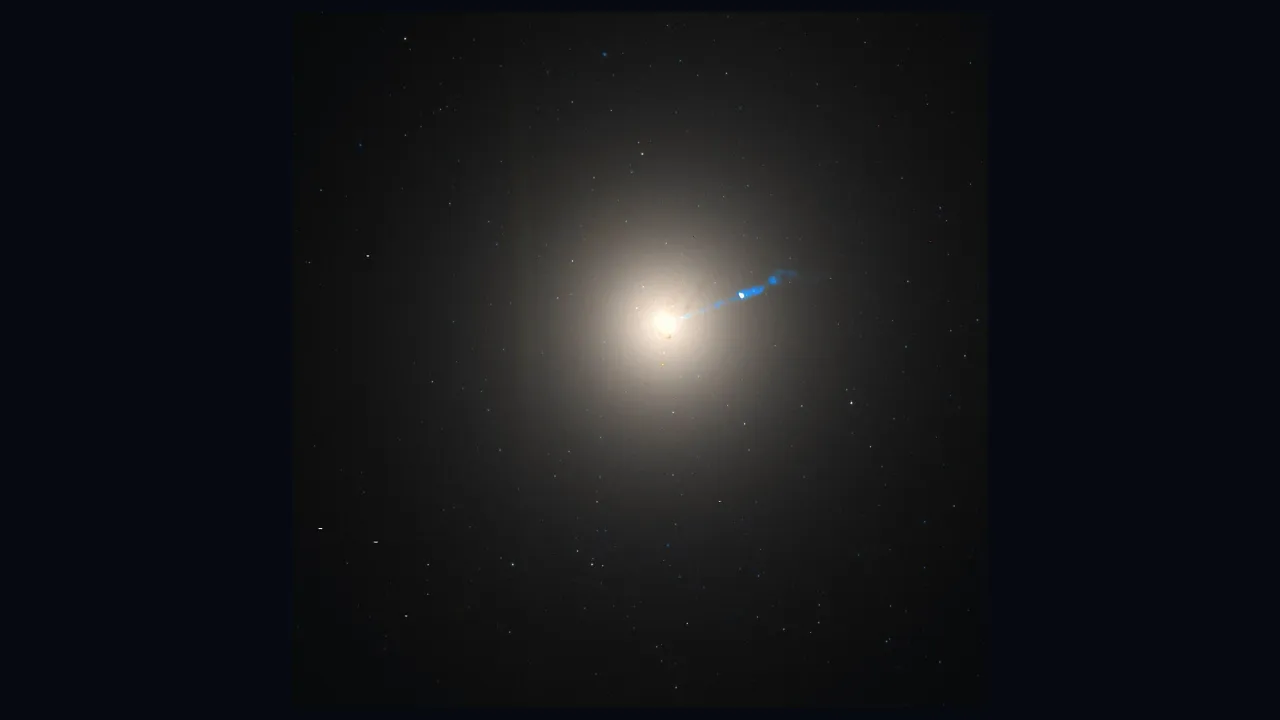
⚡ Cosmic SparkFirst black hole ever captured in a real image, wider than our entire Solar System's planet orbits
🤯 Mind-Blowing Fact • Grade 1
Hawaiian language experts gave this black hole the beautiful nickname 'Powehi,' which means 'embellished dark source of unending creation'!
✨ Word Sparks (Grade 1 Glossary)
Tap 🔊 to hear
shadow
A dark shape where light cannot reach
beam
A bright stream of light shooting outward
giant
Something super huge compared to ordinary things
🪝
How do you take a photo of something so dark that light cannot escape?
1
A Famous Space Photo
Say cheese to a cosmic ! In 2019, scientists showed the world the very first real photo of a black hole. It lives far away inside a giant galaxy called Messier 87.
2
Bigger Than Our Planet Paths
Bright orange gas spins around a round dark in the middle. That dark center is wider than every planet's path around our Sun!
3
A Giant Beam of Light
Fierce energy blasts a long blue straight out from its poles into deep space!
1. Why is the Messier 87 Black Hole famous around the world?
2. What shoots far out into space from the poles of the Messier 87 Black Hole?
🤯 Mind-Blowing Fact • Grade 2
It took so much telescope data to create the first picture of M87* that scientists had to fly half a ton of computer hard drives on airplanes—faster than sending it over the internet!
✨ Word Sparks (Grade 2 Glossary)
Tap 🔊 to hear
magnetic field
Invisible force loops like those around magnets
cosmic jet
Fast narrow beam shooting from a black hole
billion
One thousand million—an enormous counting number
🪝
Could a single black hole swallow the size of our entire Solar System with room to spare?
1
A Monster in Virgo
Travel 55 million light-years toward the constellation Virgo, and you will reach a colossal ball-shaped galaxy named Messier 87. Anchoring its center is M87*, a supermassive black hole weighing 6.5 times as much as our Sun!
2
Wider Than Pluto's Orbit
Its dark boundary spans 24 miles across—more than three times wider than Pluto's farthest trip around the Sun! Swirling gas around it heats up to billions of degrees and glows fiercely.
3
Cosmic Blowtorch
Not all nearby gas falls inside. Powerful twist like rubber bands and fling particles outward in a glowing 5,000 light-years long!
1. How wide is the dark event horizon of the Messier 87 Black Hole?
2. Why did scientists ship hard drives on airplanes to make M87*'s first image?
🤯 Mind-Blowing Fact • Grade 3
More than a century before M87* was photographed, astronomer Heber Curtis spotted its 5,000-light-year plasma jet in 1918 without having any idea black holes existed!
✨ Word Sparks (Grade 3 Glossary)
Tap 🔊 to hear
elliptical galaxy
Giant oval galaxy filled mostly with older stars
relativistic
Moving close to the extreme speed of light
petabyte
One million gigabytes of stored computer information
🪝
Why does one side of the Messier 87 Black Hole's glowing ring shine brighter than the other?
1
Heart of a Giant Elliptical Galaxy
Unlike flat spiral galaxies, Messier 87 is a colossal packed with trillions of older golden stars at the heart of the Virgo Cluster. Deep inside its core sits M87*, packing 6.5 billion solar masses—more than 1,500 times heavier than our Milky Way's central black hole!
2
Unveiling the Ring of Fire
On April 10, 2019, over two hundred Event Horizon Telescope scientists revealed a historic image from 55 million light-years away. Radio dishes spanning Earth worked together to capture M87*'s dark shadow framed by superheated plasma.
3
Why the Bottom Half Shines Brighter
Look closely at M87*'s orange donut, and its southern rim glows noticeably brighter. Because plasma races around the black hole near light speed, gas spinning toward Earth gets boosted in brightness—an effect called beaming!
4
The 5,000-Light-Year Searchlight
Back in 1918, astronomer Heber Curtis noticed a strange blue 'ray' poking out of Messier 87. Today we know M87* launches this jet at 99 percent of light speed!
1. Why does the bottom edge of M87*'s glowing ring look brighter than the top edge?
2. Roughly how much heavier is M87* than our Milky Way's black hole, Sagittarius A*?
🤯 Mind-Blowing Fact • Grade 4
Because M87* is both ~1,500 times wider and ~2,000 times farther away than Sagittarius A*, both black holes look nearly identical in apparent size from Earth!
✨ Word Sparks (Grade 4 Glossary)
Tap 🔊 to hear
photon ring
Circle of light bent around a black hole
polarized light
Light waves aligned by magnetic fields in space
spacetime
Four-dimensional fabric bent by mass and gravity
🪝
How does gravity bend light from behind a black hole so we see a glowing ring around darkness?
1
Einstein's Shadow Made Visible
More than a century ago, Albert Einstein's general relativity predicted that an ultra-compact mass would warp into a gravitational lens. At 55 million light-years away in Virgo, M87*'s 6.5-billion-solar-mass bulk bends nearby light paths into tight loops. Photons skimming just outside its 38-billion-kilometer event horizon whip around the back and escape toward Earth, outlining a bright '' around a dark central shadow roughly 2.6 times wider than the horizon itself!
2
Why M87* Sat Still for Its Portrait
Although M87 lies two thousand times farther away than our Milky Way's Sagittarius A, it is also roughly 1,500 times wider—making both appear almost the exact same tiny size in Earth's sky! Better yet, because M87* is so enormous, orbiting plasma takes days rather than minutes to circle its rim, holding steady during multi-hour telescope exposures.
3
Magnetic Launchpad for a Cosmic Jet
Polarized-light images from the Event Horizon Telescope revealed powerful, corkscrew-shaped magnetic fields wound tightly around M87*. As the black hole spins, it twists those magnetic field lines like a dynamo, tapping rotational energy to blast subatomic particles 5,000 light-years across space.
4
Sharpening the Picture With AI and New Dishes
Follow-up observations adding telescopes in Greenland, Arizona, and France confirmed that M87*'s ring size stays rock-steady year after year—proving Einstein's gravity holds firm—even as the brightest hot spot slowly shifts around the rim.
1. Why was M87* actually easier to photograph without blur than the much closer Sagittarius A*?
2. What powers the 5,000-light-year relativistic jet shooting out of M87*?
🤯 Mind-Blowing Fact • Grade 5
M87*'s jet acts like a giant cosmic thermostat—pumping shockwaves into surrounding galaxy-cluster gas so it stays too hot to collapse into trillions of extra stars!
✨ Word Sparks (Grade 5 Glossary)
Tap 🔊 to hear
microarcsecond
Tiny sky angle equal to coin seen across continents
Kerr black hole
Spinning black hole dragging surrounding spacetime with it
astronomical unit
Average distance between Earth and Sun—93 million miles
🪝
How did hydrogen maser atomic clocks, eight global observatories, and five petabytes of millimeter waves confirm century-old predictions of curved spacetime?
1
A Century From Curious Jet to Direct Horizon Shadow
In 1918, Lick Observatory astronomer Heber Curtis noted 'a curious straight ray' emerging from the core of giant elliptical galaxy Messier 87, located 55 million light-years away at the dynamical center of the Virgo Cluster. Decades of Hubble spectroscopy tracking super-fast central gas disks and stellar velocities pointed to a gargantuan dark mass inside M87's core. On April 10, 2019, the Event Horizon Telescope Collaboration unveiled humanity's first direct horizon-scale image of that engine: M87*, christened Powehi in Hawaiian.
2
Earth-Aperture Very Long Baseline Interferometry
Resolving an angular diameter of just 42 —equivalent to reading the date on a coin in Los Angeles from New York—required linking eight millimeter-wave observatories across four continents at 1.3-millimeter wavelength (230 GHz). Hydrogen maser atomic clocks stamped incoming radio waves to fractions of a nanosecond across five petabytes of hard drives, allowing supercomputer correlators to synthesize an aperture matching Earth's diameter.
3
Relativistic Shadow Geometry and Mass Calibration
General relativistic magnetohydrodynamic simulations matched the 42- asymmetric crescent to a of 6.5 billion solar masses. Its Schwarzschild event horizon spans roughly 38 billion kilometers (~254 —over six times Neptune's orbital diameter), while intense gravitational lensing expands the observed dark shadow to ~2.6 Schwarzschild radii.
4
Blandford-Znajek Jet Extraction
Polarimetric EHT maps and 3.5-millimeter Global mm-VLBI Array observations connected the base of M87's 5,000-light-year relativistic jet directly to the accretion ring. Strong poloidal magnetic fields thread the horizon, extracting spin energy via the Blandford-Znajek mechanism to accelerate electron-positron plasma to Lorentz factors exceeding ten.
5
Cosmic Thermostat of the Virgo Cluster
Far from merely devouring matter, M87*'s jet inflates colossal shock-heated cavities across Virgo's intracluster X-ray gas, preventing runaway cooling flows and regulating star birth across an entire galaxy cluster.