1. What really causes a bright shooting star in the mesosphere?
2. What is the temperature like high up in the mesosphere?
🤯 Mind-Blowing Fact • Grade 2
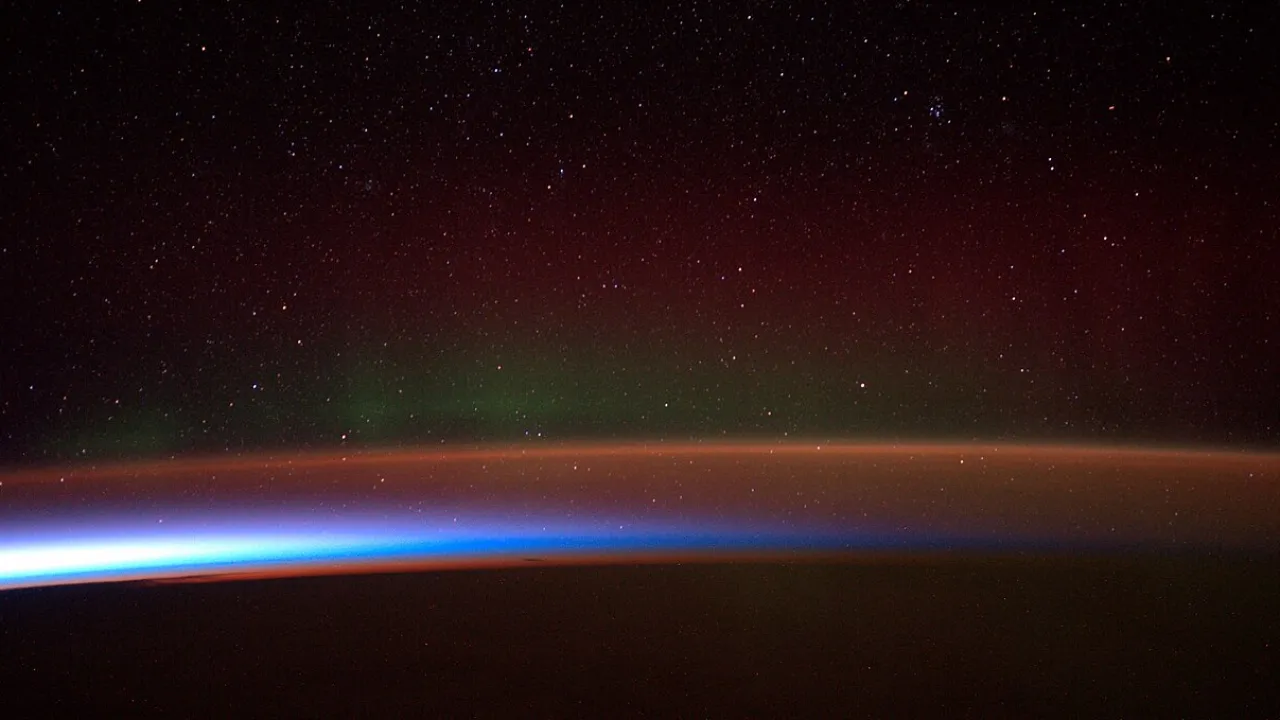
Rare icy clouds in the mesosphere glow silvery-blue at night long after sunset!
✨ Word Sparks (Grade 2 Glossary)
Tap 🔊 to hear
atmosphere
the whole blanket of gases around Earth
friction
heat made when two things rub hard together
altitude
how high something is above the ground
🪝
How does thin, icy air stop fast space rocks from hitting the ground?
1
Streaks of Night Light
Look up on a clear, dark night, and you might spot a sudden flash zooming overhead. That bright trail happens inside the mesosphere, the middle layer of Earth's blanket of air. Its name comes from a Greek word meaning middle.
2
Higher Than Planes, Lower Than Space
The mesosphere stretches from about 31 to 53 miles above the ground. Jet airplanes cannot fly that high because the air is too thin. At the top of this layer, temperatures drop to a freezing minus 130 degrees Fahrenheit!
3
Burning Up Space Rocks
Even though the air is thin, there is still enough gas to protect us. When speedy bits of rock and dust zoom in from space, they slam into air gases, heat up, and glow brightly as meteors.
1. Why does the word mesosphere fit this layer of the sky?
2. Why can't regular jet airplanes fly up into the mesosphere?
🤯 Mind-Blowing Fact • Grade 3
Earth gains dozens of tons of harmless, microscopic meteor dust every day after rocks vaporize in the mesosphere!
✨ Word Sparks (Grade 3 Glossary)
Tap 🔊 to hear
meteoroid
a small piece of rock traveling through space
vaporize
to turn a solid straight into hot gas
sounding rocket
a research rocket that measures high air layers
🪝
Why do scientists call the mesosphere one of the hardest places on Earth to explore?
1
Welcome to the Middle Sky
Whoosh! Fifty miles above your backyard, a grain of cosmic sand slams into Earth's atmosphere faster than a speeding bullet and bursts into glowing light. Welcome to the mesosphere, our planet's third atmospheric layer, tucked right above the stratosphere and below the thermosphere.
2
Extreme Chill at the Top
Unlike the stratosphere below it, the mesosphere has almost no ozone gas to soak up warming sunlight. As you climb from 50 to 85 kilometers high, the air grows colder and colder. Near its upper edge, temperatures plunge to minus 90 degrees Celsius, colder than Antarctica!
3
How Meteors Blaze and Fade
Space rocks called race toward Earth at tens of thousands of miles per hour. When they hit the mesosphere, they squeeze the air molecules in front of them so fast that intense heat builds up, vaporizing most rocks into harmless meteor trails.
4
A Tricky Zone to Study
Weather balloons pop before reaching this height, while orbiting satellites stay much higher so thin air will not slow them down. Scientists launch brief just to measure this mysterious zone!
1. Why does the mesosphere get so cold compared to the stratosphere below it?
2. How do scientists directly collect data inside the mesosphere?
🤯 Mind-Blowing Fact • Grade 4
Red electrical flashes called sprites leap upward for miles through the mesosphere right above powerful thunderstorms!
✨ Word Sparks (Grade 4 Glossary)
Tap 🔊 to hear
mesopause
the freezing top boundary of the mesosphere
compression
squeezing gas molecules tightly into a small space
noctilucent
night-shining icy clouds high in polar skies
🪝
How can air thin enough to suffocate a jet engine still shatter solid rock from outer space?
1
A Cosmic Firework Factory
Imagine watching the Perseid meteor shower from a Virginia meadow in August as dozens of luminous streaks slice across the starry dome. Every single flash is igniting roughly 50 to 85 kilometers overhead inside the mesosphere. Sandwiched between the ozone-rich stratosphere below and the sun-baked thermosphere above, this middle layer acts as Earth's frontline armor against interplanetary debris.
2
Compression Heat in Thin Air
Air pressure in the mesosphere is less than one-thousandth of what we breathe at sea level. How can such sparse gas destroy solid rock and iron? Speed is the secret. Meteoroids plunge inward at 11 to 72 kilometers per second. At those hypersonic velocities, air molecules cannot move aside fast enough. They pile up and compress violently ahead of the rock, heating its surface past 1,600 degrees Celsius until it vaporizes into a glowing meteor.
3
The Coldest Frontier Around Earth
Surprisingly, this fiery meteor graveyard is the frigid champion of our planet's sky. Because carbon dioxide molecules there radiate heat outward into space while little ozone exists to absorb solar rays, temperatures drop steadily with altitude. At the upper boundary, called the , thermometers read around minus 90 degrees Celsius.
4
Night-Shining Clouds and Lightning Sprites
Tiny wisps of water vapor freezing onto meteoric smoke form eerie clouds near the poles—the highest clouds on Earth. Mysterious red flashes called sprites also dance upward through the mesosphere above giant thunderstorms!
1. What main process heats a fast meteoroid until it glows in the mesosphere?
2. What helps noctilucent clouds form near the top of the mesosphere?
🤯 Mind-Blowing Fact • Grade 5
Summer poles actually produce the coldest mesopause temperatures on Earth—dropping past -100°C—because rising air expands and cools dramatically!
✨ Word Sparks (Grade 5 Glossary)
Tap 🔊 to hear
ablation
melting and vaporizing away a rock's outer surface
lidar
laser light pulses used to measure the sky
orbital decay
gradual sinking of a satellite slowed by air
🪝
Why have atmospheric physicists nicknamed the sky's meteor-burning shield the 'ignorosphere'?
1
Earth's High-Velocity Shield
Step outside beneath a moonless midnight sky, and within minutes you may witness a brilliant incandescent trail vanish in less than a second. That fleeting flash occurs 50 to 85 kilometers (31 to 53 miles) straight up within the mesosphere, the third major tier of Earth's atmosphere. Positioned above the stratopause and below the mesopause, this turbulent region intercepts billions of sand-sized cosmic fragments daily before they can strike the surface.
2
Aerodynamic Ram Pressure vs. Thin Air
Although atmospheric density in the mesosphere is less than 0.1 percent of sea-level density, incoming meteoroids encounter millions of gas molecules per cubic centimeter. Traveling at orbital velocities between 11 and 72 kilometers per second, a meteoroid slams into air faster than molecules can scatter. Intense aerodynamic ram pressure compresses the bow wave into incandescent plasma exceeding 1,650 degrees Celsius, ablating rock and metal into ionized trails that even reflect radio waves.
3
Radiative Cooling at the Mesopause
Paradoxically, the layer famous for white-hot meteors hosts the coldest naturally occurring temperatures anywhere in the Earth system. With negligible ozone to capture solar ultraviolet radiation, sparse carbon dioxide molecules emit infrared energy out to space. Temperatures fall with altitude to roughly minus 90 degrees Celsius (minus 130 degrees Fahrenheit) — and occasionally dip below minus 100 degrees Celsius during polar summer!
4
Why Scientists Call It the Ignorosphere
Researchers jokingly dubbed the mesosphere the 'ignorosphere' because it sits in an observational blind spot. Helium weather balloons burst near 40 kilometers, whereas satellites orbiting below 160 kilometers suffer rapid from atmospheric drag. Consequently, scientists rely on suborbital sounding rockets, ground-based beams, and specialized satellites like NASA's AIM mission.
5
Atmospheric Tides, Gravity Waves, and Polar Clouds
Far from calm, the mesosphere churns with gigantic atmospheric gravity waves rising from lower mountain ranges and storms. Near 80 kilometers altitude, scarce water vapor condenses onto nanometer-sized meteoric smoke particles, weaving electric-blue noctilucent ('night-shining') clouds that gleam in twilight after sunset below.