1. What makes a magnetar special compared to every other object in space?
2. What do scientists call it when magnetic pull cracks a magnetar's crust?
🤯 Mind-Blowing Fact • Grade 2
Only about 30 active magnetars have been spotted in our entire Milky Way galaxy, and the closest sits safely 9,000 light-years away!
✨ Word Sparks (Grade 2 Glossary)
Tap 🔊 to hear
generator
Machine or motion creating electricity and magnetism
gamma rays
Highest-energy light waves in the universe
active
Full of motion, bursts, and energy
🪝
How can a star half the width of a city outshine a hundred billion suns in a split second?
1
Rare Super-Charged Cousins
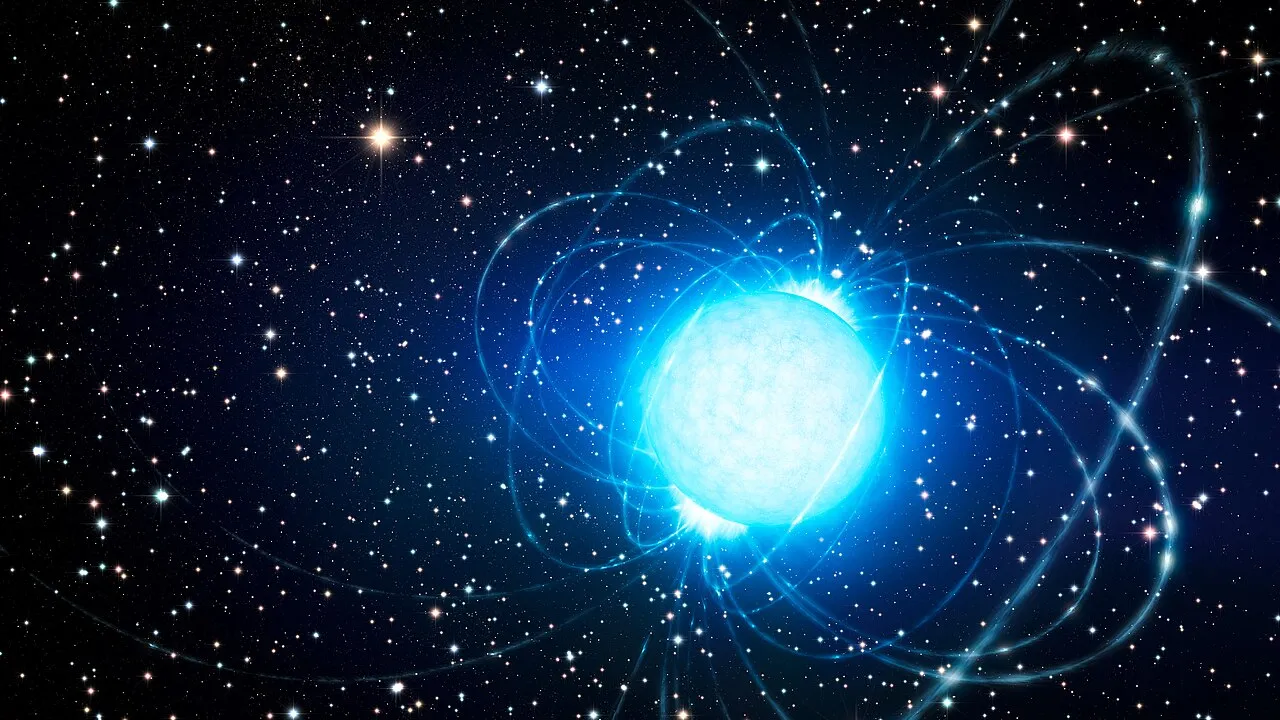
About one out of every ten neutron stars is born spinning extra fast with churning hot currents inside. That spin acts like a turbo , building a magnetic field a thousand times stronger than even a regular pulsar! Astronomers call this rare heavyweight magnet a magnetar.
2
Starquakes and Giant Flares
Inside a magnetar, shifting magnetic lines twist against its mile-thick iron crust until—CRACK!—a tiny shift of inches triggers a massive starquake. Instantly, an invisible fireball of X-rays and bursts across the galaxy!
3
Short Active Lives
Fierce magnetism acts like brakes, slowing a magnetar's spin and calming its bursts in just 10,000 years.
2. About how long does a magnetar's stormy active life last before its super-magnet fades?
🤯 Mind-Blowing Fact • Grade 3
Close to a magnetar's surface, magnetic pull stretches round atoms into thin pencils narrower than a wavelength of X-ray light!
✨ Word Sparks (Grade 3 Glossary)
Tap 🔊 to hear
gauss
Unit scientists use to measure magnetic strength
quadrillion
Huge number: a one with fifteen zeros
fast radio burst
Millisecond flash of powerful space radio waves
🪝
How did a magnetar halfway across the galaxy rattle Earth's upper sky in December 2004?
1
Quadrillion-Gauss Power
Scientists measure magnetic strength in units called . Earth's gentle magnetic field that turns a hiker's compass measures half a gauss, and a hospital MRI scanner reaches 30,000 gauss. A magnetar hits one gauss—a one followed by fifteen zeros!
2
The December 2004 Monster Flare
On December 27, 2004, satellites around our Solar System suddenly went temporarily blind with radiation! A magnetar named SGR 1806-20 suffered a colossal starquake 50,000 light-years away on the far side of the Milky Way. In two-tenths of a second, it released more energy than our Sun shines in 150,000 years!
3
Puffing Earth's Night Sky
Even after traveling 50,000 years across space, those gamma rays briefly ionized and puffed up Earth's nighttime ionosphere—all while everyone on the ground slept completely unharmed.
4
Solving Fast Radio Bursts
In 2020, astronomers caught a Milky Way magnetar shooting a millisecond radio flash, solving the mystery behind distant ''!
1. How far away was magnetar SGR 1806-20 when its 2004 flare briefly ionized Earth's upper sky?
2. What long-standing cosmic mystery did a Milky Way magnetar help explain in 2020?
🤯 Mind-Blowing Fact • Grade 4
Within 600 miles of a magnetar, its magnetic field is strong enough to distort the electron clouds of atoms into long needles 200 times thinner than their length!
✨ Word Sparks (Grade 4 Glossary)
Tap 🔊 to hear
dynamo
Spinning fluid engine generating intense magnetic fields
tesla
Metric unit equal to ten thousand gauss
polarized light
Light waves vibrating along one specific direction
🪝
Why did astronomers think two totally different kinds of mysterious flashing stars were unrelated—until magnetar theory united them?
1
Two Cosmic Puzzles Become One
Starting in 1979, space observatories spotted bizarre 'soft gamma repeaters' (SGRs) spitting erratic bursts of gamma rays alongside 'anomalous X-ray pulsars' (AXPs) shining far brighter in X-rays than their slow 2-to-12-second spins could explain. In 1992, theorists Robert Duncan and Christopher Thompson realized both puzzles were the exact same beast: magnetars powered by decaying magnetic fields rather than spin!
2
The Convective Dynamo Birth
If a collapsing massive star core spins faster than roughly 200 to 300 revolutions per second during the first ten seconds after supernova birth, furious convective boiling couples with rotation to trigger a magnetohydrodynamic —amplifying magnetic fields past $10^{14}$ to $10^{15}$ gauss ($10^{10}$ to $10^{11}$ ).
3
Vacuum Birefringence: Bending Empty Space
Close to a magnetar's surface, magnetic intensity exceeds the 'Schwinger quantum limit,' energizing virtual electron-positron pairs inside empty space itself! Instead of acting like nothingness, super-magnetized vacuum behaves like a calcite crystal prism that splits polarized X-ray light along two distinct axes—a mind-bending quantum electrodynamics prediction called vacuum birefringence verified by polarimeter observatories.
4
Origin of Fast Radio Bursts
For over a decade after their 2007 discovery, brilliant millisecond flashes from distant galaxies called 'fast radio bursts' (FRBs) stumped astronomers. Then on April 28, 2020, Canada's CHIME radio telescope and spaceborne X-ray monitors caught Milky Way magnetar SGR 1935+2154 firing colossal radio blast FRB 200428 alongside an X-ray flare—proving magnetars power cosmic fast radio bursts across the universe!
1. Unlike ordinary pulsars powered by slowing spin, what powers a magnetar's fierce X-ray glow?
2. What weird quantum effect happens to empty space right around a magnetar?
🤯 Mind-Blowing Fact • Grade 5
During the 2004 SGR 1806-20 hyperflare, astronomers detected seismic ringing notes—like a struck bell—vibrating across the magnetar's iron crust 50,000 light-years away!
✨ Word Sparks (Grade 5 Glossary)
Tap 🔊 to hear
Schwinger limit
Magnetic threshold where quantum vacuum bends light
birefringence
Splitting light into two differently polarized rays
hyperflare
Colossal gamma-ray outburst from a magnetar starquake
🪝
What happens when a magnetic field crosses the quantum Schwinger limit—where empty space itself crackles with virtual electrons?
1
Unifying SGRs and AXPs
On March 5, 1979, nine spacecraft across the inner Solar System recorded an unprecedented spike of gamma rays from supernova remnant N49 in the Large Magellanic Cloud. Over the next decade, inexplicable Soft Gamma Repeaters and slowly rotating Anomalous X-ray Pulsars baffled high-energy astrophysicists—until Robert Duncan and Christopher Thompson formulated the 1992 magnetar model, demonstrating how $\alpha-\Omega$ convective dynamos in nascent millisecond proto-neutron stars amplify poloidal and toroidal fields to $10^{14}\text{–}10^{15}$ gauss.
2
Crossing the Quantum Electrodynamic Limit
Above the critical Schwinger magnetic field ($B_Q = m_e^2 c^3 / e \hbar \approx 4.4 \times 10^{13}$ gauss), an electron's cyclotron energy exceeds its own rest-mass energy ($mc^2$). Atoms deform into quantum Landau cylinders, photons split spontaneously into pairs, and magnetized quantum vacuum exhibits —verified by NASA's Imaging X-ray Polarimetry Explorer (IXPE).
3
Magneto-Thermal Crustal Failure and QPOs
Internal toroidal magnetic stresses shear the crystalline iron-nickel lattice until magnetic reconnection launches an electron-positron fireball ($L > 10^{47} \text{ erg/s}$ during SGR 1806-20's 2004 ). High-frequency 'quasi-periodic oscillations' (QPOs) detected in the decaying X-ray tail let asteroseismologists 'hear' torsional shear waves ringing through the neutron star's crust!
4
Bridging Galactic Magnetars and Cosmological FRBs
Simultaneous X-ray bursts and a blinding megajansky radio pulse (FRB 200428) captured on April 28, 2020 from Milky Way magnetar SGR 1935+2154 bridged an enormous seven-order-of-magnitude luminosity gap between local pulsars and extragalactic radio flashes—establishing relativistic magnetospheric shockwaves and crustal reconnection as prime engines behind cosmological fast radio bursts billions of light-years away.
5
Millisecond Magnetar Supernova Engines
Theorists increasingly invoke newborn millisecond magnetars to explain enigmatic 'superluminous supernovae' and long-duration gamma-ray bursts: as a freshly collapsed magnetar brakes from 1,000 spins per second down to slower rates over days, magnetic dipole radiation injects up to $10^{45}$ joules directly behind the expanding stellar debris, making the explosion blaze 100 times brighter than ordinary supernovae!