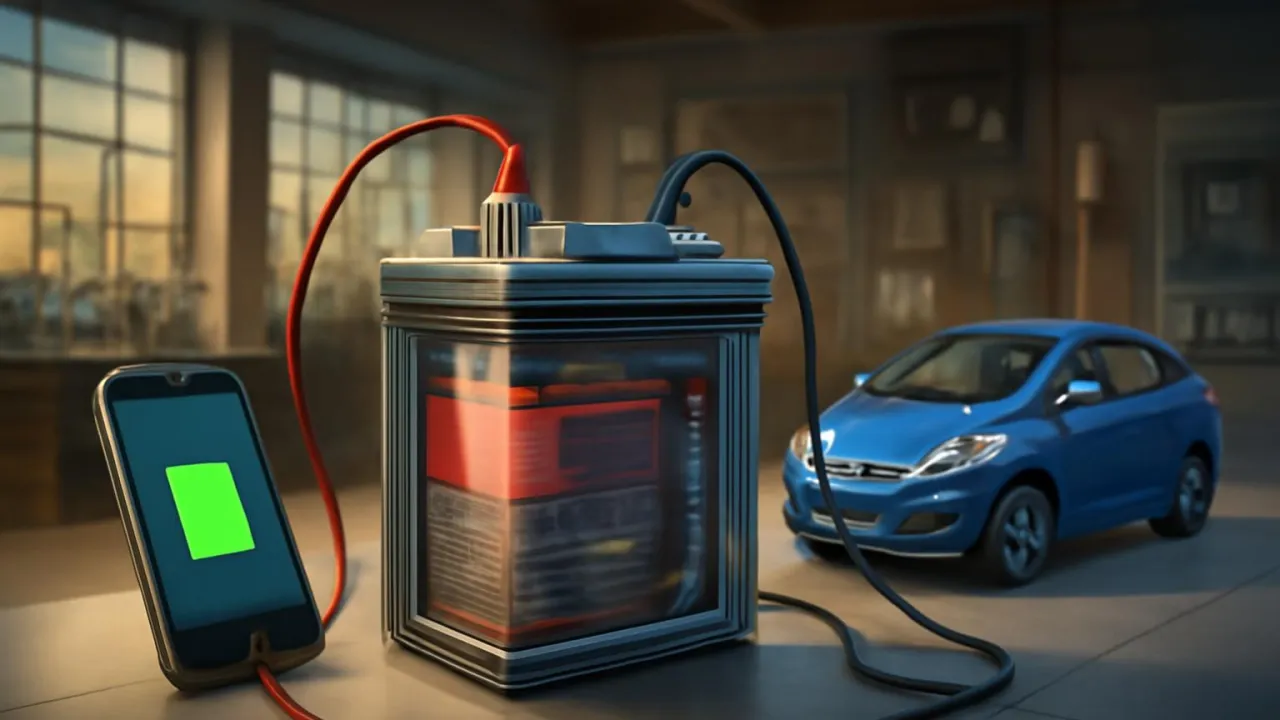
Electric cars can drive for hundreds of miles on just one battery charge!
✨ Word Sparks (Grade 2 Glossary)
Tap 🔊 to hear
lithium
A light, special metal
ion
A tiny moving part of atoms
electricity
The energy that powers things
🪝
Have you ever wondered what helps your tablet turn on anywhere?
1
Power in Your Pocket
Batteries help your tablet, toys, and even cars work without cords. You can take them anywhere, and they keep things running for hours. These special batteries are called - batteries, and they are small but mighty. They store lots of energy in a tiny space.
2
How Do They Work?
Inside, tiny parts called move back and forth to make . When you plug in your device, the battery fills up with energy. When you use your device, the battery lets the energy out. This keeps your favorite things powered up all day.
3
Changing the World
- batteries are used in phones, laptops, and even electric cars. They help people travel, talk, and play almost anywhere. Without them, many things would need to stay plugged in. Thanks to these batteries, we can explore and learn on the go!
A single lithium-ion battery can be recharged over 1,000 times before it wears out!
✨ Word Sparks (Grade 3 Glossary)
Tap 🔊 to hear
electrode
A part where electricity enters or leaves
current
The flow of electricity
rechargeable
Can be filled up with energy again
🪝
What if you could carry a tiny power station in your backpack?
1
A Pocket-Sized Powerhouse
Lithium-ion batteries are the reason you can use your phone or tablet anywhere. These batteries store lots of energy in a small, light package. They are found in laptops, electric cars, and even airplanes. Their invention changed the way people use technology every day.
2
How It Works: The Science Inside
Inside the battery, lithium ions move between two special layers called . This movement creates an electric , which powers your device. When charging, the ions travel back to their starting side. This process can happen hundreds of times before the battery wears out.
3
A World of Uses
Lithium-ion batteries are used in so many things, from tiny hearing aids to giant buses. They make it possible to store energy from solar panels and wind turbines. Their light weight and strong energy make them perfect for travel and adventure. Without them, many modern inventions would not exist.
4
Inventors and Innovations
Scientists like John B. Goodenough, Stanley Whittingham, and Akira Yoshino helped create these batteries. They won the Nobel Prize for their work in chemistry. Their invention began in the 1970s and became popular in the 1990s. Today, engineers keep making batteries safer and even more powerful.
1. What moves inside a lithium-ion battery to make power?
2. Who helped invent the lithium-ion battery?
🤯 Mind-Blowing Fact • Grade 4
The lithium-ion battery made the first mass-market electric cars and solar-powered homes possible!
✨ Word Sparks (Grade 4 Glossary)
Tap 🔊 to hear
energy density
How much power fits in a space
electrochemical
Using chemistry to make electricity
renewable
Can be used again and again
🪝
Imagine if your entire school could run on just a backpack-sized battery—how could that be possible?
1
A Revolution in Energy Storage
Lithium-ion batteries changed the world by making portable, rechargeable energy possible for millions of people. These batteries are found in everything from smartphones and laptops to electric vehicles and even spacecraft. Their small size and high allow us to carry powerful devices almost everywhere we go. Before lithium-ion batteries, most portable electronics used heavier, less efficient batteries that needed frequent replacement.
2
The Chemistry That Powers Your Devices
At the heart of every lithium-ion battery are two electrodes—one made of graphite and the other of a metal oxide. When the battery charges, lithium ions move from the metal oxide to the graphite electrode, storing energy. When you use your device, the ions travel back, releasing energy as electric current. This process is called cycling and can be repeated hundreds or even thousands of times.
3
Inventors and Global Impact
The invention of the lithium-ion battery was a team effort by scientists Stanley Whittingham, John B. Goodenough, and Akira Yoshino. Their work, which began in the 1970s, led to the first commercial batteries in 1991. Today, lithium-ion batteries are essential for energy, helping store solar and wind power for homes and cities. Their invention earned the Nobel Prize in Chemistry in 2019 for its impact on society.
4
Challenges and the Future
Despite their many advantages, lithium-ion batteries have some challenges, including limited lifespan and the need for rare materials. Scientists are working on new battery types that are safer, last longer, and use more common materials. As technology improves, batteries will help power a cleaner, more connected world for everyone.
1. Why are lithium-ion batteries important for renewable energy?
2. What is a challenge with lithium-ion batteries?
🤯 Mind-Blowing Fact • Grade 5
A modern electric car battery pack can store over 100,000 times more energy than a phone battery!
✨ Word Sparks (Grade 5 Glossary)
Tap 🔊 to hear
intercalation
Ions slipping between layers in a battery
cathode
The battery part where ions return
watt-hour
A unit for measuring stored energy
🪝
What if the secret to powering the future fit in the palm of your hand?
1
The Birth of a Game-Changing Invention
In the late 20th century, scientists Stanley Whittingham, John B. Goodenough, and Akira Yoshino revolutionized energy storage by inventing the lithium-ion battery. Their breakthrough came after decades of research into electrochemical reactions and the properties of lithium, a lightweight and highly reactive metal. The first commercial lithium-ion battery was released by Sony in 1991, transforming the electronics industry and making truly portable technology possible for the first time in history. This invention quickly replaced older, heavier batteries, such as nickel-cadmium and lead-acid types, due to its superior energy density and rechargeability. The lithium-ion battery’s impact on society earned its inventors the Nobel Prize in Chemistry in 2019.
2
Inside the Battery: How It Works
A lithium-ion battery consists of two electrodes: a graphite anode and a metal oxide , separated by an electrolyte. During charging, lithium ions move from the cathode to the anode, storing energy by embedding themselves in layers of graphite. When the battery discharges, the ions travel back to the cathode, creating an electric current that powers devices. This process is called reversible , and it can be repeated hundreds to thousands of times before the battery’s capacity fades. The battery’s voltage typically ranges from 3.2 to 4.2 volts per cell, with energy densities reaching up to 265 per kilogram.
3
Engineering Marvels and Global Impact
Lithium-ion batteries are now essential in smartphones, laptops, medical devices, power tools, and electric vehicles. Their lightweight, high-capacity design enables everything from emergency communication during disasters to the rise of clean transportation. The batteries also play a critical role in storing renewable energy, making solar- and wind-powered homes and cities possible. As of 2023, the global lithium-ion battery market is valued at over $70 billion, with production facilities spanning Asia, Europe, and North America. This invention has helped reduce reliance on fossil fuels and opened new possibilities for energy independence worldwide.
4
Challenges: Safety, Sustainability, and Innovation
Despite their advantages, lithium-ion batteries present challenges, including the risk of overheating, potential fire hazards, and the use of rare or environmentally sensitive materials like cobalt and lithium. Battery recycling and safer chemistries are active areas of research, with scientists exploring alternatives such as solid-state batteries and sodium-ion batteries. Improving battery lifespan and reducing environmental impact are key goals for the future. Innovations in battery management systems and manufacturing processes continue to make lithium-ion batteries safer, longer-lasting, and more sustainable.
5
The Future: Powering a Connected World
As technology advances, lithium-ion batteries are expected to power not just personal electronics and vehicles, but also entire smart cities and global energy grids. Engineers are developing ultra-fast charging techniques, flexible batteries for wearable technology, and grid-scale storage solutions for renewable energy. The lithium-ion battery’s story is far from over; it remains at the heart of our transition to a cleaner, more connected, and electrified world. With ongoing research and global collaboration, the next generation of batteries will continue to shape how we live, move, and communicate.